
When Crisis Calls, They Answer at 4 a.m.
By Alex Keilty, American Red Cross Volunteer
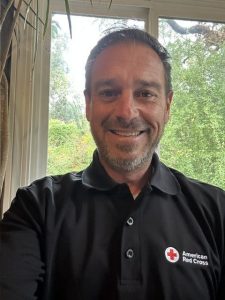
The phone calls often come in the middle of the night—when most people are still asleep. Whether it’s the fire department, the local emergency manager or the American Red Cross headquarters on the line, the message is always urgent. There’s been an emergency. People need help. And it’s the job of the Community Disaster Program Manager (CDPM) to make sure the Red Cross is there, ready to respond.
Michael “Mig” Rampa knows that call well.
Around 4 a.m. this past January, his phone rang with news of a fire in an 80-unit apartment complex in Oakland, Calif. Mig, who has served as CDPM in Alameda County for about a year and a half, sprang into action. He quickly dispatched his team of volunteers to the scene. When they arrived, the situation was already dire. They reported back: “We have 40 people already that are on the corner that have nowhere to go.”
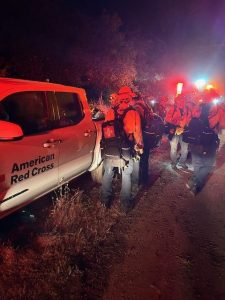
Over the course of the following week, Mig and his team helped more than 70 people affected by providing shelter, food, mental health support and, most importantly, stability and compassion. Even after the shelter closed six days later, they ensured those families still had a place to turn.
And for Mig’s team, this kind of response isn’t unusual. They are regularly called to apartment fires, watermain breaks that force evacuations and even to support firefighters battling wildfires in the hills surrounding their community.
Further south, Patsy Hernandez Gasca knows that same late-night call all too well.
As CDPM for Monterey, Santa Cruz, and San Benito Counties, Patsy is no stranger to disaster. “We’re a very disaster-prone area,” she says, referring to the wildfires, floods and house fires that regularly impact her region.
Her role reflects that unpredictability. It’s “a fast-paced, 24-hour role, especially when we’re in disaster mode,” she says.
As CDPMs, both Mig and Patsy spend several days each month on call—ready at any hour to respond. Outside of those shifts, their work continues in a different but equally important way. They lead teams of staff and volunteers, prepare communities for disasters before they strike, guide recovery efforts after a disaster and build critical partnerships with local governments and organizations.
So what does a typical day look like?
“There are no typical days,” says Mig. His schedule is often packed with meetings—with Red Cross colleagues, volunteers, community partners and county leaders. “You have to be able to pivot.”
Patsy agrees. With three counties under her care, no two days ever look the same. “I cover three counties and on some days I’m in all three counties,” she says. Some days she works from a Red Cross office, while others find her embedded alongside emergency partners like Cal Fire or local police and fire departments.
CDPMs are constantly building relationships—with volunteers, with partners and with the communities they serve. For Patsy, that collaboration is everything. “We have stellar partnerships in our area… We really do need our village, and I incorporate every avenue of our village when we have a disaster response, even if it’s a single-family fire,” she says, describing how partners come together to provide shelter, medical equipment, caregiving, clothing, food and more.
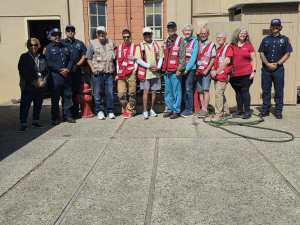
For Mig, his focus begins with his volunteers. “I’m constantly building those relationships with my top volunteers to make sure they’re happy… You can’t be successful without your volunteers,” he says. Recently, at an awards banquet, he found himself surrounded by many of them—and realized just how deep those connections had grown. “I know all their family, they know my family… It’s a genuine, mutual friendship and appreciation.”
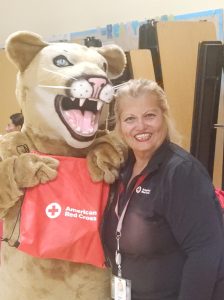
Those bonds make the work meaningful—but it’s the moments of helping others that make it unforgettable.
For Mig, it’s standing beside someone who has just lost everything, someone facing one of the hardest days of their life and being able to offer even a small sense of relief. “That’s a hell of a feeling. It really is. And that recharges the batteries too,” he says.
His journey to this work was shaped by a desire to make a difference. After more than 20 years in I.T. staffing and consulting, the COVID-19 pandemic sparked a change. “I want to help,” he thought and he followed that calling into the nonprofit shelter and housing space.
“I don’t think I will ever have a more challenging job… And that’s in a good way,” he says of his current role.
For Patsy, the Red Cross has been part of her life for decades. She first joined as a volunteer in 1989, the day the Loma Prieta earthquake struck and devastated her community.
“I heard the appeal from the Red Cross on the radio when it happened, asking for volunteers that could translate,” says Patsy, who speaks Spanish and was working as a property manager at the time.
Years later, she experienced a moment that brought everything full circle.
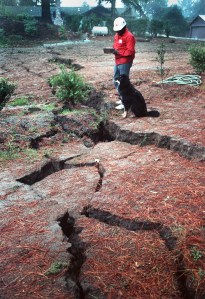
“I was at an event, and this beautiful young woman came up to me and she says, ‘Do you remember me?’” Patsy recalls. “And she said, ‘You helped my family.’”
The woman was the daughter of a family the Red Cross had supported after the Loma Prieta earthquake—when she and her father were seriously injured after part of their home collapsed.
“I think that’s the best memory for me… having it come full circle and seeing her again. And letting me know how it touched her life as a young child. You know, her family never let her forget what the Red Cross did for them,” says Patsy.
Today, that impact remains close to her heart. In her office hangs a portrait depicting seven people who lost their lives in the Loma Prieta disaster. It’s a poignant reminder of both the devastation of that day and the compassion of those who stepped in to help.
For Mig, for Patsy and for CDPMs everywhere, the calls may come at any hour. But so does the opportunity—to show up, to care, and to remind people in their darkest moments that they are never alone.
Edited with the assistance of AI tools.

