Photos and reporting by Barbara Wood/Red Cross volunteer
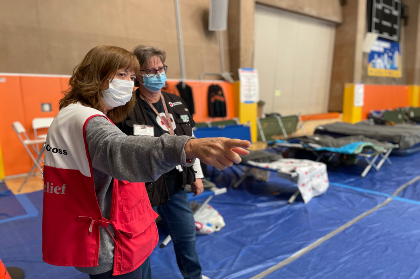
Red Cross volunteer Debbie Torres of San Mateo, California, talks to Jose Galvan Alvarez and his grandson Kingston in a Red Cross shelter. Photo by Barbara Wood/Red Cross volunteer
The Galvan Alvarez family was sound asleep in their South San Francisco apartment in the early hours of January 10 when they were jolted awake as the entire roof blew off their apartment building.
“At first we thought it was an earthquake,” Jose Galvan Alvarez said, holding his nine-month-old grandson, Kingston, in a Red Cross shelter at the San Mateo County Event Center. Water from one of the series of major storms that have been pounding California started pouring in through ceiling light fixtures, he said.
The family called the fire department, which quickly responded and referred them to the nearby Red Cross shelter that had been opened to provide refuge from the storm for all who needed it. The family arrived at about 4 a.m. and were provided supplies, such as diapers, food and toiletries, as well as a portable cot for Kingston and warm beds for the rest of the family. In the morning they had warm showers and breakfast.
“The Red Cross has been excellent,” Jose said. “I’ve got nothing but nice things to say about the Red Cross.” Jose said he had also been helped by the Red Cross years ago, when he had a fire in his apartment. Jose then excused himself to grab a broom and dustpan and clean up around his family’s cots. “The Red Cross is helping, so I can help, too,” he said.
The atmospheric rivers that pounded California for weeks, with floodwaters and damage remaining long after the storms have subsided. At one point there were as many as 100,000 people in California under evacuation orders or warnings.
Now that the skies have cleared, individuals and families are returning home to evaluate their path back towards recovery. Hundreds of Red Cross disaster workers are continuing to safely shelter those in need, deliver hot food and relief supplies to impacted neighborhoods, and provide much-needed emotional support.
For many, the road to recovery will be long – and the Red Cross will stand with survivors in the weeks and months ahead as they begin to rebuild their lives. You can help people by:
Making a financial gift to California Storms and Floods. Donations for Disaster Relief enable the Red Cross to prepare for, respond to and help people recover from disasters big and small. Visit redcross.org, call 1-800-RED CROSS, or text the word REDCROSS to 90999 to make a $10 donation.
This information was last updated on Tuesday, January 31 at 11:00 a.m.Please check back regularly for updates.
American Red Cross volunteer Diana giving an update to Shelter Supervisor Peggy at the Seven Trees shelter in San Jose. Photo by Alex Keilty / American Red Cross
As Californians continue cleaning up after the weeks of severe weather at the beginning of January, the American Red Cross is helping and will also be there in the days and weeks to come, supporting people as they move towards recovery.
This online story map offers a look at the ongoing response to the California floods. Since New Year’s eve:
Almost 800 trained Red Cross disaster workers are supporting people in California.
The Red Cross and partners have provided more than 9,300 stays in more than 80 shelters, more than 62,400 meals and snacks, and distributed more than 14,700 relief items such as comfort kits and other relief supplies.
Trained Red Cross volunteers are helping families cope during this challenging time and replacing prescription medications, eyeglasses or critical medical equipment like canes and wheelchairs.
Teams on the ground are also conducting damage assessments to determine the impact of these storms and which communities will need additional support moving forward. Preliminary damage reports indicate that of the 5879 total assessments done to date, 134 homes were either destroyed or suffered major damage.
We Need You!
While trained Red Cross volunteers and staff continue to manage the response efforts, we are looking for additional volunteers to help with disaster response and recovery activities, including feeding, supply distribution, clean-up kit building and more. Apply online to become a Red Cross volunteer by visiting tinyurl.com/ARC2023FloodsApplication if you are interested in helping with this response or responses like this in the future.
Blood During Disasters
The Red Cross is working to maintain a stable blood supply amid the threat of storms and winter weather across the country, as severe weather often causes widespread blood drive cancellations. Where it is safe to do so, we encourage donors to make and keep blood donation appointments by using the Red Cross Blood Donor App, visiting RedCrossBlood.org or calling 1-800-RED CROSS (1-800-733-2767).
Help Those in Need
You can help people affected by disasters like floods, fires and countless other crises by making a gift to Red Cross Disaster Relief.Donations for Disaster Relief enable the Red Cross to prepare for, respond to and help people recover from disasters big and small. Visit redcross.org, call 1-800-RED CROSS, or text the word REDCROSS to 90999 to make a $10 donation..
Stay Up-to-Date on Social Media
Updated information on the Red Cross response to this storm, and preparedness information is continually updated on regional social media channels:
Hundreds of American Red Cross disaster workers are in California, helping people impacted by this two-week stretch of back-to-back severe weather.
Lunch is served, thanks to Red Cross husband-and-wife volunteer team Lillian and Jeff!
The relentless storms have caused flooding, landslides, power outages, severe damage to roadways and numerous evacuations from one end of the state to the other. Almost 470 trained Red Cross disaster workers are helping people in California. Here are some of their stories.
“We enjoy having different scenery from our retired life,” says Lillian, who is serving meals with her husband at the Red Cross shelter in San José that was opened in response to flooding in the area.
“We don’t like sitting around,” says Jeff, and so they volunteer together here and also deliver blood donations to hospitals three days per week for the Red Cross.
“Lots of listening.”
That is what Gale, a retired Nurse, says is a big part of her day as an American Red Cross disaster health services volunteer in San José.
“I am helping people by listening, or helping them get lost medications, helping them get a cane or a walker,” says Gale.
“They want to know that somebody is here to support them.”
Gail Carli, San Mateo Volunteer
“This is my first rodeo,” says American Red Cross volunteer Fernando. It’s his first time volunteering at a shelter set up in response to flooding in San José.
“I am impressed by how many people are willing to volunteer from other states, to come out from their homes and help us in California,” he says.
Fernando is part of a team of volunteers from across America who are providing beds and meals to people impacted by flooding.
Red Cross volunteer, Anthony, from West Virginia
“When I go home I lock myself in the house to decompress and think about what I have been through,” Anthony says, of how he deals with the hardest parts of volunteering in disaster areas.
Anthony has experienced the emotional ups and downs of being an American Red Cross volunteer numerous times, helping in shelters and assessing damage to people’s homes after disasters.
Anthony flew into San José this week from West Virginia to help at a shelter at Seven Trees Community Center for people who have been affected by flooding.
But it’s not all tough times as a volunteer. The best parts include travel to new places, sightseeing when off duty and visiting friends in other cities, according to Anthony.
“I jam in some fun every time,” he says.
After Lisa finishes her shift as a Disaster Health Services volunteer for the American Red Cross, she will catch a few good hours of sleep and then wake up at 4:30 am to get to her day job as a Registered Nurse in a hospital caring for children after surgery.
How does she do it all?
“I just figure out how to juggle it because it’s important to me,” she says. “These people are in an incredibly challenging situation,” she says about the residents seeking refuge from flooding across California.
The Red Cross relies on people like Lillian, Jeff, Gail, Fernado, Anthony and hundreds more volunteers who offer shelter and compassion to people affected by disasters please visit redcross.org/volunteer.
Volunteer John Sternberg flew to California from Kentucky to help with the Red Cross response to the powerful storms and flooding. John joined other Red Crossers to help set up a shelter at the Sonoma County Fairgrounds in Santa Rosa. He also welcomed new shelter clients and got them settled in with a cot and a blanket.
“We’ve met everybody in the shelter here. I’ve talked with them and dealt with them.” Volunteers are available to listen to evacuees’ experiences and help them begin to recover and process the experience they went through.
Volunteer Andy Witthohn of Santa Rosa also is working in the shelter. He and his wife Betsy first volunteered with the Red Cross in 2017 when the devastating Tubbs fire swept through Sonoma County.
“There was a disaster headquarters and we walked in and said ‘what can we do?’”
Andy sorted clothing, drove supply trucks and distributed food and cleanup kits to fire-ravaged neighborhoods.
“It was very tough. Friends of mine lost their homes. It was very difficult.”
Now during the California floods, Betsy is working at Disaster Headquarters while Andy is in the Santa Rosa shelter, serving up food with a smile and friendly conversation. The people staying in the shelter say they are thankful for people like John and Andy.
“Amazing. I’m very grateful,” says Erick Langbehn. “I just needed someplace to get out of the rain for a little bit. I can’t sleep in my car. It’s a Challenger so that’d be a little hard he says, laughing. “If this wasn’t here, then I don’t know what I’d do.”
Wajeeda Curtiss of Guerneville is staying in the shelter with her teenaged son. Her apartment building sits safely above the Russian River, but they lost power days ago. “We stayed in a hotel a couple of nights but I didn’t want to use up my money for a hotel, so I decided to just come here.”
Wajeeda says she has been homeless in the past, and that she is grateful for this temporary home with the Red Cross. “Just be thankful for what you do have. The food here’s good. I can’t complain. I like that they always have water and snacks, something available.”
Everyone is welcome to take refuge inside the Red Cross shelters, as the storms continue to pound the region.
To find a shelter, or to learn how you can help those hit hard by the rain and floods, visit redcross.org, or call 1-800-REDCROSS.
A shark bite survivor reflects on the people – and blood donors – who saved him.
“Hold my ankle!”
Steve Bruemmer heard the command but struggled to comply. Issued by a stranger, repeatedly, the words were out of focus, fleeting. Hold my ankle. Yet Steve knew he had to try; his life depended on it. Facedown on a surfboard, he reached for the stranger’s ankle as his body floundered. A froth of bloody seawater churned around him, while somewhere – below? nearby? – the great white shark that had bitten him only moments before lurked beneath the surface.
“It’s very, very rare that great white sharks bite humans, so I was quite unlucky to have been bit, but very lucky in that I didn’t die.”
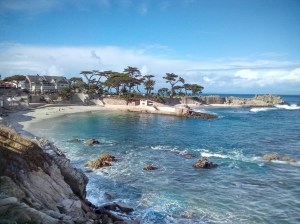
Lover’s Point Beach. Photo courtesy of Steve Bruemmer; editorial use only.
June 22, 2022 was a splendid California summer day. Blue skies and a calm, clear sea beckoned for an open water swim. An experienced swimmer and athlete, Steve, 62, donned his wet suit and set out from Lover’s Point Beach in Pacific Grove for an out-and-back, one and half mile swim. Paddleboarders, beach goers, and a small group of surfers learning water safety dotted the area.
A mere 150 yards from shore on the return leg of his swim, a 15-foot, 2,000-pound Great White shark pummeled him with a bomb-like blast so forceful that he didn’t immediately register he’d been bitten. Likely mistaking him for a seal, the shark had sliced into both of Steve’s thighs and abdomen, delivering near-fatal injuries that rendered him unable to swim.
“After I was bit, I tried to float on my back and looked at my legs. Where there should’ve been wet suit and skin, there was just red.”
A volunteer with the Monterey Aquarium, Steve is deliberate with his choice of words: the shark bit him, it did not attack him. There is no lingering resentment, and he chalks up his encounter to bad luck. Yet the uncanny string of the right people in the right place at the right time that all aligned to save his life that day can only be described as incredibly good luck.
The paddleboarders – a vacationing couple from Folsom, in town to celebrate their anniversary – heard Steve’s cries for help, as did several of the surfers on the beach. One surfing instructor, Heath, grabbed his board and a spare board and immediately paddled out to Steve.
“As Heath approached me, he was looking around for a shark and could see, as he put it, a ‘cloud of blood’ around me, about the size of a car. I was bleeding profusely.”
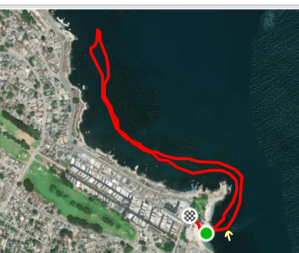
The route snapshot from Steve’s Strava that day. The yellow arrow denotes where he was bitten. Photo courtesy of Steve Bruemmer; editorial use only.
Heath helped him up onto the spare board and instructed Steve to hold onto his ankle while he paddled them both back to shore. The Folsom couple – Paul and Aimee – had also paddled over to help. Paul, a police officer, dialed 9-1-1 from his paddleboard; Aimee, a nurse, helped Steve.
“Aimee recognized that I was going to fall off the board, I couldn’t control my legs. She jumped off her paddle board and onto the back of my surfboard to hold my legs and help paddle us to shore. Blood is pouring off me, the water is red; she thought she was chumming the water with her own legs.”
Once on shore, with paramedics en route, Steve’s luck continued: of the beach goers, one was a physician and two were ICU nurses. They wasted no time cutting off Steve’s wet suit and securing three makeshift tourniquets. Fading in and out of consciousness, Steve was deathly pale; Paul tried and failed to find a pulse as the ambulance arrived.
Steve was transported to Natividad Hospital, a Level II Trauma Center in Salinas, California. Within 19 minutes of his arrival, he was in surgery. His internal temperature was 91 degrees. He would go on to spend a total of three weeks at Natividad, including time in the ICU. Remarkably, he suffered no broken bones, internal bleeding, or organ damage. Miraculously, the shark missed his pelvic iliac artery by millimeters, skirting certain death.
In addition to a skilled medical team, 33 units of blood helped save his life.
“I knew I was very, very badly hurt and there was a lot of blood. I didn’t connect that with ‘Oh I’m going to need blood’ but I knew I was in grave danger of dying.”
Recovering at Natividad Hospital. Photo courtesy of Steve Bruemmer; editorial use only.
When asked if he’d been a blood donor prior to the shark bite, Steve responded “No, I’d given blood a couple of times before, but I was not a regular blood donor.” He’s quick to add, slightly chagrinned, “That’s a mistake that I will rectify going forward.”
According to the American Red Cross, a 150-180 lb. adult will have approximately 1.2-1.5 gallons (or 10 units) of blood in their body, comprising approximately 10 percent of an adult’s weight. Having arrived at Natividad nearly exsanguinated, Steve was in dire need of a transfusion. During his hospital stay, he would receive 13 units of plasma, 18 units of packed red blood cells and two units of platelets. The experience has changed his perception of blood donation and blood donors.
“I was lucky in that anonymous, good Samaritan blood donors had done the selfless work of giving of themselves to save a stranger.”
In the U.S., the need for blood is constant with someone needing blood on average every two seconds. The blood supply is nearly always chasing demand, as, like Steve used to, many Americans don’t make blood donation a priority in their day-to-day lives. In recent years, largely due to upheaval caused by the COVID-19 pandemic, organizations like the Red Cross have faced blood shortage emergencies and struggled to motivate the public to roll up their sleeves when lockdowns were prevalent and open blood drives were scarce. Even today, when much of American life has found its post-Covid pace, it can still be a challenge to stock the shelves with an adequate supply of blood and blood products. Steve wants to change that and is using his story to inspire others into action.
The October picnic featuring the to-scale cutout of the shark that bit Steve. Photo courtesy of Steve Bruemmer; editorial use only.
“I have a great support system – just unmatched.”
Following his ordeal in June, Steve’s family, friends and community rallied around him, delivering meals, offering support, and in August, donating at a Red Cross blood drive in his honor. Later in October, Steve and his wife Brita hosted a thank-you picnic for everyone who played a part in his rescue and recovery: the Natividad medical staff, friends, family, church members, members of his running, swimming and cycling groups. In all, about 200 people turned out for Steve and Brita; also in attendance was a to-scale cardboard cutout of the great white shark. In a group photo from that day, the cutout is held up in front by nine people. It is an enormous animal.
During the picnic, Steve asked the group how many were blood donors.
“Lots and lots of hands went up,” he recalled. He followed that up by asking those with their hands raised how many had given five or more gallons of blood. Three hands stayed up, including Steve’s brother-in-law.
Now more than six months later from that fateful day, Steve continues to make steady progress with his recovery. He attends physical therapy twice per week and is navigating the transition from using special leg braces to walking with supportive poles. His muscles have healed and are getting stronger; his nerves will take longer to recover. That he was in excellent shape before the incident has proven to be a huge advantage for both his survival and recovery. Still, Steve credits his rescuers, the Natividad medical team and the anonymous blood donors for making his survival possible.
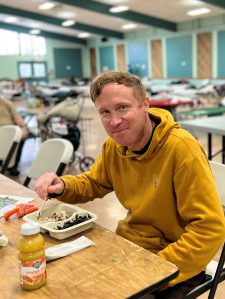
Steve smiles during a break while on a walk; he continues to get stronger as he recovers. Photo courtesy of Steve Bruemmer; editorial use only.
“The unnamed heroes these days, in most trauma cases, it’s the blood donors,” he said.
A second blood drive in Steve’s honor is scheduled for January 12 in Pacific Grove. The three then-strangers who pulled him to safety on June 22, Heath, Paul and Aimee, will be recognized at the drive with Lifesaving Awards on behalf of the Red Cross for their heroism. Steve will be in attendance, and he hopes he’ll be cleared to donate blood – his first donation following the shark bite, and hopefully one of many donations he plans to make moving forward.
When asked what he’d tell someone considering making a blood donation, he paused for a moment.
“It’s easy to say, ‘It could be you.’ You should donate blood because some day you might need it. But that’s not the right answer.” He paused again.
“We are best when we take care of each other, when we come together as a community, take care of each other, and love one another,” he said, emotion giving his voice a husky depth. “We do that when we give blood. I can’t think of a more tangible, meaningful, important way of caring for each other.”







 Your Red Cross Update