Sophia Eckert’s first experience donating platelets with the American Red Cross in January 2025 was an emotional experience. Sophia looked around at the frequent donors who, according to the phlebotomist, came weekly to give platelets and she started to think about her two-year old son Roger. “That made me tear up,” Sophia said, “thinking Roger might have used their blood product to save his life.”
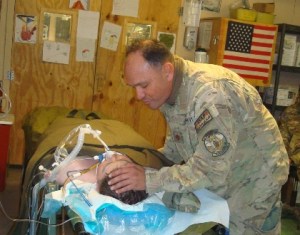
Pastor Riley praying over a wounded service member in Afghanistan. Photo courtesy of Frank Riley
As the largest non-profit humanitarian international organization, the American Red Cross unites volunteers globally in a common mission of service to others — a mission that blood donor Frank Riley strongly believes in. From his time serving in the U.S. Navy Chaplain Corps to serving his communities as a pastor, Frank has made it a priority to live out the Red Cross mission in every aspect of his life.
Frank has been a consistent blood donor since 2008 after learning that he has cytomegalovirus (CMV) negative blood, a rare blood type needed by premature babies and children with weakened immune systems. He was informed of his rare blood type during his first donation at a drive hosted by the Children’s Hospital of Orange County.
“We are so focused on responding and getting a job done, but that isn’t how you touch peoples’ lives. You do that by listening to them, talking to them, letting them tell their story and finding out what they need. Then you help them,” is a sentiment that has guided Briana Taylor, first by a career in psychology, and later by two decades of service with the American Red Cross.
Briana’s introduction to disaster response was happenstance. In her professional role in mental health, Briana had spent many years working to alleviate human suffering on an individual level, tending to the needs of her patients in their darkest hour. In 2004, Briana was vacationing in Phuket, Thailand with her family, briefly taking off her psychologist hat, when a tsunami took to the island’s shores. Six weeks later, her drive to alleviate suffering took flight on the community-level, as she returned to Thailand to support islanders in their recovery.
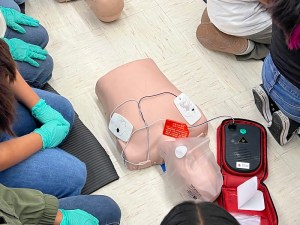
On a typical Wednesday morning, having more than one hundred eighth graders seated on the auditorium floor might not seem out of the ordinary. However, witnessing them perform synchronized CPR maneuvers while learning to save lives is impressive. On October 22, the local Red Cross Training Services Team, in partnership with the East Bay Regional Park District (EBRPD) and Dozier-Libbey Medical High School (DLMHS), hosted a record-setting youth CPR/AED certification event for nearly 350 eighth-grade students over two 90-minute sessions at Antioch’s Park Middle School.
The holiday season is traditionally hard on the nation’s blood supply. The American Red Cross typically sees a decrease in blood donations through the end of the year. To help boost blood donations and ensure patients have access to lifesaving blood and platelets, autonomous driving technology company, Waymo, partnered with the Red Cross to host its second annual blood drive from November 4-10 in San Francisco. The company generously offered two free rides to Waymo riders and employees who donated blood or platelets at the Red Cross San Francisco Blood Donation Center located on Market Street.
“I was born to help people. That’s what brings me the most joy.” Caro (Carolina) Dratva, a Red Cross Northern California Coastal Region’s Disaster Cycle Services Team member and Communications volunteer, heard the call to help others early. When she was 12 and still living in Colombia, a volcanic eruption buried a close friend’s hometown, Armero. “I could only watch TV, listen to the radio, and follow up with my friend,” whose parents had died in the disaster with 23,000 others. Responders with the Red Cross emblem arrived to rescue victims and remove debris during an operation that she would remember later when, at age 15, she noticed the same emblem among response teams in San Francisco in the aftermath of the Loma Prieta earthquake, which she witnessed. At that time, she revealed, “I didn’t realize that the Red Cross was mainly run by volunteers.” It was only after she asked how much responders were paid that she understood that most rescuers offered their unpaid time and effort to save others, a fact that must have deeply moved this scuba diver, surfer, conservationist, and explorer to dive deep and dedicate more than two decades to volunteering.
After all, when Caro set off for the Bahamas several years ago on a dolphin trip with her closest friend, she couldn’t have predicted that her life would be deeply impacted again. “During the night,” she recently shared, “I went to swim with dolphins 85 miles out on a boat. We were anchored, and I was the only one swimming. Everyone else was on the boat. So, I went off with the dolphins. There was a full moon, and I lost my sense of direction. But because of the moonlight reflecting on the water, I couldn’t find the boat. I couldn’t see it. For the first time, I felt panic, like, ‘I’m going to die here.’ But the dolphins were still hanging with me. So, I literally spoke to them: ‘Could you please bring me back to the boat.’ And then, one pushed me on one side, the other pushed me on the other, and they brought me right back to the boat.’” This profound moment of trust and connection with the dolphins helped her realize the power of relying on others during moments of crisis. Just as the dolphins guided her to safety, Caro felt compelled to help guide others through challenging times, which ultimately led her to dedicate her time to lifesaving organizations such as the American Red Cross.
Photos courtesy of Caro Dratva
“There has to be a way that I can volunteer.” The real work began with 9/11, when the Twin Towers came down in Manhattan’s Battery. She needed to help, so she joined the Red Cross. “I thought, if I have to deploy to New York, I’ll do it. But then, I realized I needed training.” Getting that training during such a fraught time for the country and those who’d lost loved ones required sensitivity and an ability to ask the right questions.
“My first training was in San Francisco,” she recalled, “connecting the missing people on lists with their families.” Mainly, she conducted interviews meant for search and rescue teams, gathering descriptions of missing people, noting the floors they worked on and what they were wearing the last time they were seen. Even now, twenty-two years later, Caro remembers one moving experience when she used her native language skills to search for a distraught woman’s husband who’d worked in the Towers. “She spoke Spanish, and the good news was that the woman’s husband was alive and able to reconnect with her.”
Later, after a one-year hiatus in Europe, she continued to dedicate herself to helping others, getting involved in Red Cross blood drives, donation collection campaigns, and numerous disaster relief operations, including the aftermath of Hurricane Katrina.
Caro and Red Cross Volunteers supporting communities affected by wildfires in North Bay, 2017
Since then, Caro has watched the Red Cross grow even more effective, learning from hard knocks like Katrina. Better organizational tools have improved efficiency before, during, and after disasters, allowing volunteers like her to give time even when time is sometimes hard to spare. Holding down two jobs—one focused on ocean conservation and the other on architectural design—Caro still finds time to volunteer in numerous ways. “Because of good organization and how the Red Cross has grown, I can be on standby for the Disaster Action Team (DAT). I’m also trained for sheltering, and I’m part of the Public Affairs and Communications team.”
All this volunteering has added up over the years. From one training session to another, Caro has developed expertise through online and real-world experience. With every exposure she’s had to disasters, shelters, and blood drives, she has noticed, listened to, and recognized others as they face some of the most challenging moments of their lives. This may be one reason why she still swims for life, giving a great gift to others along the way: how to save others while saving oneself.