
Red Cross Volunteers Distribute Emergency Supplies Along the Road to Recovery

By Alex Keilty, American Red Cross Volunteer
“A little bit of physical work and a lot of satisfaction,” is how one American Red Cross volunteer describes his experience distributing emergency supplies after a disaster. It’s a simple description from Marcel Pajuelo-Schwartz, but it captures the heart of the distribution of emergency supplies volunteer role perfectly. The physical work comes from lifting and carrying buckets of essential items, while the satisfaction comes from knowing you have helped people in a real, hands-on way when they need it most.
Marcel, who lives in Daly City, Calif., has been a Red Cross volunteer since 1967. He has tried many volunteer roles over the years but he especially enjoys this one. His efforts to distribute emergency supplies play a critical role in helping individuals and families recover in the immediate aftermath of a disaster. His role is to provide items essential to basic survival, health and sanitation as quickly and equitably as possible to people whose homes and neighborhoods have been affected. These essential supplies may include flashlights, food coolers, buckets, shovels, masks, gloves, cleaning products and garbage bags — everything people need to begin cleaning up their yards and their homes after a disaster turns life upside down.
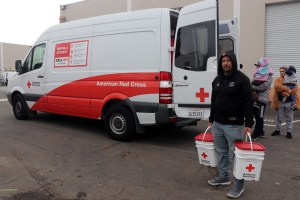
Volunteers doing this role generally work in pairs, loading and unloading large quantities of supplies into box trucks. It’s teamwork in the truest sense, with each person helping make the job more efficient and safer. Each truck can hold enough supplies for almost 100 homes, meaning a single day of work can make a significant difference for an entire neighborhood.
Once the trucks are fully loaded, volunteers either drive through disaster-damaged neighborhoods or park at central locations such as community centers. From there, they hand out supplies directly to local residents, often sharing words of encouragement or answering questions along the way. These brief interactions can be just as meaningful as the supplies themselves.
While the ability to lift and carry the supplies is important, it’s equally important to be a good listener. “Sometimes all somebody needs is someone to talk to, to vent about what they lost,” says Marcel. Disaster survivors are often dealing with shock, stress and uncertainty, and having someone truly listen can make a powerful difference.
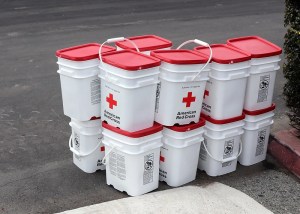
Essential supplies may include flashlights, food coolers, buckets, shovels, masks, gloves, cleaning products, and garbage bags
In some situations, workers distributing emergency supplies are paired with licensed mental health volunteers. They can offer additional compassion, understanding and care to people who may be struggling emotionally as they begin to recover.
Residents often find heartfelt ways to show their appreciation. Volunteers report that sometimes the community shows their thanks by paying for the volunteers’ lunch when they see them stopping for a well-earned break — a small gesture that means a lot.
Most disaster responses require a two-week commitment from volunteers, except when the disaster is in one’s own community, when a shorter commitment is acceptable. Volunteers who distribute emergency supplies only need a regular driver’s license, and all required training is provided by the Red Cross for free and online. Those interested in driving the emergency response vehicles do need extra training.
So, if you enjoy driving, meeting new people and listening to their stories, then distributing emergency supplies with the Red Cross may be a meaningful volunteer role for you. Visit redcross.org to learn more.
This article was edited with the assistance of AI tools.

