
You Don’t Have to Be a Chef to Feed a Community in Crisis
A wildfire near Santa Rosa, Calif. had forced more than 180,000 people to evacuate from their homes, and many would be looking for a place to stay. American Red Cross volunteers rushed to the Civic Center in San Rafael to open a shelter.

Volunteer Anna Lane arrived to see that electricity had been cut for the entire county, although there were generators to provide power on site. She recalls, “The shelter manager said to me, ‘Anna, we need breakfast things, coffee and food, something.’ So I go to the grocery store, but the grocery stores are locked down because they have no power. They can’t open the doors.
“I thought, ‘Where am I going to get stuff?’”
Anna quickly decided to drive across the San Rafael bridge to a big box store hoping they might have power. She got breakfast and snack items to the shelter. But the day was just starting.
“There were 300 shelter clients by lunchtime,” says Anna. “By dinner time, we had over 600.
“I got thrown into the deep water pretty quickly,” she says.
Luckily, as is typical in disaster response operations, community partners stepped up to help. Thanks to partners like Mercy Chefs and The Salvation Army, who organized massive food orders that took four carloads to deliver, the Red Cross was able to provide shelter and feeding for residents displaced by the disaster.
That was Anna’s introduction to feeding people with the Red Cross in 2019. It was a “wild” experience, for sure. But feeding at the Red Cross is often done on a smaller scale too. Most recently this year, Anna helped with feeding after an emergency in San Rafael where 19 units in an apartment complex burned and more than 50 people had to be sheltered and fed. Again, The Salvation Army was our feeding partner and stepped up right away to deliver burritos for lunch.
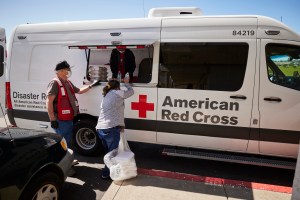
Anna says that while it may sound intimidating, almost everyone has the skills required to be a feeding service volunteer, even if they don’t realize it.
“If you have ever done any feeding… in your job, your church, social functions, like maybe you have done team sports for your kids…you might have hosted Thanksgiving,” says Anna.
However, unlike social functions like family holidays, you don’t have to cook at the Red Cross! The primary responsibilities of feeding service volunteers are to order or pick up food when delivery is not available, serve meals and keep track of the number of meals served. They may be providing meals at shelters, at hotels or from an emergency response vehicle. Meals may be served to residents affected by a disaster, to first responders like fire and police personnel or even to other volunteers from the Red Cross or other agencies.
A background in food service is also not required. All training is provided by the Red Cross free of charge and covers important food safety guidelines.
So what skills are needed? The ability to function in a changing and sometimes stressful environment is important because a disaster response can evolve quickly – from the evacuation order to the size and scope of the emergency. Some familiarity with computers is helpful because volunteers need to accurately input meal quantities online.
One skill that Anna says is important, but may not be obvious, is to be a good listener to people affected by the disaster.
“One of the main things you can do is listen. I mean, we give them a comfort kit…and we give them food. But a lot of times just being there to listen to them is actually very beneficial for them because they’re carrying anxiety and pain and sadness and confusion. And to be able to express it to someone, I think, is helpful,” said Anna.

“It’s really hard for some of these people. It still makes me really sad,” recalls Anna of her experience at the San Rafael shelter where she met a man in his 80s who had lost his home in a previous wildfire. He had rebuilt his house, and then that home burned down too. And he said, “I think I’m too old to do it again.”
Listening to people displaced by a disaster and serving them food is a way to offer comfort and compassion to people facing what may be the hardest days of their lives.
“People feel cared for when they get food,” she says. And that’s why the Red Cross tries to accommodate the cultural, religious and dietary restrictions of those it serves.
Anna started as a Red Cross volunteer after leaving her digital marketing job at a pharmaceutical company eight years ago. Just a month into retirement, she was on a plane to North Carolina in the wake of Hurricane Florence.
She had signed up to be a volunteer helping run a disaster shelter. But, to meet the needs of the evolving situation, she was reassigned to a warehouse where she was asked to drive a box truck.
“Nope, no, I would never try that,” Anna laughs. “I mean, they are huge. Those are moving vans, right? But I learned how to drive a box truck!”
Being open to doing different roles during a disaster response is important. Anna also spent some time volunteering in community partnerships before eventually landing in her feeding role where she has gained extensive experience. Anna is currently the regional feeding co-lead for the Northern California Coastal Region.
Reflecting on her various roles, Anna says, “Generally, the Red Cross has a lot of options for anyone at any level to become involved and contribute to making the world a better place… You want to leave it better than when you came, right?”
The Red Cross urgently needs feeding service volunteers and a variety of other capacities. To join Anna and other volunteers making the world a better place, start your application today at Volunteer Connection.
This article was edited with the assistance of AI tools.

