
A Quiet Presence After the Storm
In the aftermath of deadly Hurricane Helene in 2024, an American Red Cross volunteer noticed a boy sitting quietly in a shelter in Macon, Georgia.
What began as a simple observation became something deeply meaningful.
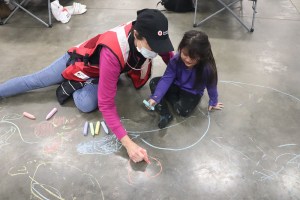
“There was a family that was in desperate need, and they had a child who they said didn’t talk to anyone,” recalls Disaster Mental Health Volunteer Leslie Grant. “And I said, ‘May I try talking with him?’ And I sat down on the floor. He was rolling a little car back and forth to himself. And I sat down about 10 feet away. And I just sat there.
“And then I moved a little closer, and I slowly moved closer. And he rolled his car to me. And I introduced myself. And he rolled the car; we rolled it back and forth.
“And he started speaking one word. And then two words. And we started conversing a little bit. And the boy who wouldn’t talk to anyone ever, spoke to me and I was able to reassure him.”
In that quiet exchange—just a toy car rolling across the floor—trust began to form. Leslie felt tears fill her eyes as she connected with a child carrying the invisible weight of disaster.
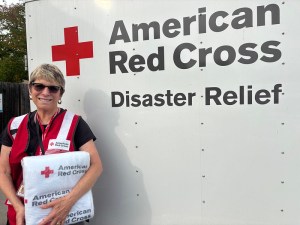
Moments like these are why she serves—because for her, the work is deeply personal.
Leslie knows what it’s like to face sudden upheaval. Years ago, Coyote Creek near her home in San José, Calif., overflowed its banks, forcing her family to evacuate with little warning.
Leslie remembers, “We got a knock on our door stating, ‘You’ve got 10 minutes. Grab your pets, grab your most important papers. You’ve got 10 minutes, get out.’”
As they fled, uncertainty surrounded them. A neighbor stood nearby, guiding people to safety as floodwaters rushed into the neighborhood.
“My street was flooded. One block down, the entire surface was entirely submerged, and the cars parked there were damaged. And everything, all my neighbors on the other side of the street, on my segment of the street I live on, they were all flooded out.
“That initial fear that I had when I was told that I had to evacuate… experiencing that personally, that gives me a little bit better understanding than I would have, had I not experienced that,” says Leslie.
While Leslie’s home was spared, many of her neighbors were not as fortunate. Later, she learned that the neighbor who helped guide others to safety was a Community Emergency Response Team (CERT) volunteer who also happened to be a Red Cross volunteer. He encouraged her to volunteer too.
With a background as a school counselor, Leslie felt called to help others navigate the emotional toll of disaster.
Understanding Trauma, One Conversation at a Time
For Vicky Powell, disaster mental health work has long meant sitting with people in their most vulnerable moments and helping them make sense of what has happened to them.
She recalls sitting on a porch in West Virginia after catastrophic flooding in 2001. As she spoke with a family, rain began to fall again. Their child reacted instantly.
“The child immediately was worried that they needed to go hide or needed to do something, that it was going to flood again. You know, that they’d have the same thing all over again,” recalls Vicky, former social worker and current regional disaster mental health program lead.
An important part of Vicky’s work is helping adults understand what children may be experiencing after a disaster, including what behaviors to expect from children and how to support them.
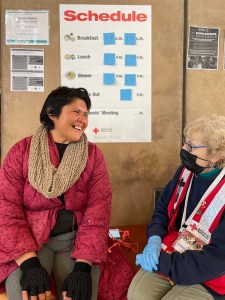
“Kids may get more clingy with a parent. They may get some physical health kinds of things where they’re having stomach aches,” says Vicky. “They may repeatedly ask, ‘Is it going to happen again?’”
But children aren’t the only ones struggling.
Adults can face overwhelming uncertainty after losing homes, routines and stability.
“You know, they’re oftentimes saying, ‘I’ve lost everything. I don’t know where to start. What do I do?’” says Vicky.
That’s where disaster mental health volunteers step in for adults—not to erase the pain, but to help people begin their recovery. While Red Cross volunteers don’t provide therapy, they talk and listen and can provide referrals to therapy.
“Most people are resilient. There’s a small group of people who may need a referral for other resources,” says Vicky.
A Program Built on Experience and Compassion
There was a time when the emotional, mental and psychological impact of disasters was not fully recognized. That began to change in 1989, when the need for structured support became clear. In 1992, the Red Cross officially established its Disaster Mental Health services program.
Vicky and her colleagues helped shape the program—drawing from firsthand experience to ensure others would be better supported.
Responding to disaster scenes can be profoundly difficult. As Vicky explains, volunteers may encounter devastation unlike anything they’ve seen before—and hear countless stories of loss that stay with them long after they return home.
Even the transition back home can be challenging. People around them may not understand what they experienced or may want to hear details they’re not ready to share.
That’s why caring for responders is just as important as caring for survivors.
Today, that support is also a part of the program of the Red Cross.
Walking Beside People as They Rebuild
Whether in a shelter, a neighborhood or a quiet conversation, disaster mental health volunteers offer something simple and profound: presence.
A typical day for these volunteers—licensed social workers, psychologists, counselors, and psychiatric nurses—revolves around showing up, asking questions and listening. As Vicky explains, “They would spend their time talking with those who have been affected, as well as talking with the staff who responded. They’re going to… check in with them, see how they’re doing.”
Sometimes, that care unfolds right in their own communities.
Leslie recalls supporting a resident at a shelter in her hometown after his apartment complex was damaged by fire. Sitting with him over several days, she watched something shift.
“I saw a lot of changes in him. I was able to settle him down. I was able to help him think coherently. I was able to give him reassurance that he didn’t have to end up on the street,” she said.
It’s moments like these that define the work.
Leslie and her fellow volunteers provide a compassionate ear and critical support to those affected by disaster, as well as to those who respond.
And sometimes, as with a little boy and a toy car, healing begins with the simplest act of all: someone willing to be there and to listen. If you are interested in supporting people affected by disasters, please visit redcross.org/volunteer to find out more.
This article was edited with the assistance of Copilot.
 Your Red Cross Update