The Volunteer of the Year Award honors individuals who best exemplify the humanitarian spirit of volunteerism.
It’s the highest honor a volunteer can achieve within our chapters, meaning that they made significant contributions to the American Red Cross over the last calendar year. These volunteers worked in multiple roles alongside fellow volunteers and staff, providing support to all lines of service. In short, they exemplify the Red Cross mission, and we are proud to share the 2022 award winners.
Long-time Oakland blood donor Jasper Smith reached a 50-gallon donation milestone
Photo courtesy of Jasper Smith
Jasper Smith is a true humanitarian: he has been a blood and platelet donor for more than 13 years. On April 20, 2023, he achieved an incredible milestone with his 50-gallon platelet donation.
When we asked who inspired him to make his first donation, he shared the memory of his friend, Chaznee Brown. “She passed away some years ago from sickle cell anemia. She was hosting a blood drive for the Blue Tag program and asked if I would consider donating. At the time I had never done a blood donation, but I was down to help,” Jasper said.
Photos by Albert and Virginia Becker / American Red Cross
In the heart of scenic Loma Mar’s Redwood Glen Camp, more than 120 enthusiastic and driven students from across the Bay Area gathered for a transformative experience. The American Red Cross Leadership Development Center (LDC), a four-day conference, aims to empower individuals ages 13 – 18 with essential leadership skills, disaster preparedness knowledge, lifesaving skills and the opportunity to make an impact in their communities. Packed with engaging activities, inspirational speakers and unforgettable moments, LDC always promises to be an adventure for these aspiring young Red Crossers.
Through hands-on training and simulations, delegates learned crucial techniques for emergency response, first aid and CPR. Delegates gained a deeper understanding of the Red Cross’ five lines of services and how to get involved through several interactive workshops. Regional Red Cross leadership and Board Members also joined them for a day to share what inspired them to serve with the organization and how passion for leadership can be turned into action at any age. They even had the opportunity to create a “Shark Tank” style sales pitch on the importance of donating blood, which helped instill a sense of responsibility to this lifesaving cause.
Paulina Munoz, lead for the winning team Photo courtesy of Paulina Munoz.
Story by Richard Payne
Creating a successful campaign focused on International Humanitarian Law (IHL) that is fun, engaging, and educational would seem like a daunting task. Doing it with a virtual team of high school students who never met face-to-face would seem doubly difficult. Yet, the winning team in the 2022-2023 Northern California Coastal Region (NCCR) IHL Youth Action Campaign did just that.
In Northern California, 8 teams, comprised of nearly 40 high school students, participated in IHL training. Each team then developed and delivered IHL awareness campaigns at their schools during the academic year. As a culmination of the campaign, a symposium was held to showcase each team’s work, the struggles they faced and the efforts they took to overcome those challenges. A panel of judges scored each campaign on a series of factors and chose the team that demonstrated the best problem-solving and leadership skills.
Razi Aftab and Paulina Munoz led the winning team, which included students from two of the region’s Red Cross chapters – the North Bay and the Heart of the Valley Chapter, covering Stockton and the surrounding area. Because the team members lived far apart, they only met virtually in weekly calls.
Paulina believed the bond they formed was one of the team’s greatest strengths. “The best part of the campaign was being able to work as a team throughout the term. We got to know the other team members and felt connected. As a result, we were a lot more productive,” she said/
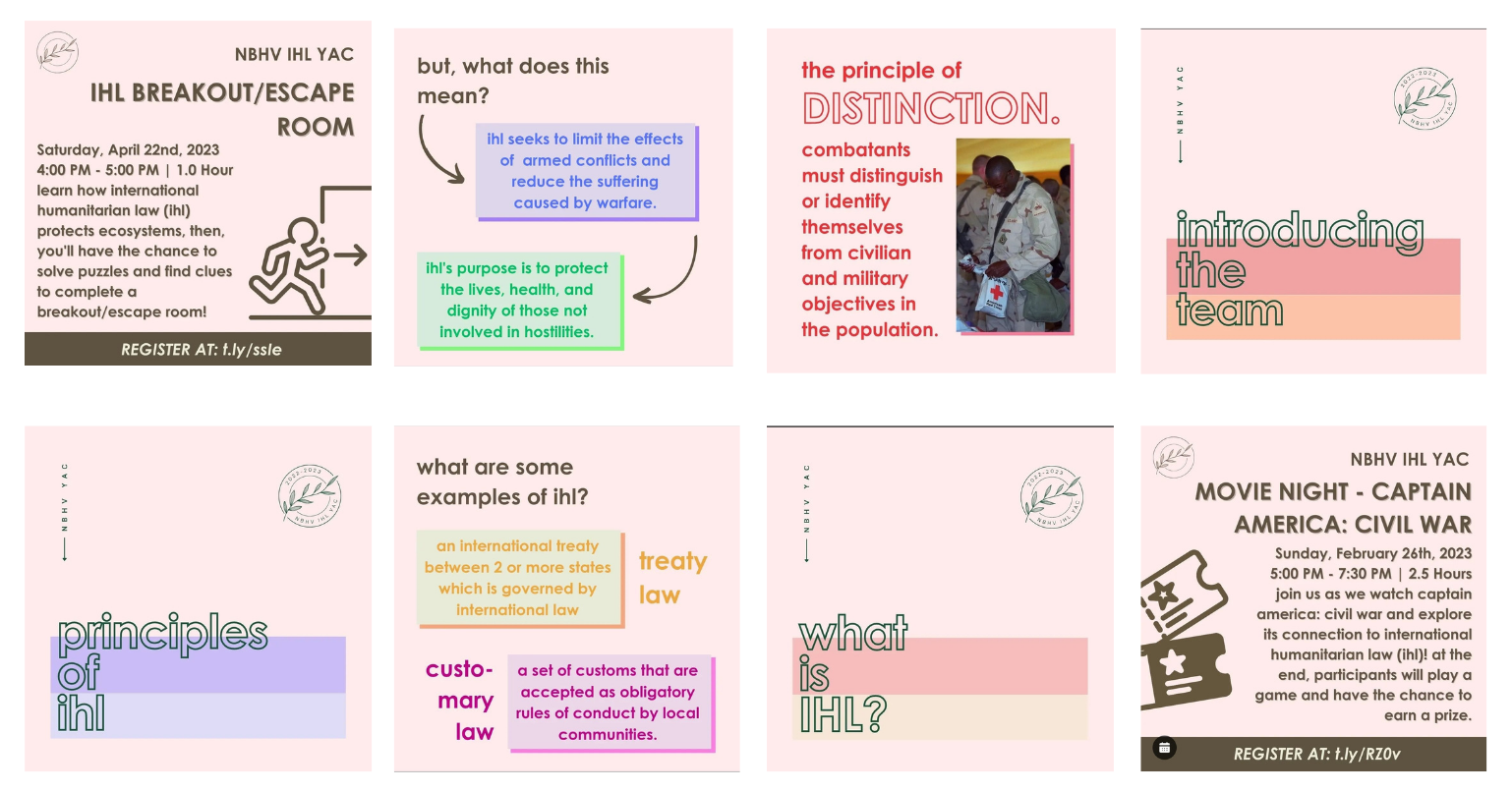
A screenshot from the Instagram account of the team, showing the activities they planned for the campaign.
In building their campaign, the team members identified that their peers had limited knowledge of the Red Cross or International Humanitarian Law. That’s why the team felt that engaging students had to be their number one priority.
“Attracting youth to be involved in the campaign was a challenge. That’s why we focused on having activities that we thought our peers would enjoy as opposed to approaching this campaign from a teaching perspective,” Razi explained.
During the academic year, each team member organized and hosted events at their school around the topic of IHL. The team also created activities and events such as interactive question-based games that tested the advocate’s knowledge on IHL.
“Probably the most distinct event was our escape room,” Razi said. “We had case studies on International Humanitarian Law and asked the advocates to work through those examples. They had to review the scenarios and apply the information they had learned to come up with the best option. We had very good engagement with that!”
In summarizing their personal experiences with the campaign, Razi shared: “Our greatest takeaway was that we were able to foster a sense of community. The program felt like a group effort rather than an academic exercise. It was voluntary and each person contributed to reaching the end goal of increasing the understanding of International Humanitarian Law.”
Paulina had similar sentiments about this experience: : “A lot of the students who participated in the campaign came into it with no idea what international humanitarian law was about. Through their participation in the campaign, they took away an understanding of IHL and the knowledge that international humanitarian law and services were more available to them than they thought. It was a great way to get them to know their community, the Red Cross, and what we stand for as a society.”
Congratulations to these incredible teams on formulating a thoughtful campaign and for spreading awareness about IHL!
The American Red Cross mission is to prevent and alleviate human suffering in the face of emergencies by mobilizing the power of volunteers and the generosity of donors. When we say “the power of volunteers,” we talk about amazing people like Helen Miller from Eastern North Carolina. She started volunteering with the Red Cross in 1991 and currently has more than 125 deployments as a disaster volunteer. She’s even served more than once during the same disaster response in different roles.
“Compassion is a thing of the heart,” she says. Helen joined the Red Cross when her husband – a Marine on active duty – was deployed to Kuwait. “I had extra time; my employer was cutting my work hours by 10. I decided to reach the Red Cross office and volunteer. I started answering the phones. I felt the need to help others,” she explained.
In January 2023, Helen was one of many volunteers from all over the coutnry who touched down in California and helped both people and communities affected by the atmospheric river storm systems and subsequent floods. She was part of the feeding team, working hard to make sure that everyone – from the shelter residents to other volunteers and staff members – had hot meals every day. She stayed two weeks on this deployment before returning home.
“I have deployed in all the roles of Mass Care: I have operated several kitchens serving over 4,000 meals daily. I have also deployed as a caseworker and even as an Emergency Response Vehicle driver,” she says. When Helen is not deployed, she serves as Mass Care Lead for the Easter North Carolina Region.
After so many deployments, Helen has all kinds of memories. Some of them happy while others left her with a bittersweet sensation: “In the aftermath of Hurricane Katrina, our team was delivering meals to affected people. One of the neighbors said ‘be sure to stop at the first house’ so we did. I saw there was a ramp at the entrance. I knew the owner was in a wheelchair. I went up to the door and knocked. I said, ‘This is the Red Cross, we have food’. A woman was living there. She said that her son – who was living in New Orleans – was the one getting her groceries, but she hadn’t heard from him for over a week. We were close to the end of our route, another tornado was coming and our kitchen was closing down until it passed. I asked the lady where her pans were. I went back to the vehicle and filled up the pan with the rest of the food we had and gave her lots of snacks and a case of Ensure. I told her we weren’t going to be available for a few days and this would help her out. She had me lean down to her face to face and put her hand on my forehead and said: “bless this angel that has come to feed me”.
In the Northern California Coastal Region, over 7,000 dedicated and committed volunteers turn their compassion into action, donating their time and energy to serve their communities. Red Cross “everyday heroes” come from all walks of life. Young, experienced, and everything in between: everyone has something special to offer.
“I plan to keep going as long as I am able. I am 76 years of age and very spunky,” Helen says. “My husband served 20 years in the military and now I’m doing my part. He understands and when he hears about a disaster, he knows I will be leaving town soon.”
Red Cross volunteer John Gee has installed more than 2,000 free smoke alarms in homes across the region since the launch of the Sound the Alarm campaign in 2014. Photo by Ashish “Ash” Mantri/American Red Cross
Home fires claim seven lives every day in the U.S. and remain one of the most frequent disasters across the region — but having working smoke alarms can cut the risk of death by half. That’s why, over five weekends in April, volunteers with the American Red Cross Northern California Coastal Region, along with local fire departments and community partners, installed 1,294 free smoke alarms and made 462 homes safer as part of the annual Sound the Alarm campaign.
“A working smoke alarm can be the difference between survival and tragedy when a home fire strikes,” said Ana Romero, Red Cross Regional Preparedness Manager. “That’s why the Red Cross is teaming up with community partners to help ensure local residents, especially those most vulnerable, have these lifesaving devices.” Sound the Alarm events are part of the Red Cross Home Fire Campaign which has helped save at least 1,664 lives nationwide since launching in October 2014. Working with local fire departments and community partners, Red Cross volunteers visit high-risk neighborhoods, install free smoke alarms and provide residents with information on common causes of home fires, how to prevent them, what to do if a fire starts and how to create an escape plan.
This work is made possible thanks to generous financial donations from our regional Sound the Alarm campaign partners: Pacific Gas and Electric Company; Arista Networks; CSAA Insurance Group, State Farm; and Gloria and Mike Ipson.
Red Cross volunteers and partners installed 396 free smoke alarms and made 190 homes safer in April across the Bay Area Chapter. More than 500 residents of San Francisco, San Bruno, Brentwood and Hayward are now better prepared to face emergencies after receiving education about home fire prevention.
“Every day, our department sees first-hand the damage and destruction that home fires can have on a community,” said Willie McDonald, Fire Chief for the Alameda County Fire Department. “This is why campaigns, like Sound the Alarm, are so important. A little home fire prevention can go a long way toward keeping families and the community safe, and a smoke alarm is one of the most effective tools we have to do that. We are proud to partner with the Red Cross for this very important event.”
Photo by Nanette Shamieh American Red Cross
Heart of the Valley Chapter
71 homes were made safer in the Heart of the Valley Chapter after two Sound the Alarm events in Stockton and Los Banos.
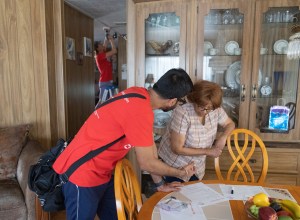
Red Cross volunteers and community partners installed 169 free smoke alarms and helped 210 residents to create an escape plan and be better prepared in case of a home fire
North Bay Chapter
Photo by Nanette Shamieh American Red Cross
Community partners and Red Crossers installed 354 free smoke alarms and made 116 homes safer in the North Bay Chapter. Over the three events in Sonoma, San Rafael and Vacaville, the teams shared home fire prevention educational information with more than 230 residents to make the community safer.
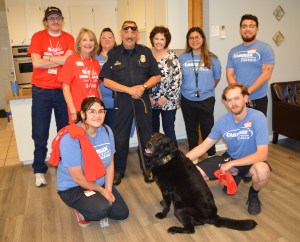
Captain Drew Kostal and his K-9 “Kepi” from the Vacaville Fire Department attended the installation event on Saturday, April 29. He spoke with the team about the importance of working smoke alarms.
Silicon Valley Chapter
Photo by Atul Trviedi American Red Cross
Red Crossers and community partners gathered at Millpond Mobile Home Park on Saturday, April 29 to install 205 free smoke alarms in 85 homes to make more than 140 residents safer.
Red Cross Board and Tiffany Circle Members participated in Sound the Alarm events across the region to help make their community safer.
Sound the Alarm – Signature Event in Hayward (CA) – April 29, 2023 Photo by Martin Gagliano – American Red Cross