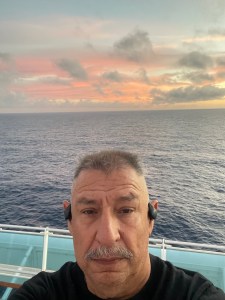
According to Curt Leo, when you volunteer to be a Fulfillment Service Associate at the American Red Cross, everyone is happy to see you, everyday.
Red Cross volunteer Curt Leo
“When you get to the shelter, it’s like Christmas for them. They love to see you!” says Curt, who volunteered for the fulfillment service associate role for the first time earlier this year, distributing essential items to shelters.
And it’s no wonder they were happy to see Curt, because he arrived at the disaster shelters with an SUV packed full of supplies, including baby diapers, 20 lbs. of bananas, healthy snacks, breakfast foods, coffee and paper goods.
Curt, who spends half the year in Sonoma County, Calif., and half the year in Sammamish, WA (a suburb of Seattle) has been a Red Cross volunteer for three-and-a-half years in various roles.
When I first attended the American Red Cross Northern California Coastal Region’s Leadership Development Center (LDC) as a delegate during the summer of 2025, I thought it would simply be a one-time, four-day camp experience in the middle of nowhere surrounded by people I didn’t know. I never imagined I would come back to Redwood Glen Camp the following summer to help plan, coordinate and document as a staff member. When I applied, I wasn’t thinking that far ahead. I was just excited for the opportunity to meet new people and try something new. Looking back now, I’m grateful that LDC became so much more than a single camp experience and that each summer, I leave with much more than I could expect.
When retired nurse Gale Carli from San Mateo County arrived in Saipan seven days after Super Typhoon Sinlaku devastated the U.S. territory in the western Pacific Ocean, the signs of destruction were impossible to miss.
Red Cross volunteer Gale Carli in Saipan.
“The electricity was off, so driving was treacherous,” Carli recalled. “There were trees down, power poles down, lights down, and you could tell that something disastrous had happened.”
Sinlaku, an exceptionally powerful Category 5-equivalent storm, blew through the Northern Mariana Islands in mid-April, unleashing catastrophic flooding and sustained winds approaching 180 miles per hour. The storm left the tourism-dependent island struggling to recover. Trees were stripped bare, roads were littered with debris, and much of the lush tropical landscape had turned brown after exposure to salt water.
In the aftermath of deadly Hurricane Helene in 2024, an American Red Cross volunteer noticed a boy sitting quietly in a shelter in Macon, Georgia.
What began as a simple observation became something deeply meaningful.
A Red Cross disaster mental health volunteer draws with a four-year-old staying at a shelter in Watsonville, Calif.
“There was a family that was in desperate need, and they had a child who they said didn’t talk to anyone,” recalls Disaster Mental Health Volunteer Leslie Grant. “And I said, ‘May I try talking with him?’ And I sat down on the floor. He was rolling a little car back and forth to himself. And I sat down about 10 feet away. And I just sat there.
“And then I moved a little closer, and I slowly moved closer. And he rolled his car to me. And I introduced myself. And he rolled the car; we rolled it back and forth.
By Alison Votaw, American Red Cross Communications Volunteer
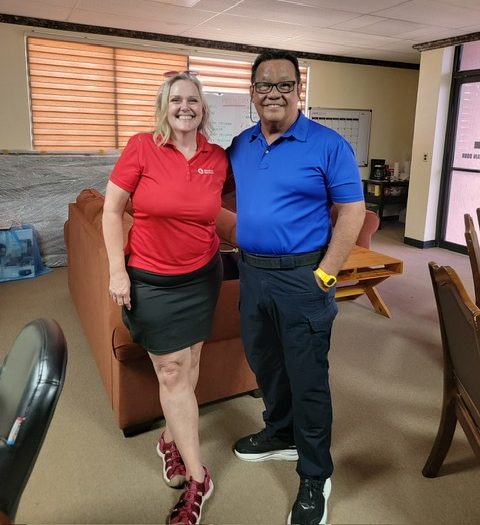
For 35 years, Vicki Dellone wore a badge with the Fresno Police Department, dedicating her career to protecting and serving her community. Retirement could have marked the end of that chapter. Instead, it opened the door to a new one.
Today, Vicki serves as a Disaster Action Team Supervisor for the American Red Cross, continuing a lifetime of service — this time in red instead of blue.
“We help your neighbors, your friends, and maybe you.”
Growing up, Vicki remembers seeing the Red Cross responding to national disasters. Now, as she witnesses the organization’s local impact firsthand, she’s made it her mission to educate others about the Red Cross. She joined the Disaster Action Team (DAT), and her passion for helping people recover from home fires has only grown stronger with each response.
In Fresno, Vicki responds to home fires alongside the Disaster Action Team (DAT), helping families navigate some of the hardest moments of their lives. With each call, her commitment to serving others has only deepened.
“We’re a team, and I’m never alone.”
The Fresno DAT team may be small, but their impact reaches across the community day and night. When families face the devastation of losing their home to a fire, volunteers arrive ready to offer comfort, practical support and compassion.
Vicki and fellow supervisor Vickie Mora help welcome and mentor new Disaster Action Team members, encouraging them as they begin their own Red Cross journeys. Together, the team provides wraparound support that can include financial assistance, spiritual care and temporary housing to help families find their footing after tragedy.
For Vicki, the work is deeply personal because every response is about people first.
“Sometimes all they need is a hug.”
Over the years, Vicki has witnessed the relief families feel when Red Cross volunteers arrive. In moments filled with uncertainty, fear and loss, that simple presence can remind someone they are not alone. Some of the most meaningful gestures are also the simplest.
“It’s the little everyday moments.”
Local quilters throughout the community create handmade blankets for families affected by home fires. Vicki says some of the most powerful moments happen when a volunteer wraps someone in one of those quilts — offering not just warmth, but comfort and hope.
She recalls meeting someone who had received a Red Cross blanket as a teenager after experiencing a fire. Years later, they still remembered the feeling of being cared for during one of the most difficult moments of their life.
For Vicki, those moments are reminders that even small acts of kindness can leave lasting impressions.
Vicki now works alongside two other former first responders, John and Jose Martinez, who also found a second chapter of service with the Red Cross. Together, they continue supporting their community through disaster response, local events and preparedness efforts.
She hopes other retired first responders recognize that their experience, compassion and leadership are still needed.
“You still have more to give.”
“There’s always a place for first responders here,” Vicki said. “A place where they can continue to serve and make a difference.”
“You never know how long your impact will be.”
Every day, volunteers like Vicki stand ready to respond to home fires 24 hours a day, seven days a week. When the call comes, they go — bringing support, compassion and hope to neighbors facing unimaginable loss.
For Vicki, serving others has never just been a job title. It’s part of who she is.
And for anyone wondering whether they still have something to give to their community, her story offers a powerful reminder: your next chapter of service could be just beginning.
If you’re looking for your own way to make a difference, volunteer with the American Red Cross and join a team where every action — big or small — can change a life.
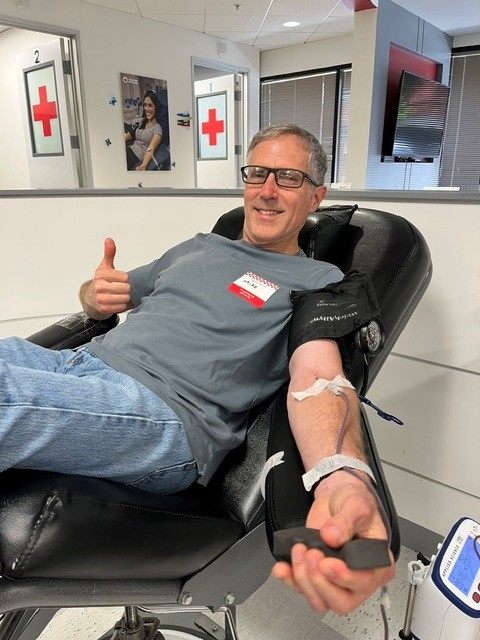
I walked into my American Red Cross blood donation appointment in February feeling confident. I eat well, I exercise and I care about doing my part. Then came the results from the hemoglobinometer they slipped over my finger and a polite but firm rejection. My hemoglobin was too low.
It was frustrating, but it sent me down a path I’m grateful for. Because I learned that if you’re vegetarian—or, like me, eat a mostly plant-based diet—you can give blood. You just have to be a bit more intentional about iron.
A pint of my finest B+ (and who wouldn’t want their blood to Be Positive?), donated and off to do its part to help save lives.Read more