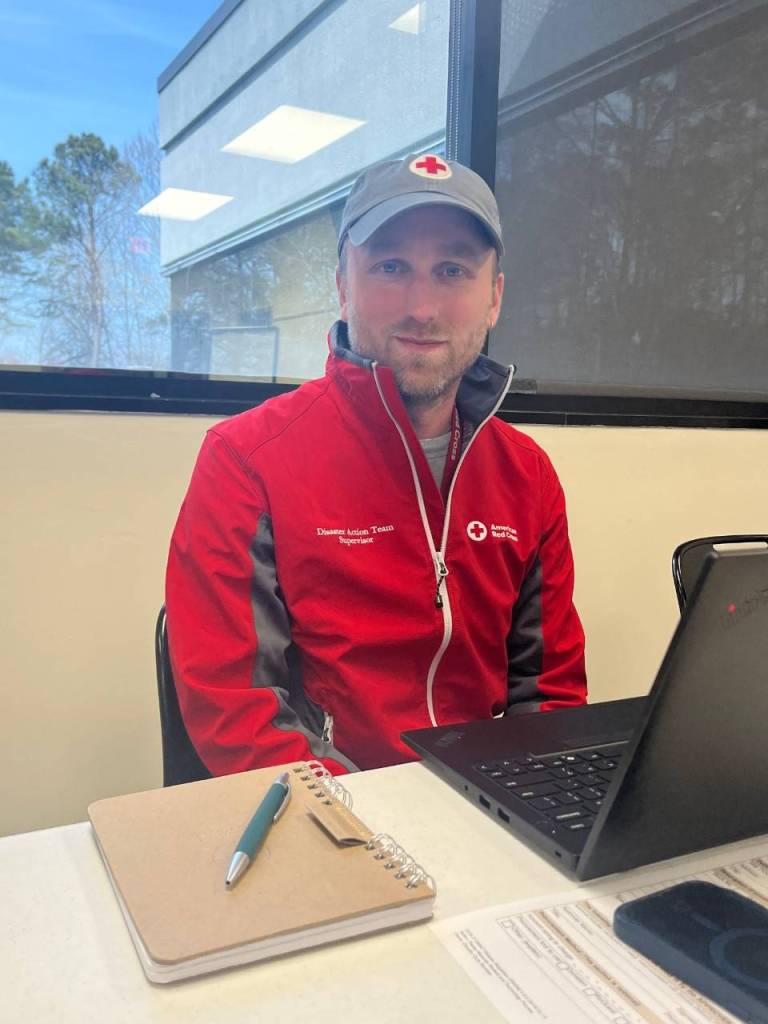
Andrew Rosenberg worked alongside the HQ Shelter Manager, Tonya, coordinating shelter efforts from HQ.
As winter storms have affected South Carolina over the past two weeks, many American Red Cross employees and volunteers deployed to the Palmetto State to help those in need. One of those employees was Andrew Rosenberg, who traveled from California.
Andrew is a community disaster program manager in the Northern California Coastal Region, based in San Francisco.
He believes deploying and helping others is incredibly important.
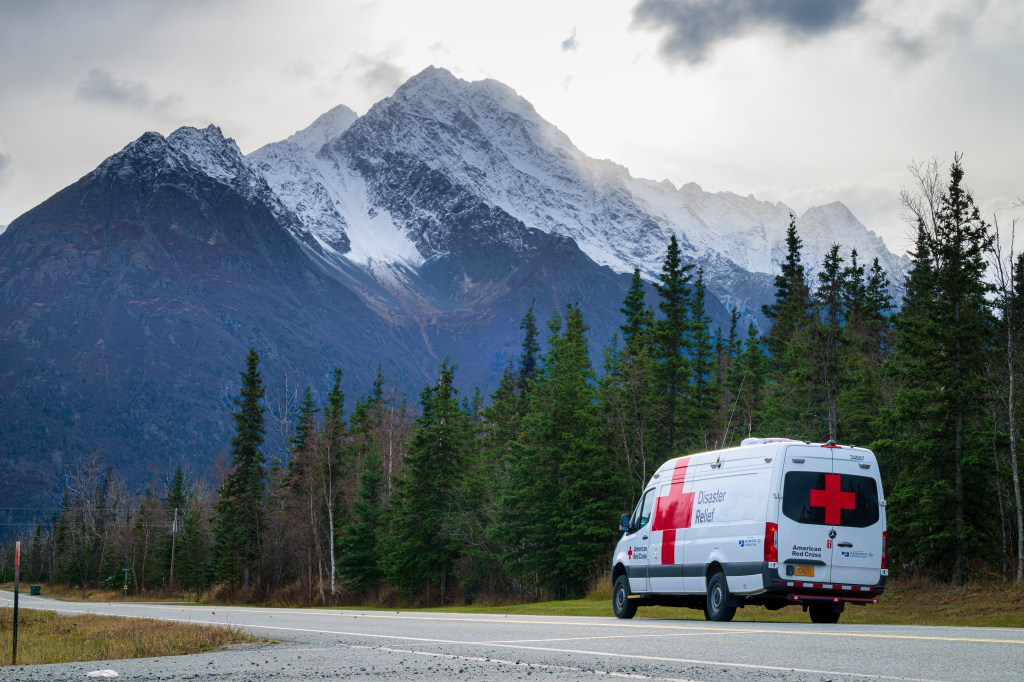
When American Red Cross volunteer Karl Matzke, from Santa Clara County, received the call to organize a team and deploy to Alaska, there was no hesitation in his decision to go. As one of the Divisional Leads for Operations Management, he ran the operations for the first shelter that opened in Alaska just three days after Typhoon Halong devastated the region on October 12.
October 22, 2025. Anchorage, Alaska. The American Red Cross deployed hundreds of Red Cross disaster workers from across the country to help during what could be a prolonged relief response from Typhoon Halong.Read more
Tammy Salwasser from Alameda County thought she had to be a nurse to volunteer with the American Red Cross.
“I first heard about it from a girlfriend of mine who was a nurse and she would deploy,” says Tammy. Her friend encouraged her to join as a volunteer, but Tammy’s work experience was in customer service and sales; so, she didn’t think she was qualified to help. That is, until she learned that there is no requirement for specialized credentials for many volunteer roles, since the Red Cross provides free training.
A Red Crosser surveys damage caused by fires in LA
What happens when you have nowhere to go after a disaster? What if your neighborhood is destroyed, or your home is no longer safe? For those affected by the January 2025 fires in Los Angeles, Calif., the American Red Cross was there to supply safe shelter, food, relief supplies, financial assistance, comfort and a specific service that only Sue Trautman and her team can provide.
Sue, a Red Cross Northern California Coastal Region volunteer, arrived in LA about a week after the fires devastated communities across the city. She set up shop in the Red Cross offices downtown and got right to work. Sue served on the Shelter Resident Transition Team — a group of volunteers that helps evacuees in shelters create a plan to move into more stable long-term housing.
It had been a children’s playground in Altadena, Calif. Now, a melted toy sat upon a melted jungle gym. Scraps of canopy were whipping in the wind. Now, it was just burned wreckage in the wake of the wildfire. Dave Crocker remembers it clearly almost a year later. “It stopped me short,” he says.
He was in Los Angeles —the place where he was born, had grown up and gone to college. Where wildfires were a fact of life. Dave is an American Red Cross volunteer who has seen the aftermath of numerous wildfires first-hand. But this fire: it had been unusual.
Local school bus drivers helped distribute food in Guam after a typhoon
After a massive typhoon hit Guam in 2023, people on the islands were struggling to feed their families. While the American Red Cross had set up a shelter to house people whose homes had been damaged, there were many people in the community who were not staying at the shelter but still needed food and water. Red Cross leaders wondered, how can we get food to the local community, when there are no street signs for navigating and we don’t have a fleet of vehicles here? Bus drivers were the answer! So, the Red Cross worked with the school district in Guam to distribute meals on school buses because the drivers knew the streets well and had transportation available already.
After some time, Red Cross leadership was considering ending the feeding program in the community, but the volunteers in the field were concerned. They drove around to all the local bodegas and there was “nothing there” on the shelves, says Briana Taylor, Red Cross volunteer. “We went back and said, ‘You can’t stop feeding until we have food in the markets.’ People wouldn’t have had any resources to provide food for their families.”