
After years of direct service to clients, Lorraine Jacobs now trains other volunteers
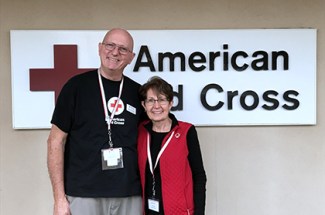
 Earlier this year, American Red Cross volunteer Lorraine Jacobs received the 2019 Clara Barton Award given by the Central Coast Chapter. Named after the organization’s founder, the award honors a volunteer for service in Red Cross leadership positions over many years. In Lorraine’s case, one look at her Red Cross resume makes it clear why she received the prestigious award.
Beginning with a deployment in the aftermath of Hurricane Katrina, Lorraine has exemplified outstanding service through her work with the Central Coast Chapter, our region, and beyond. She has devoted her time and care through long-distance deployment in shelters, training, information and planning, fundraising, and Volunteer Management. Lorraine, who has supported Red Cross staff and clients as both a full-fledged volunteer and employee, is currently volunteering as part of the regional Workforce Team.
Before beginning her Red Cross service in response to Katrina, Lorraine first came in contact with the organization following the 1989 Loma Prieta Earthquake. When the destructive quake caused significant damage to her and her family’s Soquel area home, Lorraine remembers the Red Cross sharing resources to help them with short-term rental expenses. The memory of that support has stayed with Lorraine in the years since, motivating her to continue to help people facing similar devastation and displacement.
In the following Q&A, Lorraine discusses those and other Red Cross experiences, what inspires her to respond to those in need, and what motivates her now to encourage other volunteers to do the same.
What inspired you to start volunteering with the Red Cross?
I began my work with Red Cross as a volunteer in 2005 with Hurricane Katrina. The images of the devastation, scope of the disaster, and the need for volunteers coincided with my ability to deploy at that time in my life. From a young age, I had volunteered for humanitarian causes. So the Red Cross work felt like a good fit.
What lines of service have you participated in?
In the Hurricane Katrina disaster response, I began working in a shelter and continued on to what is now called Recovery. During subsequent deployments, I worked in Information & Planning, Logistics, Staffing, Training, ERV driving, and continued with Recovery. My concentration now is on Training, and I really enjoy it.
What are some of the more challenging and uplifting moments you’ve experienced in your various roles with the Red Cross?
My experience has helped me hone my listening skills. After 14 years of Red Cross work, I am not done developing this skill. But I see it more as an opportunity for growth rather than a challenge.
My work with our clients, with people who have been affected by disasters, has also been both challenging and rewarding. The losses our clients sustain are sometimes life-changing. The challenge has been trying to figure out how I can best work with a client and help him or her move through the maze of other agencies set up to help. The reward is less simple to articulate. In fact, it is somewhat indescribable for me. When I listen to a client’s story, or help a person through difficulty, it translates to a feeling of hope. I really believe that connecting with and understanding others builds a network of common ground for shaping our future.
These days my work is more in the area of preparing other volunteers. After working in many other areas of Red Cross, I feel my skills now are best utilized in the facilitation of disaster training at Red Cross. I treasure the Principles, Values, and Mission Statement of Red Cross. Our learning platforms support these well. The opportunity exists to help volunteers find their way in our large organization by facilitating an understanding of how the Red Cross mission translates into care for others.
It is so uplifting to see volunteers progress through training and their disaster-response experiences, learn how to do the best job possible helping meet clients’ needs, and — in the process — learn a lot more about themselves.
What advice would you give people interested in volunteering with the Red Cross
There are several things I would recommend prospective volunteers do. I would recommend they start by educating themselves by utilizing Red Cross classes to choose a starting place. I think it can be very helpful to find a mentor in their chosen field. Listening to experienced volunteers and staff members is also an important step. I also always tell prospective volunteers to be flexible, as Red Cross disaster work often happens in real-time under pressure. And last but not least, I advise people to regularly re-evaluate how the work is going for them. The Red Cross is a big organization with a lot of different opportunities for service.
What does being a recipient of the Clara Barton Award mean to you?
As this award is in recognition of Red Cross work I have done for many years, receiving it from my local chapter is a particularly great honor. I am more appreciative of it than I can say.
_____
Become a Red Cross Volunteer: You can make a difference in Monterey, San Benito, or Santa Cruz County by becoming a volunteer with the American Red Cross. Volunteers constitute about 94 percent of the total Red Cross workforce to carry out our humanitarian work. Red Cross volunteers are trained to meet the needs of those affected by disasters, providing food, shelter, and comfort for families affected by major disasters such as fires, floods, and earthquakes as well as helping local residents prepare for and recover from emergencies of all kinds. We’ll find the position that appeals to you and allows you to use your skills and talents. Email VolunteerCCC@redcross.org to get started.
About the Author: Fleur Williams is a volunteer writer for the Central Coast Chapter of the American Red Cross. A resident of Aptos, Fleur is a freelance writer with a focus on the arts, culture, and humanity.
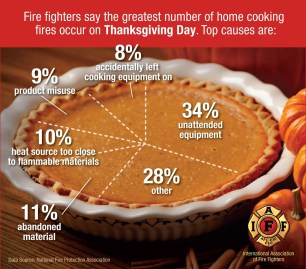 Did you know that more home cooking fires occur on Thanksgiving than any other day of the year?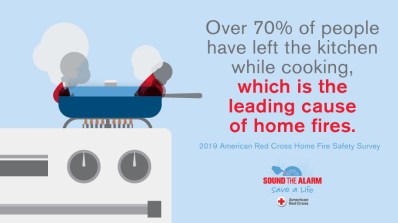

 Sitting at the dinner table, my whole family laughing, my Uncle Sammy once again tells the same story that, in my mind, is paired with the essence of who he was. He would always smile as he told it, even though I’m quite sure that on the day the story took place, he was doing the exact opposite. See, my Uncle Sammy was a paratrooper in Central America, and in his youth, he was quite proud to have earned the title. Unfortunately for him and his pride, during his very last training jump, he managed to land not on his target, and not even on the ground near his target, but instead, in an unsuspecting and probably quite surprised tree. With that, he managed to break his leg, expel himself from the paratroopers, and was instead sent to Germany to be the assistant of a Jewish chaplain stationed there not long after the end of World War II. Though the story told at the dinner table would usually end here, followed by the continuous teasing of my family, his military experience did not. My Uncle Sammy, a once paratrooper, now chaplain’s assistant and Jewish American soldier, instead went on to help a still-grieving community heal from the recent trauma of the Holocaust.
 My grandfather passed when I was still relatively young. Yet, I will always remember the tribute the Navy paid to him when he passed, for how much it honored both his memory and his service, even though he had been active many, many years before. Though I only had to chance to know him when I was young, meaning I never got the chance to hear about his service from him, my dad was able later to tell me about his time in the military. He had enlisted in the Navy during the Korean War and spent most of his time repairing ship motors in Japan and Hawaii. Two Navy members came to his memorial service and presented us with the American flag. To this day, every time I see it, proudly framed in a wooden triangle, I always think of him.
 My mom was born an army brat on a base near Huntsville, Alabama, to my grandmother, an outgoing civil rights activist, and my grandfather, an army engineer, serving during Vietnam. They entered the service right as the sputnik missile was being launched into space, meaning that all the engineers stationed there were working hard to catch up. Being the critical mission that it was, the debate was rampant in the arsenal, and to encourage the troops to get back on track so that the USA could win the space race, John F Kennedy himself showed up to the base. My grandfather met the president with an outstretched hand and a quiet “wow.” Telling the story now, my grandfather always assures us that this was not in response to meeting the president of the United States, but instead was a reaction to the president’s choice of clothes. “I’d never seen a $1500 suit in real life before.”

 Your Red Cross Update