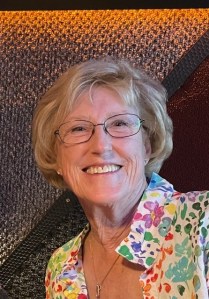
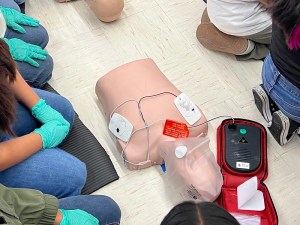
From left – Red Crossers Colin Clover, Ziya Dikhan, Mary Lee and Penny Mount greeted veterans at the Santa Clara County Stand Down. Photo: Alex Keilty – American Red Cross
Colin Clover comes from a military family. When asked how many of his family members are in the Armed Forces he said, “Too many to mention!” Although he didn’t go into the service himself, he wondered how to support people like his grandfather, cousins, aunts and uncles who had served in the Armed Forces.
Then he found out about the Service to the Armed Forces work of American Red Cross and he had found a way to help. First, he was a volunteer and now he is an employee working as a program specialist for Service to the Armed Forces and International Services.
James and his wife Sue, at Livermore 1st St. Ale House watching Raiders on the big screen. Photo courtesy of James Ferguson
As thirteen-year-old James Ferguson sat in his hospital room with a life-threatening injury, he struggled to accept that his burgeoning football career was over. His dream of playing for the Oakland (now Las Vegas) Raiders would never come true. He questioned what would come next and how he could fill football’s void. James soon knew that playing the guitar could fill part of that void, but it took him nearly 15 more years to answer more of that question.
When 27-year-old James Ferguson donated blood for the first time at a work-sponsored blood drive in 1983, he thought back to that moment in the hospital. “Giving blood made me realize those thoughts were very juvenile,” said James. It was at that blood drive that James realized donating blood could fill more of football’s void.
Today, James regularly donates blood and plasma through the American Red Cross. Since his first blood drive in 1983, James has donated nearly 30 gallons of blood. He donates through the Red Cross “whenever he can, whenever they call,” barring work, travel or other personal obligations. He describes the Red Cross as the “greatest community of people.”
For James, donating blood is a deeper act of service to other humans and a simple way of giving back to others in need. As James explains, “the basis of all this is my faith. There are things that we can do and things that we do and there are opportunities that we have to accept or we run away from. I love to do something for somebody that brightens their day. Their pleasure, their happiness makes me happy.”
James’ desire to help other people is not only unique to him. He is proud of the dedication of his whole family – which he also credits with filling football’s void – to helping others. His sister helps people every day as a nurse at a local hospital in Fremont. Other family members have even interacted with the Red Cross in the past, including his daughter, who is a medic in the Army National Guard, who helped with the emergency response to the 2018 Paradise Fire.
“Me with my grandkids and daughter. Left to Right: Owen, Madison, Daughter Sara, and me.” Photo courtesy of James Ferguson“Mom and Me… a weekend of playing Yahtzee!” Photo courtesy of James Ferguson“This is my band, my band. The Bylly James Band. I’m on left playing guitar.” Photo courtesy of James Ferguson
Music is also incredibly important to James and his family. He cites it as another major factor that helped him get through the injury. As James said, “Football ends, music never does.” He plays guitar in a classic rock/blues band in the Fremont area. One of his favorite parts of playing music is seeing the impact his music has on people’s faces.
James has found a way through the Red Cross Blood Donor app to replicate that same reaction when he gives blood. Although he cannot directly see the impact on someone’s face, James calls the app’s ability to show him where his blood was used, “powerful.” This is especially true when children receive his blood. “The app is important. It is a huge revelation. Deeper than anything. It hits home.” James says of the app’s impact.
James plans to give blood for as long as he can since it is both fulfilling and easy to do. “I am a five-minute blood donor,” he says. He also has words of encouragement for others who may be thinking about donating for the first time. “It takes half an hour to save somebody’s life. If you do these things, you will find joy that you never imagined,” he tells them.
A Red Cross volunteer shares what the Loma Prieta earthquake – and the hours that followed – were like from the Red Cross office in San Jose.
A Red Cross worker surveys the damage caused by the Lomo Prieta earthquake in the Santa Cruz area.
By Franci Collins, Red Cross Volunteer
I will always remember where I was at 5:04 p.m. on October 17, 1989. I had just walked into the San Jose Chapter of the Red Cross. Coincidentally, I was scheduled to teach an earthquake preparedness class that night, the first in several months as classes were often cancelled due to lack of enrollment. I wanted to get there before 5 p.m. to make sure all the equipment was available and working.
The slide projector was on a table right inside the classroom door and I had just turned it on and off when the ground started shaking. I am happy to say that my six years of training paid off, as I immediately ducked under the table and held on. The shaking seemed to go on for an extremely long time and I spent most of it imagining the slide projector being progressively shaken towards the edge of the table. I had time to decide that if it fell off, I would stay where I was and not try to save it.
Bill Sinn spent 35 years working for Alta Bates Summit Medical Center, 20 of which as the hospital’s blood bank manager or, officially, the blood bank’s lead technologist. Highly respected for his expertise in testing, matching, and preparing blood for transfusion to meet a variety of the hospital’s patients’ needs, Sinn is now a quiet, humble, and extremely skilled volunteer serving with the American Red Cross Biomedical Services department as a Transportation Specialist.
“He’s the blood bankers’ blood banker,” said Michael Gregory, a Red Cross board member and former staff member. “If I were having surgery, I would want the best person in charge of identifying the right match for my blood transfusion. That would have been Bill Sinn.”
Red Crossers Sophie Rebecca (left) and Eleanor Najjar greet Fleet Week visitors. Photo by Alex Keilty – American Red Cross
By Alex Keilty
She was sprawled on the ground with her arms and face covered in bruises. “I remember the firefighter scooping me up,” says Sophie Rebecca Najjar. She was just 6 years old and it was her introduction to the American Red Cross. Lucky for Sophie, the firefighter was real, but the bruises were not. She had been painted with makeup to look like a victim for a disaster practice exercise she attended with her mom. She had a great time that day!
Santa Cruz county resident, mental health professional and longtime Red Cross volunteer Jill Hoffman recounts her Loma Prieta earthquake experience 35 years later, including what she’s learned about earthquake safety.
Collapsed roadways were a common sight after the earthquake. Photo credit: U.S.G.S.
“I have been a volunteer in Santa Cruz since 1980 and was part of the Loma Prieta Earthquake Red Cross response in 1989.
I was at work with clients at 5:01p.m. on Oct. 17, 1989 when the earthquake struck; I though we were being bombed, the noise and shaking were so severe. We were just six miles from epicenter. I remember saying very quietly and calmly “door frame! door frame!” (We know now not to do that, and instead to drop to the floor, cover yourself with something sturdy like a table, and hold on until the shaking stops. Doorways are not any more structurally sound than elsewhere in a building and not a safe place to go to during an earthquake.)
“I though we were being bombed, the noise and shaking were so severe.”
I was one of the lucky ones in that I had no major damage to my home, just books falling off shelves and glass breaking. My boss at the County Mental Halth Services (CMHS) came by about an hour and a half after the earthquake via bicycle instead of her car since the route to my neighborhood was no longer driveable. We immediately joined the team working at a disaster shelter at the Civic Center in downtown Santa Cruz.
At a Red Cross shelter, residents displaced by the Loma Prieta earthquake sit and talk.
I wore two hats during most of the response: I volunteered at the shelter and did community outreach for Red Cross. Within a few weeks, I assumed the role of the Clinical Mental Health Director for a FEMA grant, a position which was extended to 18 months. We saw 25,000 people during that time.
In Santa Cruz county, (the epicenter of the earthquake) CMHS led the long term mental health care response, taking over from the Red Cross. FEMA hired six full time and 34 contracted mental health care workers.
A washed out road in Santa Cruz county. Photo credit: U.S.G.S.
I met with the couple I had been seeing that day about five weeks later and they said “Jill! You were so wonderful, you were yelling at the top of your lungs “Door frame! Door frame!” So much for my perception of the event at the time.
When we had an aftershock 6 months later I had I had the flight vs. fight response and bolted out of my chair at a restaurant and stared running before my colleague stopped me.”
Thank you, Jill, for sharing your story, your service then, and your continued service now. To learn more about disaster preparedness, including how to be prepared for an earthquake, visit redcross.org/prepare.