Author Archives: redcrossnorcalstaff

California fires touch Honolulu woman

By Tina Doty, volunteer contributor, American Red Cross (Hawaii)

It was an ordinary trip from Honolulu to our Napa Valley home located on Howell Mountain above a small town named Angwin on Saturday, September 19th. Little did my husband and I know that one of the most destructive wildfires in the area was about to take hold on the other side of the mountain.

I remember looking out my window at the vineyards surrounding our house and noticing the wind had picked up. I got an ominous feeling in the pit of my stomach. By the next morning, my sister-in-law, who lived in Calistoga, called to inform me that many people she knew living in Middletown had lost their homes and beloved pets. Eventually, the number grew to 1,000 homes and over 100 square miles burned.

I hastily made my way to the Red Cross shelter located at the Calistoga fairgrounds to offer my assistance. I was introduced to Pat Morales, a Red Cross Volunteer from the Greater Northern California Chapter, who was amazed I was a Red Cross volunteer from Oahu. He quickly set me up with a Red Cross vest, hat, and t-shirt and put me to work.

As I made my way into the cafeteria, I saw people sitting at tables, some eating, some not, others staring into space, or their heads hung low. One woman was busy nursing her young infant, and children were occupied in a corner with coloring books and related activities. “Gosh”, I thought, “Where do I start?”

I saw people covered in soot, a look of shock, despair, and hopelessness etched upon their faces. Others sat on cots outside with their pets, mostly dogs. Larger animals such as horses and llamas were in a nearby field. Calistoga residents made sure all animals were provided water and food.

I spoke with several people who told horror stories of barely making it out alive with what little belongings or pets they could. Many people only had the clothing on their backs. One man mentioned that he could not start his car because he realized that he was holding his house keys then turned around to see his house burning. He walked out of the area and eventually made it to the shelter. A woman came into the shelter crying and stated, “What do I do now? Everything’s gone!” The Red Cross offered shelter, food, and emotional support.

Other people in the shelter told stories of getting in their vehicles with family members and speeding through fireballs. Many houses were completely destroyed and turned to piles of ash or unrecognizable debris. One woman came up to me at the shelter to tearfully announce that she learned her house was still standing, at least for now. I gave her a big hug.

The residents of Calistoga responded with an outpour of donations which included food, pet food, clothing, and most of all much needed support. Residents from as far away as Marin County responded with various donations including rooms for people and their pets. A notification board was set-up to inform about other resources available.

I realized that that this was my very first large scale community disaster as a Red Cross volunteer. Kudos goes out to the many area fire fighters who are still fighting the blaze. We were lucky that our house was unaffected. Although I was definitely not anticipating this terrible event, I took away from it that even with all the global problems taking place around us, human caring and compassion still rules.

I am very proud to be a Red Cross volunteer.
Red Cross: GPS for Recovery

21576233655_8226c9ec91_o

by Kathleen Maclay, volunteer contributer, American Red Cross

The Red Cross is intensifying its efforts to make sure residents affected by the Valley Fire nearly a month ago get a solid and secure footing on their road to recovery.

Some 1,000 cases have been opened on behalf of individuals in the Lake County region by Sunday, said Martin “Rusty” Brown, the Red Cross’s client services lead for the Valley Fire.

“Our big push has been to reach clients and get them into the system, so we can help them get the help they need for recovery at each and every stage,” said Brown, for whom the Valley Fire is his 14th disaster deployment over the past four years.

The Red Cross shelter in Middletown transitioned to standby on Sunday, October 4th after answering the immediate needs of residents in the region for shelter, food and clothing  in the aftermath of the deadly fire that ignited on Sept. 12.

“Even though some of that part of the emergency response goes away, we don’t go away,” said Brown, who deployed from Winterhaven, Fla., where he belongs to the Red Cross Mid-Florida Chapter. “We will always have a presence.”

Ongoing support will include feeding, clean-up supplies, physical and mental health support and the Red Cross can open new shelters should the need arise.

And via its long-term recovery efforts, Red Cross caseworkers provide guidance and monitoring for residents trying to navigate an often daunting and frustrating assemblage of entities necessary to resolve housing, transportation, environmental, utility service or medical issues now, said Brown.

“We’re the Global Positioning System (GPS),” Brown said. “We’re not driving the car. We’re not building the road. We’re the voice on your GPS and sometimes when we need to get you back on the right path, you might hear us saying, ‘Recalculating.’”

Anyone in need of assistance can call the Red Cross 24-hour hotline at 855-224-2490.

Red Cross Pin links past and present

RedCrossRing

by Kathleen Maclay, volunteer contributer, American Red Cross

Danny Ventress’s hometown of Cobb in Lake County was under evacuation orders due to the Valley Fire, and he was packing up things at his 86-year-old mother’s home in Valley Springs in the area of the Butte Fire.

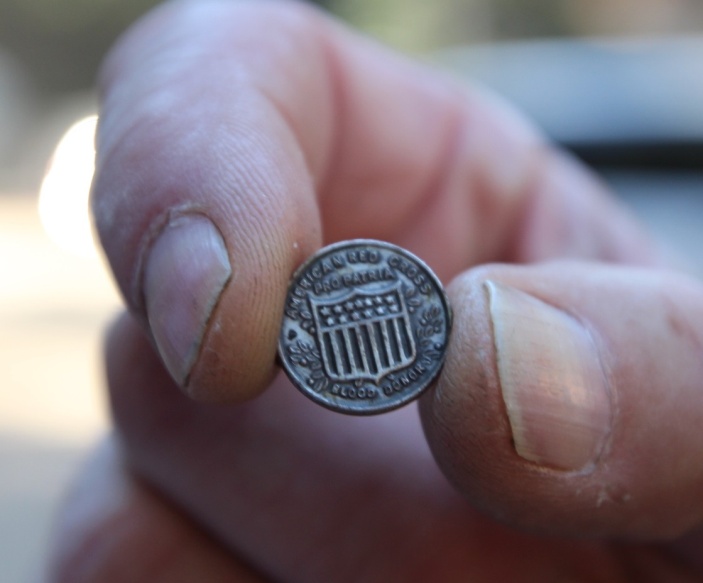
He was busy examining a cache of coins she saved over the years, glancing at television news reports about the two disasters that rank among the state’s most devastating wildfires ever. Just as a scene with the Red Cross flashed across the TV screen, Ventress says, his eyes were caught by what he thought was a special coin.  Looking more closely, Ventress says, he say the coin was a Red Cross pin given to blood donors, probably decades ago.

Although his mother doesn’t recall the details of how she acquired the pin, finding the piece struck an emotional cord for Ventress.

“I’ve seen Red Cross people out in huge numbers, ready to assist. It’s been great,” he says of the emergency and recovery efforts of the Red Cross in the Sierra foothills where his mother lives, as well as in Lake County region where his family vacationed regularly when he was a kid and where he moved  permanently 15 years ago.

As he was helping out at the Mountain Lion’s Club in Cobb, Ventressa shared with visitors story of the pin, that didn’t match his original expectations, but exceeded them.

30 Days Later – The California Wildfires Response

Immediate Collaboration 

The ongoing drought across California has given way to another historic wildfire season. Beginning September 9, 2015, two of the most destructive wildfires in state history flared throughout northern California. The Valley Fire is now the third most destructive fire in state history and the Butte Fire the seventh most destructive blaze. Combined, these fires burned more than 150,000 square acres and destroyed more than 1,700 homes, displacing thousands of families.

As the fires destroyed buildings, neighbors instantly came together to help one another showing amazing generosity and resilience. Local Red Cross chapters, community organizations and government agencies sprang into action as well, mobilizing volunteers to offer shelter, food, water, basic health services, and mental health services for thousands of people in the path of the wildfires.

As evacuation orders were lifted, Red Cross volunteers worked alongside community members to distribute food, and relief supplies to impacted neighborhoods and support people as they returned to their properties with health and mental health services.

California Wildfires Response by the Numbers:
• over 120,000 meals and snacks served by Salvation Army, Southern Baptist, community groups, local restaurants and the Red Cross
• over 58,000 relief items water, snacks, hot meals, non-perishable meals, and clean-up items such as work gloves, buckets, trash bags, sifters, and dust masks
• over 11,000 overnight stays in 12 community or Red Cross shelters
• over 9,900 health and mental health contacts
• over 1,500 cases opened by Red Cross caseworkers to provide individualized recovery support.

Disasters are often complex, with complex needs – and no single agency can meet every need on its own; it takes collaboration and partnership. The reality is that it takes the talents and resources of many agencies and organizations working together to provide necessary services after a major disaster.

The Red Cross is one of many agencies coming together to ensure that basic needs are met, to work on the long-term recovery of entire communities, and to help them be prepared for and more resilient in the face of future wildfires. During the California Wildfires response, the Red Cross collaborated with several partner agencies, including several Lions Clubs, several Sevenths Day Adventists communities, Middletown Rancheria of Pomo Indians, Twin Pine Casino, Southern Baptist Disaster Relief, Salvation Army, Jackson Rancheria, Tzu Chi, St. Vincent de Paul, Catholic Charities, Children’s Disaster Services, Samaritan’s Purse, Team Rubicon, Rotary Clubs, Community Churches, Boy Scouts of America, Center of Volunteer and Nonprofit Leadership, local and state Emergency Operation Centers, the Federal Emergency Management Agency, and many more.

It Takes the Whole Community to Make a Community Whole

To help all households in fire-impacted communities move forward, the Red Cross is working together with local Long-Term Recovery Groups in Lake and Calaveras Counties respectively, which are coalitions of community and grassroots organizations who will develop and execute long-term plans for a community’s recovery.

The Red Cross currently has highly trained caseworkers meeting one-on-one with each family affected by the wildfires to understand each unique situation and help them on the road to recovery with the information, assistance, and access to resources they need to put that plan into action. They are helping people with family reunification information, funeral assistance, emergency needs and recovery planning.

Caseworkers are also skilled in directing people to other agencies that provide specialized services not provided by the Red Cross. Much of Red Cross recovery work focuses on assisting the most vulnerable people who need extra help getting back on their feet, are ineligible for government assistance, or don’t have anywhere else to turn for help.

The Red Cross also has trained disaster mental health professionals available to help adults and children cope with the emotional impact of a disaster and its aftermath. It’s common for people to suffer from high stress, anxiety, depression and other trauma related illnesses during and after a disaster. Red Cross Disaster Mental Health workers assess clients’ needs, provide individual psychological triage, crisis intervention and condolence support, and make appropriate community referrals for longer term support.

Persons affected by the wildfires who are in need of assistance are encouraged to connect with a Red Cross caseworker by calling 855-255-2490.

Preparing for Secondary Impacts

The wildfires left vast expanses of terrain and hillsides bare and when heavy rains arrive this winter, experts predict that flooding and mudslides are not far behind. Recognizing that these secondary impacts represent a serious threat, the Red Cross will be collaborating with local communities to increase personal preparedness and strengthening the existing volunteer corps to ensure the community is ready to respond if and when another disaster strikes.

The Red Cross provides potentially life-saving preparedness apps that are absolutely free. There are apps for first aid, tornadoes, hurricanes, flood, wildfire, and earthquake that can be programmed to give an audible warning should an event be imminent. They are filled with important information on what to do before, during, and after an event, and provide directions to Red Cross shelters. Recently, the Red Cross came out with an Emergency app that combines in one place many of the features of the individual apps described above. All of these apps are free of charge. They can be found and downloaded by going to your particular app store and searching “Red Cross” or from the Red Cross website at www.redcross.org.

No matter what the disaster is, the American Red Cross is hard at work at some phase of the Disaster Cycle and often on multiple phases at the same time. The Red Cross is here today to serve those who have lost so much, and it will be ready to serve when a future disaster strikes again.

Big thanks to California Conservation Corps’ Ukiah team

ccc

by Kathleen Maclay, volunteer contributer, American Red Cross

A dozen youth with California Conservation CorpsUkiah Center received heart-felt thanks, applause and formal certificates of appreciation as they headed home after a three-week deployment to the Red Cross shelter set up at the Twin Pine Casino & Hotel in Middletown for those affected by the Valley Fire.

“We really couldn’t make it without them,” said Rose Madison, the shelter’s mass care lead, as she prepared the certificates and circulated individual thank-you cards for grateful Red Cross volunteers to sign.

The team of nine young men and two women led by Charles Coffman were assigned to the shelter for a range of responsibilities. Duties included unloading trucks delivering bulk supplies to Twin Pines; loading Emergency Response Vehicles (ERVs) dispatched to the surrounding community with food items, clean-up kits and supplies; greeting clients and other visitors; vacuuming; washing shelter cots used by clients and volunteers; setting up canopies for other partners on the scene; and more.

Members of the CCC are young men and women ages 18 to 25 who commit to a year with the state agency, performing natural resource work and emergency response. The agency was created in 1976 by Jerry Brown, California’s governor then, and now.

“They took the initiative to do what they saw needed to be done, and they did it with a smile on their faces,” said Madison, a volunteer with the American Red Cross of Central California.  “It was inspirational to see these young people really making a positive contribution.”

LaRae Ewing, 21, of Redlands, is a graphic design student at California State University, San Bernardino, who called her experience meeting “life changing.”

Angel Shah, 19, of Richmond, said in the 10 months or so he has been with the CCC, the Red Cross is the largest sponsoring agency he’s worked with, and the Valley Fire assignment his first emergency response.

Employed in carpentry and construction before joining the Corps, Shah said he has learned invaluable skills in terms of workplace organization and better communication that he will take with him as he moves forward.

Special delivery to Cobb Mountain

CobbDelivery1

by Kathleen Maclay, volunteer contributor, American Red Cross

As Red Cross volunteers were dispatched Monday, Oct. 5th in response to torrential rains and flooding on the East Coast, Red Crossers assigned to the West Coast after the Northern California Valley Fire made a special delivery of supplies for a hard-hit Cobb Mountain community.

Leaders of the Mountain Lion’s Club in Cobb, located on state Highway 175, asked for specific items that they said residents needed after their community was finally reopened after the lifting of mandatory evacuation orders that came as the fire roared toward Cobb nearly a month ago.

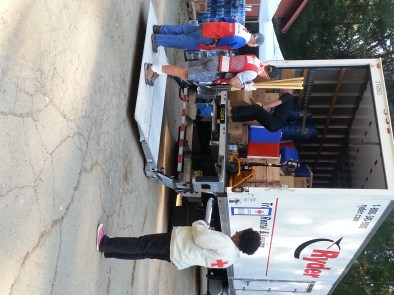
A Red Cross crew working out of nearby Middletown worked to unload sleeping bags, ice chests, blankets, shovels, camp chairs, tents, charcoal, cots, pallets of ready-to-eat meals, and more than 300 sifters specially made by Redwood Empire Council Boy Scouts of America of Sonoma and Mendocino counties.

Rose Geck, a 31-year resident of Cobb and a Lion’s Club volunteer who helped direct the unloading of supplies, said the community is incredibly grateful for the emergency and recovery response it has witnessed.

“The landscape here will be changed for many, many years,” she said.  “It will take a long time for the Old Cobb to come back.  It will actually be the New Cobb.  There’s a lot of hope.”

« Older Entries Recent Entries »