Author Archives: redcrossnorcalstaff

Spotlight on the Region’s Chapter Board Chairs

By Chloe Li

At the heart of the Red Cross’s vast network lies an essential role: that of the Board of Director’s Chair for a local chapter. These individuals play a pivotal part in guiding community leaders and leading their respective chapters to fulfill the organization’s mission to alleviate human suffering.

Our region’s five Chapter Board Chairs share their inspiration for joining the Red Cross below, and the critical responsibilities and significant contributions they hope to make in the community. We thank all our Board Members for their dedication, commitment and impact to ensure the Red Cross remains a beacon of hope and support when it is needed most.

To learn more about our chapters within the Northern California Coastal Region and our Board Members, visit: redcross.org/norcalcoastal

Read more

“I am putting good vibes out into the world.” 

by: Alex Keilty 

Photo courtesy of Mary Dorst

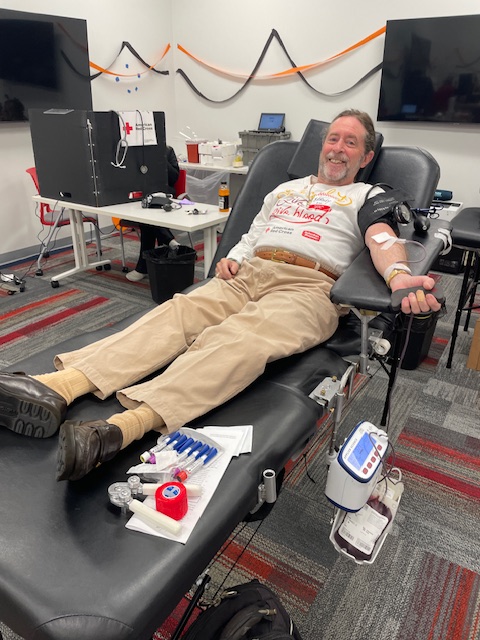
If you can donate it, Mary Dorst has probably given it. Hair? Check! Blood? Check! An organ? Check! 

Her latest donation was giving plasma at the Red Cross Blood Donation Center in Oakland, which is something she does about every six weeks. After donating Mary, 59, says, “Physically I feel fine and emotionally I feel good. I know my donation will help anyone with a need in the hospital.”  

 As a little girl in the early 1970’s Mary regularly accompanied her father when he donated blood. “I used to sit next to him while he donated. I especially liked the juice and cookies after,” she remembers.  

Read more

Local young Red Crossers wins the Regional International Humanitarian Law Red Cross Youth Action Campaign

Paulina Munoz, lead for the winning team
Photo courtesy of Paulina Munoz.

Story by Richard Payne

Creating a successful campaign focused on International Humanitarian Law (IHL) that is fun, engaging, and educational would seem like a daunting task.  Doing it with a virtual team of high school students who never met face-to-face would seem doubly difficult.  Yet, the winning team in the 2022-2023 Northern California Coastal Region (NCCR) IHL Youth Action Campaign did just that.

In Northern California, 8 teams, comprised of nearly 40 high school students, participated in IHL training.  Each team then developed and delivered IHL awareness campaigns at their schools during the academic year. As a culmination of the campaign, a symposium was held to showcase each team’s work, the struggles they faced and the efforts they took to overcome those challenges. A panel of judges scored each campaign on a series of factors and chose the team that demonstrated the best problem-solving and leadership skills.

Razi Aftab and Paulina Munoz led the winning team, which included students from two of the region’s Red Cross chapters – the North Bay and the Heart of the Valley Chapter, covering Stockton and the surrounding area.  Because the team members lived far apart, they only met virtually in weekly calls.

Paulina believed the bond they formed was one of the team’s greatest strengths. “The best part of the campaign was being able to work as a team throughout the term. We got to know the other team members and felt connected. As a result, we were a lot more productive,” she said/

A screenshot from the Instagram account of the team, showing the activities they planned for the campaign.

In building their campaign, the team members identified that their peers had limited knowledge of the Red Cross or International Humanitarian Law. That’s why the team felt that engaging students had to be their number one priority. 

“Attracting youth to be involved in the campaign was a challenge.  That’s why we focused on having activities that we thought our peers would enjoy as opposed to approaching this campaign from a teaching perspective,” Razi explained.

During the academic year, each team member organized and hosted events at their school around the topic of IHL. The team also created activities and events such as interactive question-based games that tested the advocate’s knowledge on IHL.

“Probably the most distinct event was our escape room,” Razi said. “We had case studies on International Humanitarian Law and asked the advocates to work through those examples. They had to review the scenarios and apply the information they had learned to come up with the best option. We had very good engagement with that!”

In summarizing their personal experiences with the campaign, Razi shared: “Our greatest takeaway was that we were able to foster a sense of community.  The program felt like a group effort rather than an academic exercise. It was voluntary and each person contributed to reaching the end goal of increasing the understanding of International Humanitarian Law.”

Paulina had similar sentiments about this experience: : “A lot of the students who participated in the campaign came into it with no idea what international humanitarian law was about. Through their participation in the campaign, they took away an understanding of IHL and the knowledge that international humanitarian law and services were more available to them than they thought. It was a great way to get them to know their community, the Red Cross, and what we stand for as a society.”

Congratulations to these incredible teams on formulating a thoughtful campaign and for spreading awareness about IHL!

Getting Blood to Babies in Need

By Alex Keilty, American Red Cross volunteer

Across the top of the box is a typed address label for a local hospital and a simple handwritten note: “Pediatric Order.” Down the side is the American Red Cross logo and the words “Human Blood.”

Volunteer Claudia Langley loads the white box into the trunk of a Red Cross van, along with the rest of the boxes packed with blood products she is delivering to four hospitals today.

As she starts the engine and types the address of the hospital into the GPS on her cell phone she says, “The sad part is there are not enough donations.”

It’s true, she’s right. Certain kinds of blood are rarer than others. For example, this pediatric order she is carrying today – blood destined for babies – must be screened for a flu-like virus called CMV that is very common and mild in adults but can be fatal to infants. Only about 15 percent of American adults have not been exposed to CMV and therefore are able to donate to newborns. Plus, blood products have a limited shelf life so there is always a need for more donations to replenish the supply.

But today, there is blood available for a tiny patient in MarinHealth Medical Center, thanks to blood donors and volunteers like Claudia, a blood transportation specialist.

Retired from a career in art direction and graphic design, Claudia has been doing this role for the Red Cross for 2.5 years. To get trained, she completed a course online and then shadowed a fellow volunteer until she felt comfortable going alone. Now she does a four-hour shift once a week by herself.

As she drives across the Richmond Bridge over San Francisco Bay she plays music on the radio – “anything but country” – and explains how her volunteer role gives her faith in the good in others.

“It makes me feel better about people in general. You run across people who are trying to help,” she says.

Half an hour after setting off from the Red Cross Oakland Blood Center, she pulls up to the front of the hospital, stacks some of the Red Cross boxes on a cart and rolls them to the lab. Clinical laboratory scientists will match the blood types of the donated blood to patients’ blood types and then give it to the doctors and nurses who are treating the babies and other patients awaiting these blood products.

Everyone she interacts with mentions how grateful they are for her efforts, including Red Cross staff, laboratory staff and even strangers in the hospital.

“Sometimes random people walk by and say thank you for doing this,” she says.

Claudia has encouraged friends and acquaintances to begin volunteering as Red Cross blood transportation specialists because of how positive her experience has been.

“It’s not strenuous or super challenging, but it’s something you can do that’s helpful,” she says. “I am thrilled with the way they treat me and the way they are organized for the drivers and deliveries.”

From Marin she will do deliveries to hospitals in Richmond, Alameda and then back to Oakland where she will hand in the keys to the van and head home before traffic gets busy.

She describes her role as “getting the blood to where it needs to be” and today she definitely delivered blood to where it needed to be: to a tiny patient waiting in hospital for life-saving treatment.

The Red Cross relies on volunteers like Claudia to ensure patients have lifesaving blood products when they need them – and more volunteers are needed. Learn more and submit a volunteer application at redcross.org/volunteertoday.

From Donor to Distribution: A trip through the blood lab

The request arrives from a local Kaiser Permanente hospital just before lunch: a patient needs platelets STAT! “Stat” means immediately; if you watch hospital dramas, you might already know that. But this is no fictional TV show, it’s a real assignment for Nataly Breisath, a Hospital Services Tech in the American Red Cross blood lab in San José.

Nataly Breisath prepares a unit of platelets. Photo by Alex Keilty/American Red Cross.

Nataly grabs a clear bag of the yellowish platelets from the agitator – a machine whose shelves slide back and forth constantly to keep the platelets full of oxygen. She packs the bag into a box bearing the Red Cross logo and marked “Rush: Keep at Room Temperature.” It will be driven to the hospital immediately.

Although the order form doesn’t say who the patient is or why they need platelets, that component of blood can be essential to surviving surgeries, fighting cancer, chronic diseases and traumatic injuries.

Is it stressful for Nataly fulfilling orders for blood products from local hospitals?

Once an order for blood products comes in to the lab, techs like Nataly Breisath carefully pack them for delivery. Photo by Alex Keilty/American Red Cross.

“There is usually some amount of pressure (and a little anxiety),” she says. “Even more so with stat orders.”

The most challenging ones are when orders for a massive transfusion protocol come into the lab – when a patient needs approximately 10 units of blood within 24 hours – which is roughly equivalent to the volume of blood in an average adult. It can be tough hearing details later on the news about a tragedy and figuring out that is what led to the transfusion. But Nataly says she is glad she can “possibly save their life and help with recovery.”

Although Nataly doesn’t meet the patients who receive the blood she prepares at the lab, she does know someone personally whose life was saved by blood donations, someone who had a “significant need after giving birth.” So Nataly knows for sure that giving blood saves lives.

Before blood can get to a hospital patient from a Red Cross lab it needs to undergo many steps:

Red blood cells are stored in special refrigerators for up to 42 days. Photo by Alex Keilty/American Red Cross.
  1. The donation: People go to a donation center to give blood.
  2. Processing: After giving blood at a local drive, it is packed on ice and taken to a blood manufacturing laboratory where it can be separated it into transfusable components, such as red blood cells, platelets and plasma.
  3. Testing: As the donation is processed, test tubes with blood samples that were taken at the time of donation go to a testing laboratory where a dozen tests are performed to determine the donor’s blood type and check for infectious diseases. These results are transferred to the processing center. If any diseases are found, the donor will be notified and the blood is discarded.
  4. Storage: Once testing is complete, the processed donation will be labelled and stored. Red cells are stored in special refrigerators for up to 42 days; platelets are stored at room temperature for up to five days while being continuously agitated to prevent them from clumping together; and plasma can be stored in freezers for up to one year.
  5. Distribution: Hospitals keep some blood products on their shelves, but the Red Cross is on standby to replenish those supplies and respond in case of an emergency.

Learn more about the blood donation journey: https://www.redcrossblood.org/donate-blood/blood-donation-process/what-happens-to-donated-blood.html

Story, reporting and photos by Alex Keilty

California Storms Response: Stories of the Helpers

By Alex Keilty/American Red Cross 

Hundreds of American Red Cross disaster workers are in California, helping people impacted by this two-week stretch of back-to-back severe weather.

Lunch is served, thanks to Red Cross husband-and-wife volunteer team Lillian and Jeff!

The relentless storms have caused flooding, landslides, power outages, severe damage to roadways and numerous evacuations from one end of the state to the other. Almost 470 trained Red Cross disaster workers are helping people in California. Here are some of their stories.

“We enjoy having different scenery from our retired life,” says Lillian, who is serving meals with her husband at the Red Cross shelter in San José that was opened in response to flooding in the area.

“We don’t like sitting around,” says Jeff, and so they volunteer together here and also deliver blood donations to hospitals three days per week for the Red Cross.

“Lots of listening.”

That is what Gale, a retired Nurse, says is a big part of her day as an American Red Cross disaster health services volunteer in San José.

“I am helping people by listening, or helping them get lost medications, helping them get a cane or a walker,” says Gale.

“They want to know that somebody is here to support them.”

Gail Carli, San Mateo Volunteer

“This is my first rodeo,” says American Red Cross volunteer Fernando. It’s his first time volunteering at a shelter set up in response to flooding in San José. 

“I am impressed by how many people are willing to volunteer from other states, to come out from their homes and help us in California,” he says. 

Fernando is part of a team of volunteers from across America who are providing beds and meals to people impacted by flooding.

Red Cross volunteer, Anthony, from West Virginia

“When I go home I lock myself in the house to decompress and think about what I have been through,” Anthony says, of how he deals with the hardest parts of volunteering in disaster areas. 

Anthony has experienced the emotional ups and downs of being an American Red Cross volunteer numerous times, helping in shelters and assessing damage to people’s homes after disasters. 

Anthony flew into San José this week from West Virginia to help at a shelter at Seven Trees Community Center for people who have been affected by flooding. 

But it’s not all tough times as a volunteer. The best parts include travel to new places, sightseeing when off duty and visiting friends in other cities, according to Anthony. 

“I jam in some fun every time,” he says. 

After Lisa finishes her shift as a Disaster Health Services volunteer for the American Red Cross, she will catch a few good hours of sleep and then wake up at 4:30 am to get to her day job as a Registered Nurse in a hospital caring for children after surgery. 
 
How does she do it all? 
 
“I just figure out how to juggle it because it’s important to me,” she says. “These people are in an incredibly challenging situation,” she says about the residents seeking refuge from flooding across California.

The Red Cross relies on people like Lillian, Jeff, Gail, Fernado, Anthony and hundreds more volunteers who offer shelter and compassion to people affected by disasters please visit redcross.org/volunteer.

« Older Entries Recent Entries »