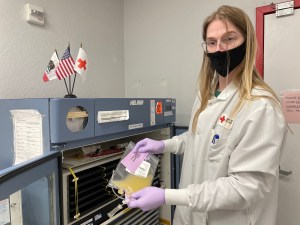
The request arrives from a local Kaiser Permanente hospital just before lunch: a patient needs platelets STAT! “Stat” means immediately; if you watch hospital dramas, you might already know that. But this is no fictional TV show, it’s a real assignment for Nataly Breisath, a Hospital Services Tech in the American Red Cross blood lab in San José.
Nataly Breisath prepares a unit of platelets. Photo by Alex Keilty/American Red Cross.
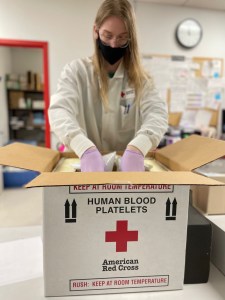
Nataly grabs a clear bag of the yellowish platelets from the agitator – a machine whose shelves slide back and forth constantly to keep the platelets full of oxygen. She packs the bag into a box bearing the Red Cross logo and marked “Rush: Keep at Room Temperature.” It will be driven to the hospital immediately.
Although the order form doesn’t say who the patient is or why they need platelets, that component of blood can be essential to surviving surgeries, fighting cancer, chronic diseases and traumatic injuries.
Is it stressful for Nataly fulfilling orders for blood products from local hospitals?
Once an order for blood products comes in to the lab, techs like Nataly Breisath carefully pack them for delivery. Photo by Alex Keilty/American Red Cross.
“There is usually some amount of pressure (and a little anxiety),” she says. “Even more so with stat orders.”
The most challenging ones are when orders for a massive transfusion protocol come into the lab – when a patient needs approximately 10 units of blood within 24 hours – which is roughly equivalent to the volume of blood in an average adult. It can be tough hearing details later on the news about a tragedy and figuring out that is what led to the transfusion. But Nataly says she is glad she can “possibly save their life and help with recovery.”
Although Nataly doesn’t meet the patients who receive the blood she prepares at the lab, she does know someone personally whose life was saved by blood donations, someone who had a “significant need after giving birth.” So Nataly knows for sure that giving blood saves lives.
Before blood can get to a hospital patient from a Red Cross lab it needs to undergo many steps:
Red blood cells are stored in special refrigerators for up to 42 days. Photo by Alex Keilty/American Red Cross.
The donation: People go to a donation center to give blood.
Processing: After giving blood at a local drive, it is packed on ice and taken to a blood manufacturing laboratory where it can be separated it into transfusable components, such as red blood cells, platelets and plasma.
Testing: As the donation is processed, test tubes with blood samples that were taken at the time of donation go to a testing laboratory where a dozen tests are performed to determine the donor’s blood type and check for infectious diseases. These results are transferred to the processing center. If any diseases are found, the donor will be notified and the blood is discarded.
Storage: Once testing is complete, the processed donation will be labelled and stored. Red cells are stored in special refrigerators for up to 42 days; platelets are stored at room temperature for up to five days while being continuously agitated to prevent them from clumping together; and plasma can be stored in freezers for up to one year.
Distribution: Hospitals keep some blood products on their shelves, but the Red Cross is on standby to replenish those supplies and respond in case of an emergency.
Story and photos by Alex Keilty/American Red Cross
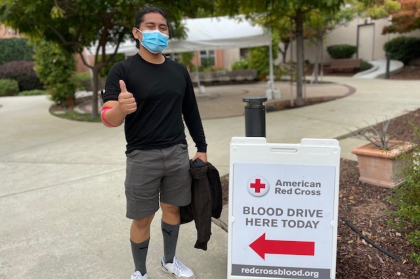
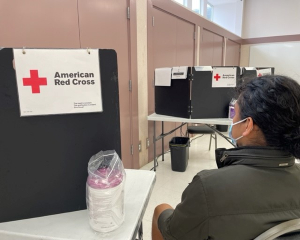
Do you want to give blood but don’t know how? Are you curious about donating blood but aren’t sure what is involved? Join Emmanuel as he goes through the five simple steps of donating whole blood.
1. Book it
The best way to make an appointment is on the American Red Cross Blood Donor app. That is how Emmanuel made his appointment the day before. “It’s too easy with the app,” he says.
You can also make an appointment online at redcrossblood.org or by calling 1-800-RED CROSS.
Pro tip: “Hydrate the day before your appointment,” says Eric Magalued, Team Supervisor at the San Fransisco Blood Center. “The day of the donation: EAT! Have something in your stomach.” Eric has been taking blood donations at the Red Cross for five years. He knows that drinking lots of water the day before and eating before you donate will lesson the chances you will feel dizzy.
2. Check in
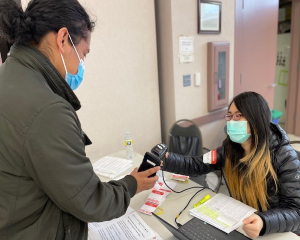
The Blood Donor Ambassador at the front desk asks for your donor card and identification (such as a driver’s license). They scan the QR code on your phone if you have a RapidPass. The Ambassador also gives you some material to read about donating blood.
Pro tip: “Complete the RapidPass,” says Eric. Donors can save time by completing a RapidPass which allows them to complete the pre-donation reading and health history questionnaire online, on the day of the donation, from a mobile device or computer.
3. Health history
Complete a private and confidential questionnaire with a trained technician in a separate room or a cubicle. The questionnaire covers topics like travel, medications and health.
The technician gives you a brief physical exam, checking your vital signs, blood pressure, temperature and pulse. They also look at your arm veins to see if they appear suitable for donation and prick your finger for a drop of blood to check your hemoglobin levels.
4. Give blood
Lay down on a reclining chair in the blood collection area and a Phlebotomist will disinfect your inner elbow and insert a brand new, sterile needle there. The needle will draw blood through a tube and into a collection bag. Once the bag is full for a whole blood donation – which is one pint in about 10 minutes – the Phlebotomist will remove the needle and bandage your arm. Other types of donations, like plasma, platelets and Power Red can take up to two hours to complete.
Many people wonder if the needle will hurt. The Red Cross recommends you pinch the fleshy underside of your arm to experience a similar feeling. Emmanuel agrees with that description. He says, “It feels like a pinch, just a split-second pinch.”
Pro tip: If you feel faint, Eric recommends squeezing your legs together to force the blood from your legs back to your heart. Tell the Phlebotomist you are feeling dizzy and then cross your legs, squeeze your inner thigh and stomach muscles, stretch your ankles and hold for five seconds. Repeat five times then switch legs.
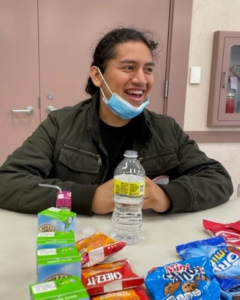
5. Snack time
Remain for 10 to 15 minutes longer to ensure you are feeling well after your donation. Get refreshed with a free snack and a drink.
6. Bonus!
Please don’t forget to make your next donation appointment on the app before you leave.
Emmanuel will be back for sure. He says, “It’s a wonder to think the blood is going to someone who I will never meet, but it’s going to help them.”
Thank you to blood donors like Emmanuel who show up to provide life-saving blood!
“I ran out of my house with slippers – that’s everything,” says Minh Tran. “I had nothing the next day.”
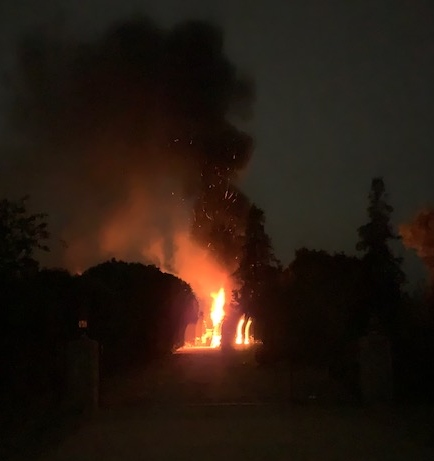
On a night in November 2019, a fire spread from Minh’s fireplace to engulf his home in Gilroy. While his family made it out alive, the house was totally destroyed.
Minh knows how close he came to losing his family and credits the house’s smoke alarms for saving their lives. “Without the alarm we might be dead,” he says.
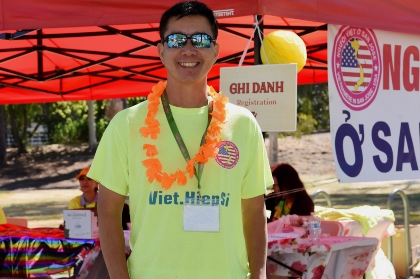
Now as an American Red Cross Community Volunteer Leader, Minh is determined to raise awareness of the need to be prepared for home fires and other disasters.
“In this area we have earthquakes, wildfires, flooding, home fires, power outages,” Minh says. “From my experience of the fire, I know the need to be better prepared.”
Minh’s advice? Install working smoke alarms, make sure to have adequate home insurance, and keep a disaster kit ready to go.
“Everybody should have a disaster kit in the home – water and food for three days – so when disaster hits they can grab that bag and run,” says Minh.
Joining the Red Cross last year, he has been acting as a liaison with the Vietnamese community. Minh came to San José from Vietnam 28 years ago to reunite with his family and live in this area since.
This year, he helped recruit volunteers from his community for Sound the Alarm, a program of the Red Cross to provide home fire safety education and install free smoke alarms in local homes.
“Volunteering is fun and fulfilling,” he says. And he recommends more people from the Vietnamese community join him in furthering the Red Cross mission.
To find out more about volunteering for the Red Cross, please visit redcross.org.
The Volunteer of the Year Award is the highest honor a volunteer can achieve within our chapters, awarded annually to the individuals who best exemplify the spirit of volunteerism.
The most recent awardees have contributed significantly to the American Red Cross across all our lines of service and worked alongside staff and other volunteers in multiple roles.
Their contributions have enabled the Red Cross to fulfill our mission to the community throughout the region. We proudly present:
Cindy Leung Bay Area Chapter Alameda County
Cindy has been part of the Community Partnership outreach program in Alameda County since 2020.
Her leadership has made the program a model for similar initiatives across the region. Her professionalism and dedication has allowed the Red Cross to reengage with multiple key partners while developing new relationships.
Cindy is a passionate volunteer who believes that “we can only fulfill our mission as a team and as a community.”
“I’m motivated by the incredible selflessness and dedication of other Red Cross volunteers, the staff and our partners who all drive towards disasters instead of away from them. With climate change, I see more and more human suffering and displacement in our future, and there will be even greater need for our services, before, during and after emergencies.”
Suzanne Garrett Bay Area Chapter Contra Costa County
Red Crosser extraordinaire Suzanne Garrett was honored for her service, dedication and time as a large-scale disaster responder and as a Disaster Action Team member. She’s held several key roles in Contra Costa County, including Disaster Chair, Disaster Action Team Lead, Duty Officer and Caseworker.
She also serves as our county Program Lead for The Pillowcase Project and has kept the program thriving in Contra Costa County, even through the challenging period of the COVID-19 pandemic.
“I want to thank all the many volunteers I have the pleasure to serve with, in Contra Costa and also throughout (our region.) You have made me feel like part of a true family where we all have a common purpose – Sleeves Up, Hearts Open, All In.” Ann Bennett Young Central Coast Chapter Santa Cruz County
Since joining the Red Cross, Ann has supported blood drives as a Donor Ambassador and as a blood drive coordinator.
She has also been an advocate and champion of inclusion, belonging, equity, and access, and has presented on cultural intelligence on multiple occasions within our region and to regions across the U.S.
Ann has also assisted Disaster Cycle Services, working with community partners and residents to ensure they are prepared to respond to disasters.
“Volunteering with the Red Cross allows me to spend time with people who know that they can make a difference for those around them. Problem-solving and meeting needs become so much more meaningful in a context where others can benefit directly. Additionally, I learn so much and am always able to strengthen my skills by taking on new and different challenges.”
Alisa Zhou North Bay Chapter Marin County
Alisa is a kind and passionate volunteer, and a wonderful leader for her chapter’s Youth Executive Board. From her position on the North Bay Board of Directors, Alisa was inspired to create a storybook that highlights Red Cross volunteers around the world. In addition to her storybook project, Alisa is always thinking of new ideas to engage chapter youth volunteers and promote Red Cross Clubs.
Furthermore, she has invited notable guest speakers to events that allow high school students to learn about the organization’s impact.
“I’m blessed to have found a family among the Red Cross community and look forward to continuing to grow — both personally and professionally — together. The Red Cross community is one that is so special…(t)his organization truly bridges the line between friends and colleagues,” she said.
Matthew Tsai Silicon Valley Chapter Santa Clara County
With his determination to serve communities impacted by wildfires, Matthew became an effective advocate for expanding youth engagement in disaster response within our region.
He was the first youth volunteer from our region to be deployed in the staffing function, specifically the Disaster Event Based Volunteer team.
In this role, Matthew supported community members who graciously raised their hands to join our wildfire response. He hosted new volunteer welcome sessions, managed the regional volunteer shift tool, and helped fill open shifts, all while attending school during the day.
“I am continually inspired by how the collective power of our organization enables us to respond to major disasters and help people across the globe.”
Stuart Chessen knows the value of preparedness, but also the power of helping people in their darkest moments.
Photo courtesy of Stuart Chessen
“I’ve always been one willing to help,” he says. “I like to talk and listen to people when they’re having a problem. You may help them further along by listening to what their problems are and I am good at listening.”
As the Specialty Vehicle Lead for the American Red Cross Pacific Division, Stuart oversees the maintenance of Emergency Response Vehicles, or ERVs, Mission Ready Vehicles and sheltering trailers. He also leads specialty vehicle driver training, getting both the fleet and people ready to respond and reach communities in times of need. He was recently honored with the Clara Barton Award for Meritorious Volunteer Leadership for the Silicon Valley Chapter of the Red Cross. This is the highest honor of volunteer achievement at the chapter level, highlighting the significant contributions of someone who serves in a series of leadership positions held over a period of years.
Stuart was an active volunteer in his community for many years before he joined the Red Cross in 2009. When asked about what it’s like being a Red Crosser, he responds humbly, “That is our mission in action. I like the way we all work together to help people. We are there to ease some of their pain in difficult situations, where they just don’t know which way to go because their world’s been turned upside down.”
Stuart Chessen in an Emergency Response Vehicle
Stuart has deployed to disaster responses multiple times, both throughout Northern California and nationwide; he even crossed the country to New York as an ERV driver after Hurricane Sandy in 2012.
“We took the vehicle here in San Jose and drove it all the way to the East Coast. We had a small delay in Pennsylvania avoiding bad weather and we reached our destination on Long Island after five days. We did mobile feeding around the neighborhoods where people had no gas or power. They were in cold homes, waiting for us to arrive with a hot meal.”
On the preparedness side of Stuart’s Red Cross contributions, his background as a First Aid & CPR instructor makes him an excellent Be Red Cross Ready presenter and he enjoys teaching disaster preparedness in communities across Santa Clara County. In addition to his many roles, Stuart also works as a trainer and coach for Logistics and Disaster Action Team members, recovery caseworkers, ERV drivers and new volunteers.
Stuart is an extremely dedicated volunteer who wears many hats within the Silicon Valley Chapter and the region. He exemplifies the Red Cross values of compassion, collaboration, creativity, credibility, and commitment. Congratulations on this well-deserved award, Stuart, and for all you do on behalf of the Red Cross.
By Martin Gagliano, Alex Keilty, Jenny Arrieta & Marcia Antipa
Photo by Jenny Arrieta/American Red Cross
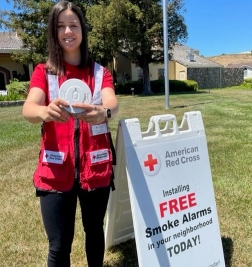
Home fires claim seven lives every day in the U.S. and remain one of the most frequent disasters across the region — but having working smoke alarms can cut the risk of death by half. That’s why over three weekends in May, American Red Cross Northern California Coastal Region volunteers and partners installed 1,217 free smoke alarms and made 450 homes safer as part of the Sound the Alarm program.
Launched in October 2014, the Red Cross Home Fire Campaign aims to prevent deaths and injuries from home fires. Sound the Alarm is a critical part of this campaign. Working with local fire departments and other community partners, Red Cross volunteers visit high-risk neighborhoods, install free smoke alarms and provide residents with safety education on how to prevent home fires, what to do if a fire starts and how to create an evacuation plan.
“Sound the Alarm is a meaningful way to be part of a larger movement while directly helping local families,” said Ana Romero, Red Cross Regional Preparedness Manager. “In just one day, our teams could help save a neighbor’s life.”
Richmond, Calif. 05.07.22. Photo by Brenda Dawson Dove/American Red Cross
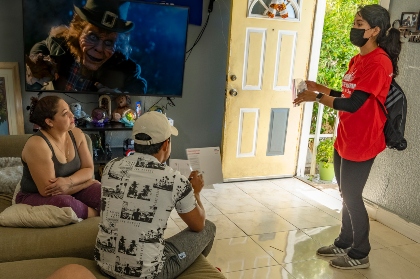
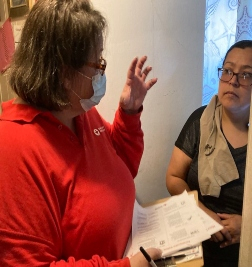
Isabel Oliva and Julio Hernandez are two of many Richmond residents who received a visit from Red Cross volunteers and the Richmond Fire Department on a Saturday morning in early May.
With the help of local volunteer Yvette Cuellar, Isabel and Julio learned how to prevent home fires and create an evacuation plan to keep their family safe.
Volunteers like Yvette are the heart and soul of this lifesaving program. After four successful Sound the Alarm events across the Bay Area Chapter in May, 396 free smoke alarms were installed, making 132 homes and 392 residents safer in Richmond, Oakland, San Bruno and San Francisco.
Oakland, Calif. 05.14.22. Photo by Kane Wong/American Red Cross
Novato, Calif. 05.21.22 – Photo by Marcia Antipa/American Red Cross
Marin County sisters Angel and Alisa Zhou are two of the dozen Red Cross volunteers who gifted their time to help install smoke alarms and share safety information at the Novato Sound the Alarm event on May 21 in the North Bay Chapter.
“It’s important that for their own safety, and the safety of the children as well, that there are alarms installed,” Angel said.
Alisa chimed in, “It was so much fun meeting these people and getting to know more about our local community.”
Across the chapter in May, Red Crossers made 118 homes and 251 residents of Santa Rosa, Fairfield and Novato safer by installing 270 free smoke alarms.
Fairfield, Calif. 05.14.22 – Video produced by Nanette Shamieh/American Red Cross
Las Lomas, Calif. 05.14.22. Photo by Jenny Arrieta/American Red Cross
Las Lomas, Calif. 05.14.22. Photo by Jenny Arrieta/American Red Cross
On May 14, Red Cross volunteers, local Seaside High School Students and partners from the Monterey County Fire Department came together on a bright, sunny morning in Las Lomas, Calif.
After briefings by the Fire Department, Red Cross Disaster Program Manager Patsy Gasca, and remarks by Monterey County Supervisor Phillips, the teams spread out into the neighborhood to install free smoke alarms and share home fire safety information.
During two weekends of Sound the Alarm events in the Central Coast Chapter, 78 homes and 339 residents from Las Lomas and Watsonville were made safer with the installation of 229 free smoke alarms by our volunteers and partners.
Modesto, Calif. 05.14.22. Photo by Martin Gagliano/American Red Cross
The Heart of the Valley Chapter had a busy Saturday morning on May 14 when Red Cross volunteers and staff gathered at the Modesto Mobile Home Park for a Sound the Alarm event alongside the Modesto Fire Department and local community partners.
In this community, Red Crossers, including long-time volunteer Tracey Singh, visited 23 homes and installed 48 free smoke alarms. Tracey is an experienced volunteer who enjoys helping equip residents like Martha Guerrero with the knowledge needed to keep her family safe in event of a home fire.
Martha is one of the 89Modesto residents that was provided with safety information and had free smoke alarms installed in their home during this Sound the Alarm event.
“I dealt with people who have been through fires or floods in their homes and these fires are really fast,” said German Barajas, who used to work at a restoration company. “With a plan in hand already, everyone gets out safely and nothing really bad happens, besides the property being damaged, and that’s always replaceable.”
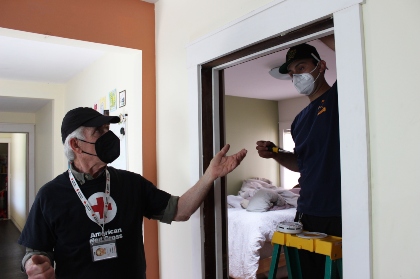
German was happy to receive a visit from Red Cross volunteers at his home in San Jose on May 21 as part of the region’s signature Sound the Alarm event. In just one day, Red Cross volunteers from the Silicon Valley Chapter installed 274 free smoke alarms, making 99 homes safer and helping 329 residents.
San Jose, Calif. 05.21.22 – Video produced by Alex Keilty/American Red Cross
“My stepdad has been a fireman for 27 years, so we have always talked about fire preparedness, prevention, escape plans and what to do in case of emergencies. It’s definitely been drilled into me from a young age how important these things are,” says Megan, a volunteer for the Red Cross Sound the Alarm program.
San Jose, Calif. 05.21.22 Photo by Alex Keilty/American Red Cross
Megan was one of 297 local Red Cross volunteers that helped with the Sound the Alarm events across the Northern California Coastal Region this May.
In addition to these larger Sound the Alarm events, the Red Cross will continue this work across the region throughout the year, installing free smoke alarms and conducting home fire safety educational visits with individuals and families on an appointment basis. Residents who need assistance or would like to schedule a visit with Red Cross volunteers can sign up at SoundTheAlarm.org/NorCalCoastal.
The Red Cross Home Fire Campaign has helped save at least 1,275 lives across the U.S. since its launch, including 24 lives saved right here in the Northern California Coastal Region. As part of the campaign, the Red Cross, along with partners, has installed more than 2.3 million free smoke alarms and made 982,369 households safer nationwide.
This work is made possible thanks to generous financial donations from regional partners: Pacific Gas and Electric Company; E. & J. Gallo Winery; Arista Networks; Silicon Valley Bank; and State Farm.
For a full suite of photos from the month’s events, visit the full Northern California Coastal Region album. To watch additional videos from the month’s events, visit YouTube.










 Your Red Cross Update