Many Bay Area organizations are making community service part of their annual plan by giving staff paid time to volunteer or organizing events that benefit a cause close to their employees’ hearts.
Deloitte, a professional services organization and longtime supporter of the American Red Cross, hosts an annual in-house “Impact Day”. Impact Day is Deloitte’s national annual day of service in the US, an opportunity for professionals to come together and engage in social impact efforts that reflect Deloitte’s purpose commitments to help create positive change for ourselves, each other and our community, and—together—drive progress toward a more equitable and sustainable future for all.
On Friday June 7th, Deloitte professionals, nonprofit relationships, and communities connected in over 1,200 social impact projects across more than 100 US cities to drive social and economic prosperity in the communities where they live and work. This year’s Impact Day took a unique approach when Deloitte’s local staff was asked to troubleshoot a real issue: the difficulty of recruiting and retaining volunteers to transport donated blood to hospitals in the San Francisco area.
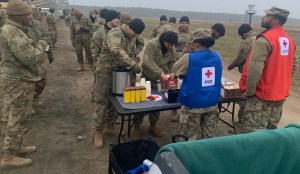
The holiday season can be a tough time for those who are away from home. For U.S. military members and their families stationed at an international military base, this feeling can be particularly strong. Aerial Chen, Service to the Armed Forces specialist for the Northern California Coastal Region, has been deployed to Poland since July 2024 to support the Red Cross mission and bring a sense of home and warmth to the service members on base.
Aerial and volunteers from the morale team coordinate several activities year-round but get especially creative around the holidays. They are excited to organize holiday traditions, including decorating Santa hats, undertaking a holiday cooking challenge, baking holiday cookies from scratch, performing surprise caroling for the troops, building gingerbread houses, and more.
“For me, this holiday [season] reminds me to be grateful,” Aerial stated. “I am currently grateful for the warm weather, delicious food, and a supportive network of family, friends, and colleagues back home in California. I am especially grateful for the care packages that folks from our Red Cross teams and staff had been sending me as it truly helps to keep me motivated in supporting our service members.”
Photo Courtesy of Aerial Chen
This particular deployment has challenges like no other for Red Crossers and service members alike. From experiencing sunset at 3 p.m., lacking access to a proper kitchen to cook, or being away from loved ones for a long time, these unique moments can be difficult. “To ease these hardships, the Red Cross has helped by facilitating fun morale events every day to keep people’s spirits up, providing cooking equipment that can be used in the Morale Welfare and Recreation tent, and offering free stamps and cards to send home to loved ones,” Aerial explained.
Service members are always encouraged to volunteer with the Red Cross. “They can recruit other volunteers, brainstorm and facilitate morale events, or keep the respite room clean and stocked with snacks, hygiene supplies, and coffee, among many other activities,” Aerial commented.
Photo Courtesy of Aerial Chen
As a thank you note for Aerial and her amazing team, Sergeant Daniel Sotoluna shared a story that surely portrays the Red Cross mission in action: “It was a dark and cloudy day. We had been firing tanks and enduring the cold all day, and night was fast approaching. As we sat there in the cold huddled up like penguins, the wind howled and rushed past feeling sharp like a knife. As we started to go quiet, taking a break for a couple of hours, the Red Cross showed up like an angel coming to help us fight the cold,” he said. “Morale picked up quickly within the companies of 2-12 and even after enduring such harsh cold, soldiers were able to smile and ran towards the Red Cross. Not only was hot chocolate and coffee provided which warmed the soul, but they armed us with hand warmers to help us stay warmer longer during the night. With smiles on our faces and warm fluids in our bodies we prepared for the night and thanked the volunteers of the Red Cross for coming to our aid during training and the battle of the cold. Everyone appreciated how the Red Cross provided us with support and couldn’t wait to see them once again. Thank you, Red Cross.”
We are proud to be represented abroad by Aerial Chen and many other Red Crossers who dedicate their time to our humanitarian mission. Thank you for your service!
“We are so focused on responding and getting a job done, but that isn’t how you touch peoples’ lives. You do that by listening to them, talking to them, letting them tell their story and finding out what they need. Then you help them,” is a sentiment that has guided Briana Taylor, first by a career in psychology, and later by two decades of service with the American Red Cross.
Briana’s introduction to disaster response was happenstance. In her professional role in mental health, Briana had spent many years working to alleviate human suffering on an individual level, tending to the needs of her patients in their darkest hour. In 2004, Briana was vacationing in Phuket, Thailand with her family, briefly taking off her psychologist hat, when a tsunami took to the island’s shores. Six weeks later, her drive to alleviate suffering took flight on the community-level, as she returned to Thailand to support islanders in their recovery.
Shivang visited the American Red Cross National Headquarters in D.C. “When I was in D.C. for the AAPI+ Resources Group convention, I saw how dedicated everyone was. These people were volunteering their own time on top of their actual day-to-day jobs to help support AAPI+ and other resource groups. It made me feel like I was part of a family, not part of a corporation,” he said. Photo courtesy of Shivang Pasi
From holding a cybersecurity internship, to attending a compelling diversity conference in Washington D.C. to becoming an active member of a national resource group, Shivang Pasi exemplifies how one can make an impact in several ways within the American Red Cross in a short time. Shivang is one of over 275,000 American Red Cross volunteers from across the country who has engaged with the organization’s humanitarian mission, though he never expected himself to be this involved when he started.
Shivang’s journey as a Red Crosser began the summer of 2024 when he secured a cybersecurity internship with the organization’s Northern California Coastal Region, which serves more than 10 million people across 15 counties from Monterey to Sonoma. As a current fourth year student at San Jose State University, Shivang was drawn to specialize in cybersecurity because of his love for puzzle solving.
Recognizing Susan Winters, Heart of the Valley Chapter’s Clara Barton Award Winner
By Selena Nisha
Photo courtesy of Susan Winters
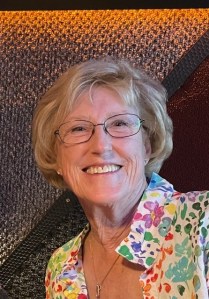
After retiring from a career as a speech therapist and school secretary, Susan Winters from Modesto, California found herself searching for new ways to stay engaged in her community. Susan has always believed in the importance of giving back. Her parents were active in community service and instilled in her the values of volunteerism and compassion towards others. This passion for service led her to the American Red Cross in 2010, and her contribution to the organization was recently recognized with the Clara Barton Award for Meritorious Leadership. Named after the founder of the Red Cross, the award recognizes a volunteer for their years of service in various leadership positions.
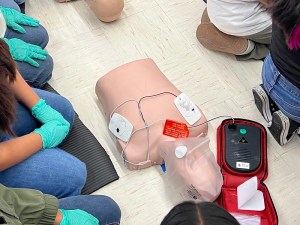
On a typical Wednesday morning, having more than one hundred eighth graders seated on the auditorium floor might not seem out of the ordinary. However, witnessing them perform synchronized CPR maneuvers while learning to save lives is impressive. On October 22, the local Red Cross Training Services Team, in partnership with the East Bay Regional Park District (EBRPD) and Dozier-Libbey Medical High School (DLMHS), hosted a record-setting youth CPR/AED certification event for nearly 350 eighth-grade students over two 90-minute sessions at Antioch’s Park Middle School.




 Your Red Cross Update