Story and Photos by Marcia Antipa, Public Affairs Volunteer
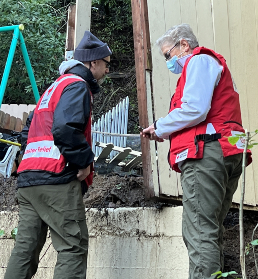
Joe Baldi and Dianna Soula inspect damaged Marin County building Photo by Marcia Antipa / American Red Cross volunteer
After weeks of heavy rain and high winds, the sun has come out again in California. However, the American Red Cross disaster response continues. More than 800 trained Red Cross volunteers from nearly all 50 states have been supporting people in the affected communities. Eighty shelters were opened during the disaster, and the Red Cross, working with community partners, distributed thousands of meals and relief items such as comfort kits and cleaning supplies. Now, as people slowly move toward recovery, volunteer Red Cross Disaster Assessment Teams are spreading out through storm-ravaged communities, taking stock of damage to homes.
“The assessment gives us information on the homes that were destroyed or had major damage,” says DA volunteer Joe Baldi of Sacramento.
Baldi and fellow volunteer Dianna Soula of Lancaster, Ohio recently visited an apartment complex in Marin County, California. During the heavy rains, a mud-soaked hillside slammed into one of the buildings, making it uninhabitable. The two walked through thick mud to view the home, then documented the damage using guidelines from the Federal Emergency Management Agency (FEMA). That information helps the Red Cross and its partner agencies provide assistance for those displaced by the disaster.
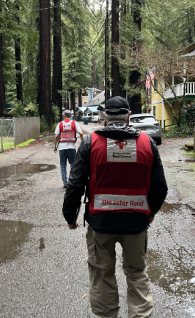
Al Gharibian and Howard Wilkens doing Disaster Assessment in Guerneville Photo by Marcia Antipa / American Red Cross
Right now, more than a dozen of Disaster Assessment teams have “boots on the ground” in California. Volunteers Howard Wilkens of Kansas City, MO and Alan Gharibian of Glendale, CA, took a preliminary Disaster Assessment tour of the Sonoma County town of Guerneville along the Russian River. After days of heavy rain, the river was swollen, muddy and threatening to crest its banks. The two men visited the Guerneville Fire Department to get information on which neighborhoods were hardest hit. Wilkens, who has deployed for the Red Cross to 30 disasters across the country in five years, explains just some of the damage they look for after a storm.
“For example, we look for water lines on the side of the house, broken joists on the roof decking, or homes where the winds have blown off the siding or the roof shingles.”
Alan Gharibian recently deployed to Hurricanes Nicole and Ian in Florida. He says the devastation and the suffering in the wake of the hurricanes was “heartbreaking, to say the least.” But he says he is happy to volunteer again, using his 37 years of experience in the insurance business to help assess the damage in California.
Ultimately, Disaster Assessment volunteers are the heart of the Red Cross mission to prevent and alleviate human suffering in the face of emergencies.
“It’s the Red Cross’s goal to assist them in any way they can,” says Dianna Soula, “to get them into a recovery state, someplace where they’re safe, have comforts and feeding, and medication that they needed, and just try to get their life back on track as quickly as we can.”
To find out how you can help those hit by the California storms, visit redcross.org.
Photos and reporting by Barbara Wood/Red Cross volunteer
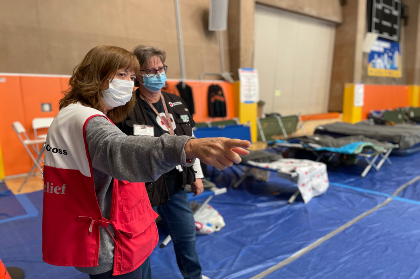
Red Cross volunteer Debbie Torres of San Mateo, California, talks to Jose Galvan Alvarez and his grandson Kingston in a Red Cross shelter. Photo by Barbara Wood/Red Cross volunteer
The Galvan Alvarez family was sound asleep in their South San Francisco apartment in the early hours of January 10 when they were jolted awake as the entire roof blew off their apartment building.
“At first we thought it was an earthquake,” Jose Galvan Alvarez said, holding his nine-month-old grandson, Kingston, in a Red Cross shelter at the San Mateo County Event Center. Water from one of the series of major storms that have been pounding California started pouring in through ceiling light fixtures, he said.
The family called the fire department, which quickly responded and referred them to the nearby Red Cross shelter that had been opened to provide refuge from the storm for all who needed it. The family arrived at about 4 a.m. and were provided supplies, such as diapers, food and toiletries, as well as a portable cot for Kingston and warm beds for the rest of the family. In the morning they had warm showers and breakfast.
“The Red Cross has been excellent,” Jose said. “I’ve got nothing but nice things to say about the Red Cross.” Jose said he had also been helped by the Red Cross years ago, when he had a fire in his apartment. Jose then excused himself to grab a broom and dustpan and clean up around his family’s cots. “The Red Cross is helping, so I can help, too,” he said.
The atmospheric rivers that pounded California for weeks, with floodwaters and damage remaining long after the storms have subsided. At one point there were as many as 100,000 people in California under evacuation orders or warnings.
Now that the skies have cleared, individuals and families are returning home to evaluate their path back towards recovery. Hundreds of Red Cross disaster workers are continuing to safely shelter those in need, deliver hot food and relief supplies to impacted neighborhoods, and provide much-needed emotional support.
For many, the road to recovery will be long – and the Red Cross will stand with survivors in the weeks and months ahead as they begin to rebuild their lives. You can help people by:
Making a financial gift to California Storms and Floods. Donations for Disaster Relief enable the Red Cross to prepare for, respond to and help people recover from disasters big and small. Visit redcross.org, call 1-800-RED CROSS, or text the word REDCROSS to 90999 to make a $10 donation.
This information was last updated on Tuesday, January 31 at 11:00 a.m.Please check back regularly for updates.
American Red Cross volunteer Diana giving an update to Shelter Supervisor Peggy at the Seven Trees shelter in San Jose. Photo by Alex Keilty / American Red Cross
As Californians continue cleaning up after the weeks of severe weather at the beginning of January, the American Red Cross is helping and will also be there in the days and weeks to come, supporting people as they move towards recovery.
This online story map offers a look at the ongoing response to the California floods. Since New Year’s eve:
Almost 800 trained Red Cross disaster workers are supporting people in California.
The Red Cross and partners have provided more than 9,300 stays in more than 80 shelters, more than 62,400 meals and snacks, and distributed more than 14,700 relief items such as comfort kits and other relief supplies.
Trained Red Cross volunteers are helping families cope during this challenging time and replacing prescription medications, eyeglasses or critical medical equipment like canes and wheelchairs.
Teams on the ground are also conducting damage assessments to determine the impact of these storms and which communities will need additional support moving forward. Preliminary damage reports indicate that of the 5879 total assessments done to date, 134 homes were either destroyed or suffered major damage.
We Need You!
While trained Red Cross volunteers and staff continue to manage the response efforts, we are looking for additional volunteers to help with disaster response and recovery activities, including feeding, supply distribution, clean-up kit building and more. Apply online to become a Red Cross volunteer by visiting tinyurl.com/ARC2023FloodsApplication if you are interested in helping with this response or responses like this in the future.
Blood During Disasters
The Red Cross is working to maintain a stable blood supply amid the threat of storms and winter weather across the country, as severe weather often causes widespread blood drive cancellations. Where it is safe to do so, we encourage donors to make and keep blood donation appointments by using the Red Cross Blood Donor App, visiting RedCrossBlood.org or calling 1-800-RED CROSS (1-800-733-2767).
Help Those in Need
You can help people affected by disasters like floods, fires and countless other crises by making a gift to Red Cross Disaster Relief.Donations for Disaster Relief enable the Red Cross to prepare for, respond to and help people recover from disasters big and small. Visit redcross.org, call 1-800-RED CROSS, or text the word REDCROSS to 90999 to make a $10 donation..
Stay Up-to-Date on Social Media
Updated information on the Red Cross response to this storm, and preparedness information is continually updated on regional social media channels:
Story and photos by Alex Keilty/American Red Cross
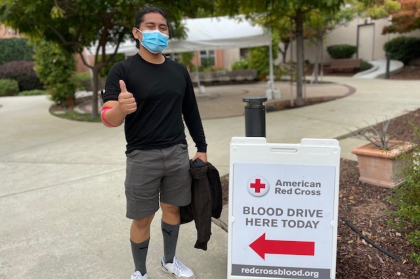
Do you want to give blood but don’t know how? Are you curious about donating blood but aren’t sure what is involved? Join Emmanuel as he goes through the five simple steps of donating whole blood.
1. Book it
The best way to make an appointment is on the American Red Cross Blood Donor app. That is how Emmanuel made his appointment the day before. “It’s too easy with the app,” he says.
You can also make an appointment online at redcrossblood.org or by calling 1-800-RED CROSS.
Pro tip: “Hydrate the day before your appointment,” says Eric Magalued, Team Supervisor at the San Fransisco Blood Center. “The day of the donation: EAT! Have something in your stomach.” Eric has been taking blood donations at the Red Cross for five years. He knows that drinking lots of water the day before and eating before you donate will lesson the chances you will feel dizzy.
2. Check in
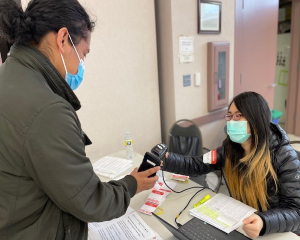
The Blood Donor Ambassador at the front desk asks for your donor card and identification (such as a driver’s license). They scan the QR code on your phone if you have a RapidPass. The Ambassador also gives you some material to read about donating blood.
Pro tip: “Complete the RapidPass,” says Eric. Donors can save time by completing a RapidPass which allows them to complete the pre-donation reading and health history questionnaire online, on the day of the donation, from a mobile device or computer.
3. Health history
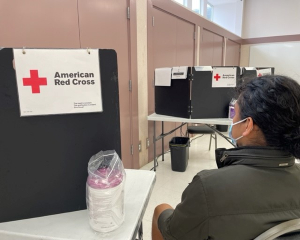
Complete a private and confidential questionnaire with a trained technician in a separate room or a cubicle. The questionnaire covers topics like travel, medications and health.
The technician gives you a brief physical exam, checking your vital signs, blood pressure, temperature and pulse. They also look at your arm veins to see if they appear suitable for donation and prick your finger for a drop of blood to check your hemoglobin levels.
4. Give blood
Lay down on a reclining chair in the blood collection area and a Phlebotomist will disinfect your inner elbow and insert a brand new, sterile needle there. The needle will draw blood through a tube and into a collection bag. Once the bag is full for a whole blood donation – which is one pint in about 10 minutes – the Phlebotomist will remove the needle and bandage your arm. Other types of donations, like plasma, platelets and Power Red can take up to two hours to complete.
Many people wonder if the needle will hurt. The Red Cross recommends you pinch the fleshy underside of your arm to experience a similar feeling. Emmanuel agrees with that description. He says, “It feels like a pinch, just a split-second pinch.”
Pro tip: If you feel faint, Eric recommends squeezing your legs together to force the blood from your legs back to your heart. Tell the Phlebotomist you are feeling dizzy and then cross your legs, squeeze your inner thigh and stomach muscles, stretch your ankles and hold for five seconds. Repeat five times then switch legs.
5. Snack time
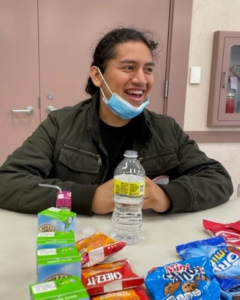
Remain for 10 to 15 minutes longer to ensure you are feeling well after your donation. Get refreshed with a free snack and a drink.
6. Bonus!
Please don’t forget to make your next donation appointment on the app before you leave.
Emmanuel will be back for sure. He says, “It’s a wonder to think the blood is going to someone who I will never meet, but it’s going to help them.”
Thank you to blood donors like Emmanuel who show up to provide life-saving blood!
A veteran’s transition to civilian life can be tough and sometimes it becomes hard to find a purpose in serving after leaving the U.S. military. But for many veterans, volunteering and responding to community needs is a way to share comradery and apply their unique skills and talents to the needs of their local neighborhood.
On this Veterans Day, we’d like to recognize all the Red Crossers who continue their service after service across the Northern California Coastal Region.
We are honored to have all of them on our team – across counties and lines of service, and we proudly present some of their unique stories:
Daniella Zapata Regional Business Operations Coordinator
Photo courtesy of Daniela Zapata
At 17 years old, I enlisted in the United States Marine Corps to serve our country. It was my first experience doing something for the greater good and it taught me to think beyond myself and to look out for those around me. On my first day of bootcamp, I was introduced to the Red Cross and its services to our armed forces. A Red Cross card was handed to me to fill out with all the contact information for my unit. This tool would be used by my family if they needed to contact me. The Red Cross would quickly pass on information in case of emergency. Military training was intense, but I had the comfort of knowing that my family could find me if needed.
While in the fleet, I had the pleasure of working as an embark and logistics specialist where I learned valuable skills that continued to be of use after my military service – discipline, hard work and the importance of integrity.
In 2005 Hurricanes Katrina and Rita hit our nation and I felt an overwhelming need to help. The news showed immense devastation and volunteers from the Red Cross were already on-site providing comfort and relief. I immediately checked in with our local Red Cross office, which was buzzing with community members taking various trainings, ready to lend a hand. This was my calling; I knew my experience moving resources in the Marine Corps could be used to help with disaster relief efforts. Within a few weeks, I had taken all the classes needed and was deployed to Texas. The service I was able to provide alongside thousands of other volunteers was immeasurable. We looked into the eyes of those who lost so much and through generous donations from across the nation, we were able to provide hope.
Those moments sparked something in me that has continued to fuel my passion for service through the Red Cross for the past 17 years. Every day I get to work alongside community members who volunteer their time and talents to support our military personnel, assist families after a disaster, provide lifesaving blood, and so much more. I am honored to have the opportunity to continue serving our beloved country.
Semper Fidelis!
Diane St. Denis Pacific Division Disaster Health Services Advisor
Photo courtesy of Diane St. Denis
I spent 3 years in the Navy during the Vietnam War, and it was there that I realized how little I knew about the world. I also saw discrimination and limitations on what I, as a young woman, could expect as far as deployment opportunities, but also made lifelong friends, saw the Blue Angels up close and personal, and met the love of my life, my partner in crime, my Marine, my husband.
As a naive 18-year-old (who thought I was very worldly), I joined the Navy with no idea what to expect – I only knew that I wasn’t ready to do the college thing. After a battery of tests, I was told I was going to Air Traffic Controller “A” school after bootcamp.
I was promoted to AC3, learned how to handle a stressful but exciting job, and how to live on a minuscule paycheck. To this day, Kraft Macaroni & Cheese is a meal near and dear to my heart. All of the experiences I had in the Navy molded much of my future and made me realize how blessed I am to have learned the value of service to others.
After my discharge from the Navy and getting married, I found a job as a police dispatcher, utilizing the skills I learned in my time in service, but I finally recognized that my life was really meant to be in healthcare. Parenthood delayed my nursing education, and it took many years before I finally obtained my nursing license, but it was worth the wait. Nursing is what I was meant to do all along. I joined the Red Cross while I was in Nursing School, and I haven’t looked back.
I have seen many changes in Red Cross over the years. My training in the Navy taught me to deal with adversity, change direction on a dime, value friendships, the importance of organization, and believing in the mission.
I eventually became the Disaster Health Services Lead for my Red Cross Chapter and was later appointed the advisor for the Pacific Division. At some point, I will relinquish the advisor role, and when I do, hope to have more time so that I can become more active in Service to the Armed Forces and serve our military community.
Reflecting on early my life, I learned the value of giving to others from my parents, particularly my mother. The Red Cross allowed me to utilize my nursing skills while helping others in need.
I have devoted myself to a life of service, including volunteering for organizations outside the Red Cross. It all started by serving my country and I continue to do that through my service in the Red Cross. And, like most of us that volunteer, I couldn’t do it without the support of my family. Their support of the mission and my passion allow me to do all that I do.
Kathleen Lenihan Services to the Armed Force Volunteer Partner
Photo courtesy of Kathleen Lenihan
I joined the Army Nurse program in 1970 when I was still in nursing school. After graduation I was lucky to be stationed stateside at Fort Ord, California, for a year and then at Letterman Army Medical Center in San Francisco. I was the first army nurse to have a baby and stay on active duty at the Letterman Army Medical Center.
After I was released from active duty, I joined the Army Reserve and provided medical support to the active duty who were in training. We also set up a combat support hospital in various areas of the U.S. and provided medical care for those who were ill or injured during their time in the field.
While I was on one of these training missions, we had a briefing from a Red Cross volunteer who gave us the number for the Hero Care Center to give to our family members. My son was 17 at the time and staying home alone, having this number was a relief. If he needed to get a message to me, he was able to do it through the Hero Care Center, so in my personal experience, it does work.
One of the highlights of my Army Reserve training was going on a medical mission to a small town in the northern Andes mountains, called Cajamarca (Perú), at 9,000ft height. We went there for two and a half weeks and provided medical care to the local residents. We also brought along our veterinary team to provide veterinary care to the animals. Most people don’t realize the number of medical missions that the U.S. military provides throughout the years to countries that have very little medical or veterinary care.
Kathleen is now the Volunteer Partner for the region’s Service to the Armed Forces team, she is a Red Cross representative at the VA Hospital in San Francisco, and she is a member of the Disaster Health Services team, deploying to support people affected by disasters big and small.
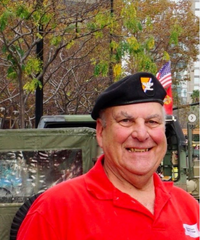
Larry Dietz Regional Public Affairs Volunteer Partner
Photo courtesy of Larry Dietz
I began my military service in September 1963 when I joined Reserve Officers Training Corps at Northeastern University, Boston. It was either ROTC or gym class, and I hated going to the gym, so it was an easy decision.
I was commissioned a 2nd Lieutenant, Military Intelligence, US Army on August 1, 1968. In April 1969 I was assigned to the 509th Radio Research Group in the Republic of Viet Nam, where my first assignment was as a Radio Research Platoon leader in support of the 1st Infantry Division in Quan Loi, Dau Tieng, and Xian.
September 1969 found me reassigned as a Communications Security (COMSEC) Officer and responsible for Crypto Facility inspections. My tour in the Republic of Viet Nam was over in April 1969 and I was released from active duty in September 1970. I served four years in the inactive Army Reserve and was discharged in September 1974.
In 1980 I decided that I wanted to go back into the Reserve and was reappointed as a Captain and commanded the 519th ASA Company, providing support to warfighters such as the Marines and the 7th Infantry Division. Subsequent assignments in the Reserve took me to Dobbins Air Force Base in Georgia.
In August 1989, I joined the Strategic Intelligence section. From July 1997 to February 1998, I served as the Deputy Commander of the Joint Information Campaign Task Force, Sarajevo, Bosnia, and I was promoted to Colonel in November 1998.
After my retirement, in April 2002, I graduated from the US Army War College. I served as a volunteer instructor for deploying personnel at Fort Hunter Liggett in December 2003 and April 2005, and was elected Honorary Colonel of the US Army in 2003, and served in that position until 2010.
In the summer of 1999, I attended a Red Cross Northern California Coast Region Training Symposium in Pebble Beach, Calif. where I was certified as a Public Affairs Associate. I volunteered sporadically until December 2016 when I was assigned as the Volunteer Partner to the Regional Communications Director.
In addition to Public Affairs, I am active in Service to the Armed Forces and serve as an International Humanitarian Law Instructor. I have deployed for the San Jose Flood, numerous wildfires and two mass casualty events.
Being a Red Crosser has certainly afforded me opportunities that I wouldn’t have had otherwise. It’s very refreshing to work for an organization that has a universal humanitarian cause. It feels that you’re actually helping others and Red Cross volunteers are genuinely nice people – they just want to help out and do good.
To learn more about how the Red Cross supports active military, veterans and their families or volunteer to work alongside them to make our communities stronger, visit redcross.org/SAF.
By Sharon J. Alfred, Red Cross, Senior Journalist Volunteer
Photo courtesy of Edmund Tang
Edmund Tang started volunteering with the American Red Cross at an early age. He was just 16 years old when he became heavily involved with the Red Cross Youth Corps. During his high school years, Tang was a dual volunteer in both Northern and Southern California regions. Then he went to the University of California – Santa Cruz.
Settling in the Northern California Coastal Red Cross Region (NCCR), Tang found out there were no formal youth programs there so he met with his Red Cross chapter and region team and AmeriCorps representatives to start official youth programs. This four-year project was one of his favorites. Tang proudly asserted that “by the time I left my position in 2021, we had a small Youth Corps in our chapter that was linked to the region’s Youth Corps.”
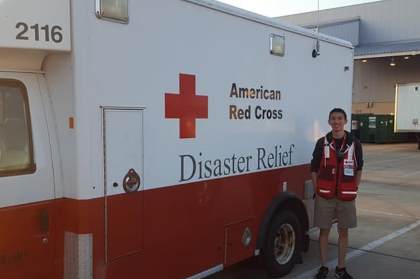
Now, Tang identifies his main volunteer region as the NCCR, though he sometimes volunteers in the Los Angeles area. He said, “I spend a lot of my other time volunteering in NCCR as a Disaster Action Team (DAT) Administrator and Information & Planning (I&P) Coordinator. I am also a medical responder, assistant station leader for the First Aid Stations team in the LA Region for the annual Rose Parade in Pasadena, CA. I deploy nationally in Disaster Health Services (DHS) as an Emergency Medical Technician (EMT) and Shelter Associate.”
Photo courtesy of Edmund Tang
Tang continues to volunteer with the Red Cross because of the valued connections he makes in the communities. Even as a busy medical student, he keeps up his Red Cross volunteer activities. “On my breaks from school, I schedule myself available to volunteer at any capacity from tabling events, chapter logistics to community events in both the LA region and NCCR, and I also spent some time virtually as a DAT Dispatcher, taking information and sending DAT responders to calls,” he remarked.
Tang plans to remain a Red Cross volunteer for a long time. He loves to hear disaster victims’ stories of recuperation, progress and recovery, such as: “I am fully recovered from the hospital”; or, “my insurance got everything handled”; or, “I finally got my house rebuilt.”









 Your Red Cross Update