Tag Archives: Regional

Red Cross Responds as Severe Winter Weather Impacts California

This information was last updated on Friday, March 24 at 9:30 a.m. Please check back regularly for updates.

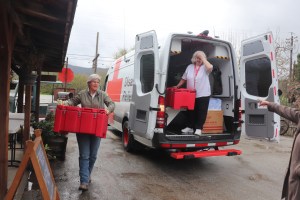
March 22, 2023. Red Cross Warehouse, Alameda, California. American Red Cross volunteers, Lisa Wright-Bishop and Vicki McNeil, load cleanup supplies to be distributed to residents affected by the California Atmospheric River Event. Photo by Jaka Vinsek/American Red Cross

Much of California continues its recovery from yet another round of intense rain and wind earlier this week.

Thursday night 732 people took refuge in 17 Red Cross and partner shelters statewide. Within our region, 530 people were supported in 11 shelters.

The American Red Cross has been helping in California since the atmospheric river onslaught began in late December of last year and is currently responding all over the state alongside local and state officials to help ensure people get the assistance they need.

For an updated map of road/lane closures, please visit the CalTrans QuickMap. Check your route before heading out!

Shelters

The following shelters are open in anticipation of forecast weather and potential for flooding. Open shelters may also be found online at redcross.org/shelter.

Monterey County

Santa Cruz County

San Joaquin County

  • Manteca Senior Center, 295 Cherry Lane, Manteca CA 95337

Stanislaus County:

  • Salvation Army, Red Shield Community Center, 1649 Las Vegas St, Modesto, CA 95358
  • Stanislaus Fairgrounds–RV Grounds Outdoor Shelter, 800 N. Broadway Ave, Turlock, CA 95380


Everyone is welcome at Red Cross shelters, and anyone affected by the extreme weather can always stop by the shelter to access Red Cross services, warm up, and contact loved ones regardless of whether or not they choose to stay overnight at the shelter.

Donating Items at Shelters

Please do not drop off items like blankets, toys, food, etc. at Red Cross shelters. We appreciate everyone’s desire to help during a disaster, but the Red Cross does not have the capacity to accept, process, clean, organize or distribute these items. We work with our partners to procure items for our shelters and ensure everyone who comes to our shelters has everything they need.

Stay Up-to-Date on Social Media

Updated information on the Red Cross response to this storm, and preparedness information is updated regularly on our regional social media channels:

Sign up to volunteer

While trained Red Cross volunteers and staff continue to manage the response efforts, we are looking for additional volunteers to help with disaster response and recovery activities. Apply online to become a Red Cross volunteer by visiting redcross.org/volunteertoday if you are interested in helping with this response or responses like this in the future.

Blood During Disasters

The Red Cross is working to maintain a stable blood supply amid the threat of storms and winter weather across the country, as severe weather often causes widespread blood drive cancellations. Where it is safe to do so, we encourage donors to make and keep blood donation appointments by using the Red Cross Blood Donor App, visiting RedCrossBlood.org or calling 1-800-RED CROSS (1-800-733-2767).

Disaster Mental Health Team: tips to improve coping skills after repeat disasters

photo by Barbara Wood / American Red Cross

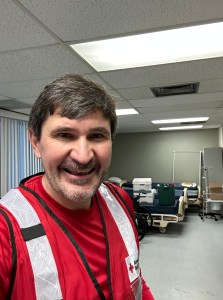
American Red Crosser Jeff Roediger has some tips for coping with the anxiety and other effects of stress caused by the series of severe atmospheric river storms (currently 11 and counting) that have slammed California this winter. 

Roediger says that events such as disasters and evacuations, especially those that occur more than once, “are mentally, physically and spiritually draining.” Such events can create a sense of loss or grief over things already lost, fear for life or safety, even hopelessness, he says.

Among the thoughts and behaviors that can appear, Roediger says, are anger, cognitive difficulties such as not being able to think clearly, racing thoughts, the desire to isolate ones self, or bad coping skills such as using drugs or alcohol or risky behavior.

Here are some of Roediger’s tips:

1  –  Keep in touch with family and friends.  
“Talk to somebody about the event. Don’t bottle it up,” Roediger, a professional counselor from South Carolina on his 30th disaster response assignment, says.

“The more we talk about it, the more we normalize it,” he says.  “It becomes part of our life and it no longer it has power over us.”  

2 -If you know someone who has suffered from a disaster Listen to what the person has to say.
”Just let them talk,” Roediger says. “People want to be heard.”  

3  – Distract yourself 
If you find yourself unable to stop thinking about the disaster, find something else to do Roediger says.  Listen to music, draw, write, go for a walk, make a gratitude list.

4 – If you have suffered a loss in a disaster, make a list of things you must do to recover.
“Let the list sit for a time and then prioritize each item. Lists help move focus to the future, not the past,” he says. 

5 – Anyone stressed by a disaster can ask to speak to a Red Cross counselor, free of charge.
The Red Cross also partners with the free SAMHSA Disaster Distress helpline, where a trained counselor is available 24 hours a day at (800) 985-5990. 

Prepare with Pedro: A fun way to build resilient and aware young students

Everyone in the family can have an active role in household safety. Prepare with Pedro and The Pillowcase Project – the two American Red Cross educational programs for kindergarten through 5th grade learners – help young students stay safe in case of an emergency.

Zeien Cheung, Red Cross Regional Preparedness Lead – Prepare with Pedro Program, posing next to
Pedro the Penguin.
Photo courtesy of Zeien Cheung

Fire experts agree that people may have as few as two minutes to safely escape a burning home before it’s too late. This short amount of time is frightening for adults and can be traumatic for children.
To help everyone in the household learn how to stay safe before, during, and after an emergency, the Red Cross has created The Pillowcase Project and Prepare with Pedro, two classroom-based programs designed to teach preparedness to students. Prepare with Pedro is designed for kindergartners through second graders, while The Pillowcase Project is geared toward third through fifth graders.

“These programs teach (students) how to act, help them understand what is happening around (them) during an emergency and give them some control over a stressful situation, even when there is not much control possible,” said Ana Romero, Regional Preparedness Manager for the Northern California Coastal Region of the red Cross.

Prepare with Pedro is a 30-to-45-minute storytelling-based presentation designed for students in kindergarten – second grade. Specially-trained Red Cross volunteers visit classrooms and introduce Pedro the Penguin to young students. Reading about Pedro’s adventures in storybooks and with the help of some training exercises, school kids can learn basic preparedness concepts like what a smoke alarm sounds like, what’s important to remember in case of a home fire, protecting themselves during an earthquake, practicing deep breathing to remain calm during an emergency, or how to talk with adults about their feelings after a stressful experience.

Romero explains that the focus of Prepare with Pedro is to build more resilient kids.

“Pedro helps children to develop stronger coping skills. They learn how to manage stress not only during emergencies, but also in their everyday life,” she said. “I was presenting the program in a local school recently when I asked the students if they think that these relaxation techniques, these coping skills, could be applied in some other challenging situations in everyday life, besides an emergency. One of them immediately raised his hand and replied, ‘when we get a vaccine shot!’ and yes, he was right. Those skills are useful in everyday life and the objective of Prepare with Pedro is to build resilient kids prepared to face any unexpected situation.”

Zeien Cheung is the Regional Preparedness Lead for the Prepare with Pedro program, and has been a Red Cross volunteer since 2018. She started her Red Cross journey as a member of the Disaster Cycle Services team helping with the response to the Napa wildfires, but then realized teaching preparedness was a better fit for her. Always passionate about teaching and working with young students, she has vast experience presenting these programs at schools in the Bay Area Chapter. “I believe in equipping young students with knowledge,” she said. “Make them aware of how important preparedness is and how useful learning these things can be.”

The most challenging aspect of presenting these programs, according to Cheung, is capturing the students’ attention. In her role, she oversees volunteers who present these programs at schools and emphasizes that being both a good narrator and able to engage with them are the keys to success.

“Prepare with Pedro is perhaps less involved than The Pillowcase Project, because the students are younger and the activities you can do with them in the classroom are different. But that doesn’t mean that can’t be fun and interactive. I have a Pedro the Penguin stuffed toy that comes with me every time I visit a classroom and the kids love it. It’s an excellent way to connect with them. They ask all kinds of questions about him – where does he live, how old he is, who are his friends – they talk with him and I talk with all of them, using those answers to complement the preparedness knowledge,” Cheung said.

After the presentation, students and their families can continue learning about emergency preparedness through the Prepare with Pedro storybooks, videos and other free resources available for digital download in English and Spanish. There is also a Pedro Fire Safety Challenge for Google Assistant and Alexa-enabled Devices.

“Storybooks and online resources make the children realize that they can have an active role in household safety. Grown-ups at home may not know or not remember how to stay safe during an emergency. We encourage young students to teach others what they learn after Pedro visits their classroom,” Cheung said.

The Red Cross has preparedness programs for all ages: Prepare with Pedro and The Pillowcase Project are for school-aged students and the Be Red Cross Ready presentation is geared toward teens and adults. You can learn more about how to stay safe during emergencies here, or you can sign up to volunteer with the Red Cross and be a preparedness presenter here.

The Heart of the Mission: Red Cross Volunteers Assess California Storm Damage

Story and Photos by Marcia Antipa, Public Affairs Volunteer

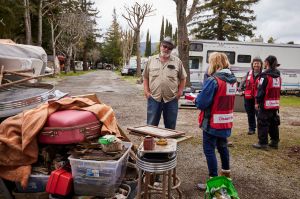
Joe Baldi and Dianna Soula inspect damaged Marin County building
Photo by Marcia Antipa / American Red Cross volunteer

After weeks of heavy rain and high winds, the sun has come out again in California. However, the American Red Cross disaster response continues. More than 800 trained Red Cross volunteers from nearly all 50 states have been supporting people in the affected communities. Eighty shelters were opened during the disaster, and the Red Cross, working with community partners, distributed thousands of meals and relief items such as comfort kits and cleaning supplies. Now, as people slowly move toward recovery, volunteer Red Cross Disaster Assessment Teams are spreading out through storm-ravaged communities, taking stock of damage to homes.

“The assessment gives us information on the homes that were destroyed or had major damage,” says DA volunteer Joe Baldi of Sacramento.

Baldi and fellow volunteer Dianna Soula of Lancaster, Ohio recently visited an apartment complex in Marin County, California.  During the heavy rains, a mud-soaked hillside slammed into one of the buildings, making it uninhabitable. The two walked through thick mud to view the home, then documented the damage using guidelines from the Federal Emergency Management Agency (FEMA). That information helps the Red Cross and its partner agencies provide assistance for those displaced by the disaster.

Al Gharibian and Howard Wilkens doing Disaster Assessment in Guerneville
Photo by Marcia Antipa /
American Red Cross

Right now, more than a dozen of Disaster Assessment teams have “boots on the ground” in California. Volunteers Howard Wilkens of Kansas City, MO and Alan Gharibian of Glendale, CA, took a preliminary Disaster Assessment tour of the Sonoma County town of Guerneville along the Russian River. After days of heavy rain, the river was swollen, muddy and threatening to crest its banks. The two men visited the Guerneville Fire Department to get information on which neighborhoods were hardest hit. Wilkens, who has deployed for the Red Cross to 30 disasters across the country in five years, explains just some of the damage they look for after a storm.

“For example, we look for water lines on the side of the house, broken joists on the roof decking, or homes where the winds have blown off the siding or the roof shingles.”

Alan Gharibian recently deployed to Hurricanes Nicole and Ian in Florida. He says the devastation and the suffering in the wake of the hurricanes was “heartbreaking, to say the least.” But he says he is happy to volunteer again, using his 37 years of experience in the insurance business to help assess the damage in California.

Ultimately, Disaster Assessment volunteers are the heart of the Red Cross mission to prevent and alleviate human suffering in the face of emergencies.

“It’s the Red Cross’s goal to assist them in any way they can,” says Dianna Soula, “to get them into a recovery state, someplace where they’re safe, have comforts and feeding, and medication that they needed, and just try to get their life back on track as quickly as we can.”

To find out how you can help those hit by the California storms, visit redcross.org.

When they needed shelter, the Red Cross was there 

Photos and reporting by Barbara Wood/Red Cross volunteer 

Red Cross volunteer Debbie Torres of San Mateo, California, talks to Jose Galvan Alvarez and his grandson Kingston in a Red Cross shelter.
Photo by Barbara Wood/Red Cross volunteer 

The Galvan Alvarez family was sound asleep in their South San Francisco apartment in the early hours of January 10 when they were jolted awake as the entire roof blew off their apartment building.  

“At first we thought it was an earthquake,” Jose Galvan Alvarez said, holding his nine-month-old grandson, Kingston, in a Red Cross shelter at the San Mateo County Event Center. Water from one of the series of major storms that have been pounding California started pouring in through ceiling light fixtures, he said. 

The family called the fire department, which quickly responded and referred them to the nearby Red Cross shelter that had been opened to provide refuge from the storm for all who needed it. The family arrived at about 4 a.m. and were provided supplies, such as diapers, food and toiletries, as well as a portable cot for Kingston and warm beds for the rest of the family. In the morning they had warm showers and breakfast.  

“The Red Cross has been excellent,” Jose said. “I’ve got nothing but nice things to say about the Red Cross.” Jose said he had also been helped by the Red Cross years ago, when he had a fire in his apartment. Jose then excused himself to grab a broom and dustpan and clean up around his family’s cots. “The Red Cross is helping, so I can help, too,” he said. 

The atmospheric rivers that pounded California for weeks, with floodwaters and damage remaining long after the storms have subsided. At one point there were as many as 100,000 people in California under evacuation orders or warnings.

Now that the skies have cleared, individuals and families are returning home to evaluate their path back towards recovery. Hundreds of Red Cross disaster workers are continuing to safely shelter those in need, deliver hot food and relief supplies to impacted neighborhoods, and provide much-needed emotional support.

For many, the road to recovery will be long – and the Red Cross will stand with survivors in the weeks and months ahead as they begin to rebuild their lives. You can help people by:

  • Making a financial gift to California Storms and Floods. Donations for Disaster Relief enable the Red Cross to prepare for, respond to and help people recover from disasters big and small. Visit redcross.org, call 1-800-RED CROSS, or text the word REDCROSS to 90999 to make a $10 donation.
  • Sharing Red Cross updates through your social media channels (Facebook, Twitter, Instagram or LinkedIn).
  • Becoming a Red Cross volunteer: http://tinyurl.com/ARC2023FloodsApplication

Red Cross Responds as Bomb Cyclone Impacts California

This information was last updated on Tuesday, January 31 at 11:00 a.m. Please check back regularly for updates.

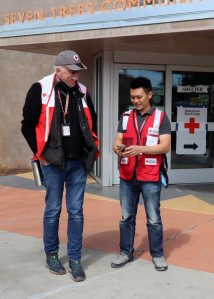
American Red Cross volunteer Diana giving an update to Shelter Supervisor Peggy at the Seven Trees shelter in San Jose. Photo by Alex Keilty / American Red Cross

As Californians continue cleaning up after the weeks of severe weather at the beginning of January, the American Red Cross is helping and will also be there in the days and weeks to come, supporting people as they move towards recovery.

This online story map offers a look at the ongoing response to the California floods. Since New Year’s eve:

  • Almost 800 trained Red Cross disaster workers are supporting people in California.
  • The Red Cross and partners have provided more than 9,300 stays in more than 80 shelters, more than 62,400 meals and snacks, and distributed more than 14,700 relief items such as comfort kits and other relief supplies.
  • Trained Red Cross volunteers are helping families cope during this challenging time and replacing prescription medications, eyeglasses or critical medical equipment like canes and wheelchairs.
  • Teams on the ground are also conducting damage assessments to determine the impact of these storms and which communities will need additional support moving forward. Preliminary damage reports indicate that of the 5879 total assessments done to date, 134 homes were either destroyed or suffered major damage.

We Need You!

  • While trained Red Cross volunteers and staff continue to manage the response efforts, we are looking for additional volunteers to help with disaster response and recovery activities, including feeding, supply distribution, clean-up kit building and more. Apply online to become a Red Cross volunteer by visiting tinyurl.com/ARC2023FloodsApplication if you are interested in helping with this response or responses like this in the future.

Blood During Disasters

  • The Red Cross is working to maintain a stable blood supply amid the threat of storms and winter weather across the country, as severe weather often causes widespread blood drive cancellations. Where it is safe to do so, we encourage donors to make and keep blood donation appointments by using the Red Cross Blood Donor App, visiting RedCrossBlood.org or calling 1-800-RED CROSS (1-800-733-2767).

Help Those in Need

  • You can help people affected by disasters like floods, fires and countless other crises by making a gift to Red Cross Disaster Relief.Donations for Disaster Relief enable the Red Cross to prepare for, respond to and help people recover from disasters big and small. Visit redcross.org, call 1-800-RED CROSS, or text the word REDCROSS to 90999 to make a $10 donation..

Stay Up-to-Date on Social Media

« Older Entries Recent Entries »