A Staff Planning and Support Service Associate Feature
Neil went the extra mile to help set up a shelter in the middle of the night
You may have seen American Red Crossers on the news handing out food or welcoming people into disaster shelters. But you may not have seen the countless volunteers working tirelessly behind the scenes of a disaster response. Staff Planning and Support Service Associate Neil Katin is one of those people.
Neil has responded 39 times to disasters, big and small, in-person and virtually, to be the first and last Red Crosser that volunteers speak with during their deployment.
From December 2022 through March 2023, devastating storms and flooding drenched California over several months, destroying homes and businesses. This intense precipitation—the result of atmospheric rivers—is extremely rare in California, so areas that normally wouldn’t flood, like the community of Pajaro in Monterey County, home to migrant farmworkers, and large portions of Tulare and Kern counties, were completely inundated. These damaging atmospheric rivers spurred landslides and tore apart homes, inflicting financial losses and destroying irreplaceable, precious memories. While the relentless rain affected much of the state, this disaster took a severe and disproportionate toll on the most vulnerable.
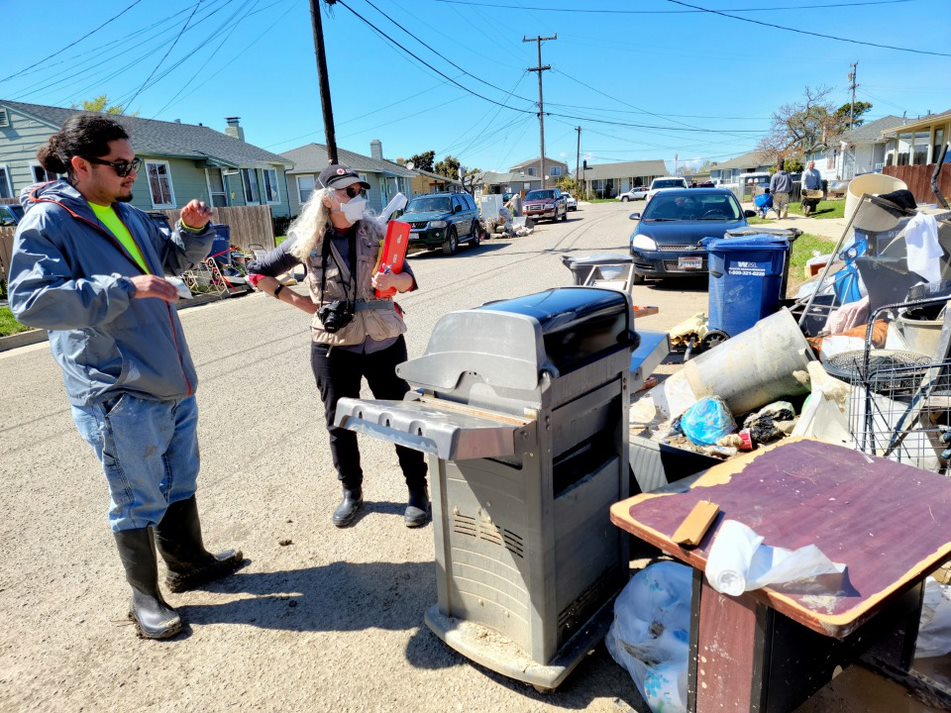
On March 9, 2023, Eddie Rocha of Watsonville was shocked to see flood waters creeping into his kitchen. His home quickly became soaked with flood waters leaving him no choice but evacuate.“This is everything,” Simon Mata says, showing American Red Cross volunteer Barbara Wood the huge pile of muddy garbage in front of his home in Pajaro, where everything that had furnished his home awaits pickup.Read more
“I was born to help people. That’s what brings me the most joy.” Caro (Carolina) Dratva, a Red Cross Northern California Coastal Region’s Disaster Cycle Services Team member and Communications volunteer, heard the call to help others early. When she was 12 and still living in Colombia, a volcanic eruption buried a close friend’s hometown, Armero. “I could only watch TV, listen to the radio, and follow up with my friend,” whose parents had died in the disaster with 23,000 others. Responders with the Red Cross emblem arrived to rescue victims and remove debris during an operation that she would remember later when, at age 15, she noticed the same emblem among response teams in San Francisco in the aftermath of the Loma Prieta earthquake, which she witnessed. At that time, she revealed, “I didn’t realize that the Red Cross was mainly run by volunteers.” It was only after she asked how much responders were paid that she understood that most rescuers offered their unpaid time and effort to save others, a fact that must have deeply moved this scuba diver, surfer, conservationist, and explorer to dive deep and dedicate more than two decades to volunteering.
After all, when Caro set off for the Bahamas several years ago on a dolphin trip with her closest friend, she couldn’t have predicted that her life would be deeply impacted again. “During the night,” she recently shared, “I went to swim with dolphins 85 miles out on a boat. We were anchored, and I was the only one swimming. Everyone else was on the boat. So, I went off with the dolphins. There was a full moon, and I lost my sense of direction. But because of the moonlight reflecting on the water, I couldn’t find the boat. I couldn’t see it. For the first time, I felt panic, like, ‘I’m going to die here.’ But the dolphins were still hanging with me. So, I literally spoke to them: ‘Could you please bring me back to the boat.’ And then, one pushed me on one side, the other pushed me on the other, and they brought me right back to the boat.’” This profound moment of trust and connection with the dolphins helped her realize the power of relying on others during moments of crisis. Just as the dolphins guided her to safety, Caro felt compelled to help guide others through challenging times, which ultimately led her to dedicate her time to lifesaving organizations such as the American Red Cross.
Photos courtesy of Caro Dratva
“There has to be a way that I can volunteer.” The real work began with 9/11, when the Twin Towers came down in Manhattan’s Battery. She needed to help, so she joined the Red Cross. “I thought, if I have to deploy to New York, I’ll do it. But then, I realized I needed training.” Getting that training during such a fraught time for the country and those who’d lost loved ones required sensitivity and an ability to ask the right questions.
“My first training was in San Francisco,” she recalled, “connecting the missing people on lists with their families.” Mainly, she conducted interviews meant for search and rescue teams, gathering descriptions of missing people, noting the floors they worked on and what they were wearing the last time they were seen. Even now, twenty-two years later, Caro remembers one moving experience when she used her native language skills to search for a distraught woman’s husband who’d worked in the Towers. “She spoke Spanish, and the good news was that the woman’s husband was alive and able to reconnect with her.”
Later, after a one-year hiatus in Europe, she continued to dedicate herself to helping others, getting involved in Red Cross blood drives, donation collection campaigns, and numerous disaster relief operations, including the aftermath of Hurricane Katrina.
Caro and Red Cross Volunteers supporting communities affected by wildfires in North Bay, 2017
Since then, Caro has watched the Red Cross grow even more effective, learning from hard knocks like Katrina. Better organizational tools have improved efficiency before, during, and after disasters, allowing volunteers like her to give time even when time is sometimes hard to spare. Holding down two jobs—one focused on ocean conservation and the other on architectural design—Caro still finds time to volunteer in numerous ways. “Because of good organization and how the Red Cross has grown, I can be on standby for the Disaster Action Team (DAT). I’m also trained for sheltering, and I’m part of the Public Affairs and Communications team.”
All this volunteering has added up over the years. From one training session to another, Caro has developed expertise through online and real-world experience. With every exposure she’s had to disasters, shelters, and blood drives, she has noticed, listened to, and recognized others as they face some of the most challenging moments of their lives. This may be one reason why she still swims for life, giving a great gift to others along the way: how to save others while saving oneself.
Santa Cruz county resident, mental health professional and longtime Red Cross volunteer Jill Hoffman recounts her Loma Prieta earthquake experience 35 years later, including what she’s learned about earthquake safety.
Collapsed roadways were a common sight after the earthquake. Photo credit: U.S.G.S.
“I have been a volunteer in Santa Cruz since 1980 and was part of the Loma Prieta Earthquake Red Cross response in 1989.
I was at work with clients at 5:01p.m. on Oct. 17, 1989 when the earthquake struck; I though we were being bombed, the noise and shaking were so severe. We were just six miles from epicenter. I remember saying very quietly and calmly “door frame! door frame!” (We know now not to do that, and instead to drop to the floor, cover yourself with something sturdy like a table, and hold on until the shaking stops. Doorways are not any more structurally sound than elsewhere in a building and not a safe place to go to during an earthquake.)
“I though we were being bombed, the noise and shaking were so severe.”
I was one of the lucky ones in that I had no major damage to my home, just books falling off shelves and glass breaking. My boss at the County Mental Halth Services (CMHS) came by about an hour and a half after the earthquake via bicycle instead of her car since the route to my neighborhood was no longer driveable. We immediately joined the team working at a disaster shelter at the Civic Center in downtown Santa Cruz.
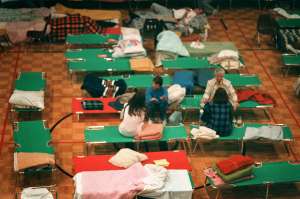
At a Red Cross shelter, residents displaced by the Loma Prieta earthquake sit and talk.
I wore two hats during most of the response: I volunteered at the shelter and did community outreach for Red Cross. Within a few weeks, I assumed the role of the Clinical Mental Health Director for a FEMA grant, a position which was extended to 18 months. We saw 25,000 people during that time.
In Santa Cruz county, (the epicenter of the earthquake) CMHS led the long term mental health care response, taking over from the Red Cross. FEMA hired six full time and 34 contracted mental health care workers.
A washed out road in Santa Cruz county. Photo credit: U.S.G.S.
I met with the couple I had been seeing that day about five weeks later and they said “Jill! You were so wonderful, you were yelling at the top of your lungs “Door frame! Door frame!” So much for my perception of the event at the time.
When we had an aftershock 6 months later I had I had the flight vs. fight response and bolted out of my chair at a restaurant and stared running before my colleague stopped me.”
Thank you, Jill, for sharing your story, your service then, and your continued service now. To learn more about disaster preparedness, including how to be prepared for an earthquake, visit redcross.org/prepare.
Mary H. Lee, Red Cross Disaster Health Services Volunteer, shared her memories of the Loma Prieta Earthquake.
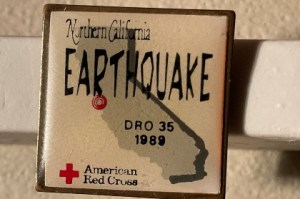
A Red Cross pin, the perfect way of thanking all the dedicated volunteers who helped during the Earthquake Disaster Relief Operation Photo courtesy of Mary H. Lee
“As we were standing outside our newly renovated home in Belmont on October 17, 1989 at 5 pm, we shook hands with our contractor to thank him for a job well done. Moments later the ground shook under us. We looked at our house and smiled as it was still standing. At that time little did we know of the severity of the earthquake.
Late that evening I was called in by the San Mateo Red Cross Chapter to staff a shelter as Disaster Health Service (DHS) Nurse. It was eerie to drive down a darkened highway 101 with no cars on the road to the shelter located in a hotel in Burlingame. The people in the hotel shelter were a tour group that had their trip interrupted. It was a very quiet night.





 Your Red Cross Update