Kelly Marie Harris Packard, 1991-2024. (Photo courtesy of Diane Harris)
She was a gifted athlete, captain of her team at Scotts Valley High School and an All-American at California Polytechnic State University. Intelligent and having acquired her master’s degree, she worked in New York City with a leading accounting firm before marrying the love of her life and landing her dream job in sports marketing in Portland.
In January 2023, Kelly Harris climbed Mt. Kilimanjaro in Tanzania, Africa, with her mother, Diane, and they reached the summit — 19,341 feet up. Shortly thereafter, Kelly was diagnosed with Ewing sarcoma, a rare form of cancer. Kelly began chemotherapy and eventually underwent radiation, all while continuing to work.
“It took a toll on her body,” Diane said. Kelly received platelets and several blood transfusions over the course of her treatment. Realizing how dependent patients are on having a sufficient blood supply for this vital treatment, Kelly organized her own blood drive.
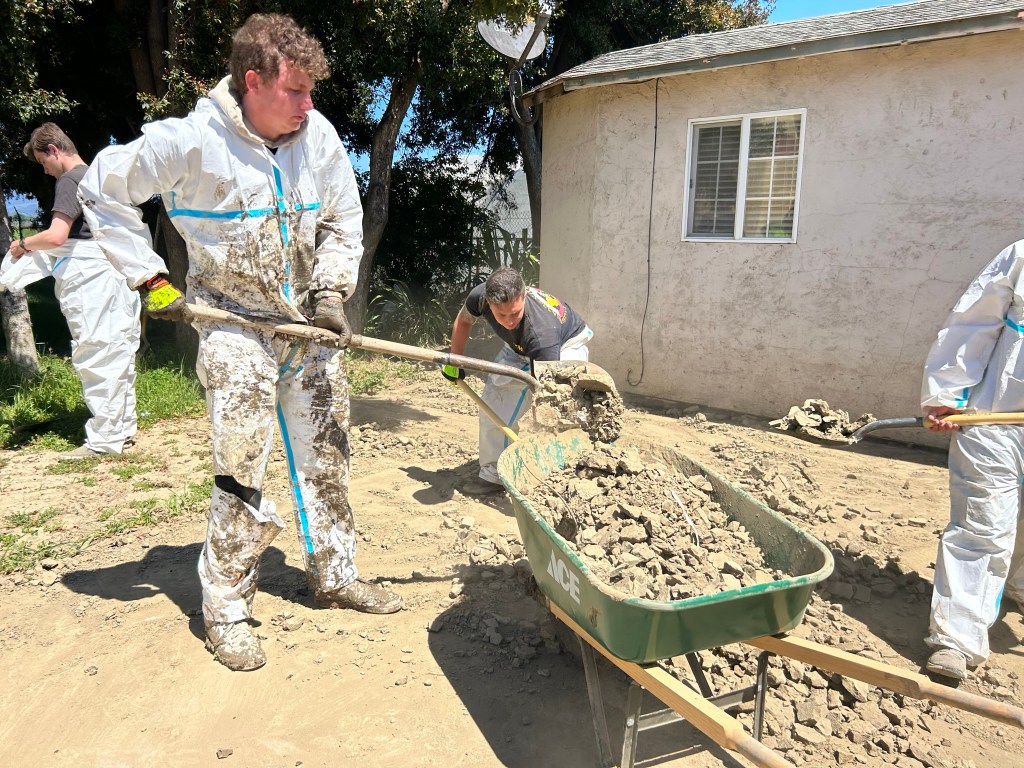
Volunteers with Hope Crisis Response Network help clean up the muck in resident’s homes.
“Pajaro was a really good project,” said Kevin Cox, CEO of Hope Crisis Response Network (HCRN).
In the city of Pajaro, California, HCRN managed the cleanup after the floods, deploying teams from United Methodists, Team Rubicon and others. Compared to other agencies they’ve partnered with in the past where “we were just a conduit,” the American Red Cross relationship was a true partnership characterized by mutual trust.
First, they formed Hope City Resource Village, a place to collaborate with partners and register families for cleanup.
Red Crossers surveyed the widespread flooding that left Pajaro underwater, including Joanne’s home (pictured in the distance between the volunteers).
Written by: Jillian Robertson | Senior Manager, Long-Term Recovery Communications, American Red Cross
“People were caught off guard. It was 1 a.m. The levees were breaking, and we were told, ‘You’ve got to go!’ It was very traumatic.”
Joanne Jackson lived with her husband and her daughter in their home in Pajaro, California, before catastrophic floods forced them from their home two years ago, in December 2022.
For Joanne and her husband, they were lucky. The day before, the sheriff had warned them to evacuate. They left in their travel trailer where they’re still living today, as they work on repairs to their home that was rendered uninhabitable by the floods.
From left to right: Maria, Gabriela, and Lucy are leading the new CAP chapter in Monterey. Photo Courtesy of CAP team.
When natural disasters sweep across regions repeatedly, it takes a lot of strength and resilience from communities to rebuild their lives. For some folks, it can take a greater effort to reestablish a sense of normalcy due to the lack of resources in the area or their socioeconomic conditions. The Community Adaptation Program (CAP) is a recent initiative by the American Red Cross designed to bring relief to regions that experience high risk of disasters through partnerships with local nonprofit organizations. One of the newest additions to the CAP’s locations across the country was just established in Monterey County, California.
CAP focuses on addressing three key areas through its initiatives: health, hunger and housing. Each CAP team is composed of a manager and two coordinators who work together to foster and sustain the connection between the Red Cross and local partners. The community of Pajaro in Monterey was a strong contender for needing these services due to reoccurring natural disasters that devasted the area. the area.
Nikita Johnson at the CFSBC office Photo courtesy of Nikita Johnson
A home fire is one of the many unthinkable, tragic events that cause massive disruptions to the lives of those affected. While these tragedies are often preventable, an American Red Cross survey demonstrated that the majority of Americans are more unprepared to survive a home fire than they believe. This is why the partnership between the Red Cross and the Community Foundation of San Benito County (CFSBC), which started back in 2019, is so integral to protecting communities against home fires.
Santa Cruz county resident, mental health professional and longtime Red Cross volunteer Jill Hoffman recounts her Loma Prieta earthquake experience 35 years later, including what she’s learned about earthquake safety.
Collapsed roadways were a common sight after the earthquake. Photo credit: U.S.G.S.
“I have been a volunteer in Santa Cruz since 1980 and was part of the Loma Prieta Earthquake Red Cross response in 1989.
I was at work with clients at 5:01p.m. on Oct. 17, 1989 when the earthquake struck; I though we were being bombed, the noise and shaking were so severe. We were just six miles from epicenter. I remember saying very quietly and calmly “door frame! door frame!” (We know now not to do that, and instead to drop to the floor, cover yourself with something sturdy like a table, and hold on until the shaking stops. Doorways are not any more structurally sound than elsewhere in a building and not a safe place to go to during an earthquake.)
“I though we were being bombed, the noise and shaking were so severe.”
I was one of the lucky ones in that I had no major damage to my home, just books falling off shelves and glass breaking. My boss at the County Mental Halth Services (CMHS) came by about an hour and a half after the earthquake via bicycle instead of her car since the route to my neighborhood was no longer driveable. We immediately joined the team working at a disaster shelter at the Civic Center in downtown Santa Cruz.
At a Red Cross shelter, residents displaced by the Loma Prieta earthquake sit and talk.
I wore two hats during most of the response: I volunteered at the shelter and did community outreach for Red Cross. Within a few weeks, I assumed the role of the Clinical Mental Health Director for a FEMA grant, a position which was extended to 18 months. We saw 25,000 people during that time.
In Santa Cruz county, (the epicenter of the earthquake) CMHS led the long term mental health care response, taking over from the Red Cross. FEMA hired six full time and 34 contracted mental health care workers.
A washed out road in Santa Cruz county. Photo credit: U.S.G.S.
I met with the couple I had been seeing that day about five weeks later and they said “Jill! You were so wonderful, you were yelling at the top of your lungs “Door frame! Door frame!” So much for my perception of the event at the time.
When we had an aftershock 6 months later I had I had the flight vs. fight response and bolted out of my chair at a restaurant and stared running before my colleague stopped me.”
Thank you, Jill, for sharing your story, your service then, and your continued service now. To learn more about disaster preparedness, including how to be prepared for an earthquake, visit redcross.org/prepare.





 Your Red Cross Update