A Red Cross volunteer shares what the Loma Prieta earthquake – and the hours that followed – were like from the Red Cross office in San Jose.
A Red Cross worker surveys the damage caused by the Lomo Prieta earthquake in the Santa Cruz area.
By Franci Collins, Red Cross Volunteer
I will always remember where I was at 5:04 p.m. on October 17, 1989. I had just walked into the San Jose Chapter of the Red Cross. Coincidentally, I was scheduled to teach an earthquake preparedness class that night, the first in several months as classes were often cancelled due to lack of enrollment. I wanted to get there before 5 p.m. to make sure all the equipment was available and working.
The slide projector was on a table right inside the classroom door and I had just turned it on and off when the ground started shaking. I am happy to say that my six years of training paid off, as I immediately ducked under the table and held on. The shaking seemed to go on for an extremely long time and I spent most of it imagining the slide projector being progressively shaken towards the edge of the table. I had time to decide that if it fell off, I would stay where I was and not try to save it.
Santa Cruz county resident, mental health professional and longtime Red Cross volunteer Jill Hoffman recounts her Loma Prieta earthquake experience 35 years later, including what she’s learned about earthquake safety.
Collapsed roadways were a common sight after the earthquake. Photo credit: U.S.G.S.
“I have been a volunteer in Santa Cruz since 1980 and was part of the Loma Prieta Earthquake Red Cross response in 1989.
I was at work with clients at 5:01p.m. on Oct. 17, 1989 when the earthquake struck; I though we were being bombed, the noise and shaking were so severe. We were just six miles from epicenter. I remember saying very quietly and calmly “door frame! door frame!” (We know now not to do that, and instead to drop to the floor, cover yourself with something sturdy like a table, and hold on until the shaking stops. Doorways are not any more structurally sound than elsewhere in a building and not a safe place to go to during an earthquake.)
“I though we were being bombed, the noise and shaking were so severe.”
I was one of the lucky ones in that I had no major damage to my home, just books falling off shelves and glass breaking. My boss at the County Mental Halth Services (CMHS) came by about an hour and a half after the earthquake via bicycle instead of her car since the route to my neighborhood was no longer driveable. We immediately joined the team working at a disaster shelter at the Civic Center in downtown Santa Cruz.
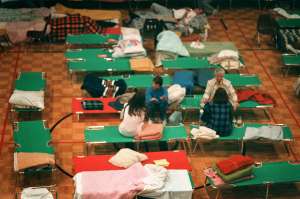
At a Red Cross shelter, residents displaced by the Loma Prieta earthquake sit and talk.
I wore two hats during most of the response: I volunteered at the shelter and did community outreach for Red Cross. Within a few weeks, I assumed the role of the Clinical Mental Health Director for a FEMA grant, a position which was extended to 18 months. We saw 25,000 people during that time.
In Santa Cruz county, (the epicenter of the earthquake) CMHS led the long term mental health care response, taking over from the Red Cross. FEMA hired six full time and 34 contracted mental health care workers.
A washed out road in Santa Cruz county. Photo credit: U.S.G.S.
I met with the couple I had been seeing that day about five weeks later and they said “Jill! You were so wonderful, you were yelling at the top of your lungs “Door frame! Door frame!” So much for my perception of the event at the time.
When we had an aftershock 6 months later I had I had the flight vs. fight response and bolted out of my chair at a restaurant and stared running before my colleague stopped me.”
Thank you, Jill, for sharing your story, your service then, and your continued service now. To learn more about disaster preparedness, including how to be prepared for an earthquake, visit redcross.org/prepare.
Thirty-five years later, a Red Cross volunteer recalls his experience during the 1989 Loma Prieta earthquake.
Red Cross volunteer photographer Larry Brazil remembers where he was during the Loma Prieta earthquake in 1989, 35 years ago today. The 6.9-magnitude earthquake rocked Northern California, with the Bay Area and Central Coast bearing the brunt of the impact. The epicenter was approximately eight miles north-northeast of Santa Cruz and 50 miles from downtown San Francisco. The quake lasted 15 seconds and struck during the peak of evening rush hour. The resulting catastrophic damage and loss of life forever changed the landscape, infrastructure and people of the Golden State. Sixty-six people lost their lives, 2,400 were injured and more than 10,000 homes were left uninhabitable. Larry shares what that fateful day was like, and what happened next:
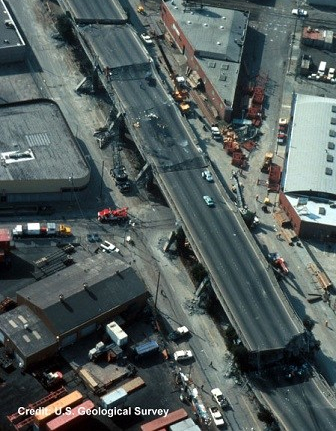
The aftermath of the Bay Bridge following the earthquake. Photo credit: U.S.G.S.
“October 17,1989 was going to be a special day. Little did I know how memorable that day would end up being. It was special because a friend and I had tickets to Game 3 of the World Series that evening. We got to the game early and had a little tailgate party. We were just getting ready to head into the game when all of a sudden, time seemed to stand still, but the earth surely wasn’t standing still! The parking lot was literally rolling in waves. Cars were swaying back and forth, up and down, with their tires almost coming off the ground. It seemed to last for a long time, but it was probably about 15 seconds. When the shaking stopped, there was a loud roar from inside the stadium. We didn’t yet know the extent of damage and thought that the game would proceed after a delay. While trying to get into the stadium, someone had a little TV and we saw that the Bay Bridge had collapsed. It really sunk in then.
The Bay Bridge was our way home, and we knew we were in for a long night. The only way back home to Pleasanton was to go all the way around the Bay as the other bridges were closed for damage inspection. It took 9 hours to get home at 3a.m. We were transfixed by the images we saw of the widespread devastation. That was our first glimpse into the enormity of the situation.
“The next few days were a blur; it was not business as usual. We were pretty much glued to the TV, watching the drama unfold on the Cypress Freeway collapse and Marina fires.”
The bi-level Cypress Freeway, collapsed onto itself, was a sobering reminder of the quake’s intensity. Photo credit: U.S.G.S.
I was a member of a professional photographers group, the Peninsula Advertising Photographers Association. The Red Cross had reached out to our group looking for photographers to document the recovery efforts. I and two other photographers volunteered; I spent the next couple of days photographing Red Cross recovery efforts, mostly in Santa Cruz county.
I was with them day and night; at night we went out to highway workers in the Santa Cruz Mountains on Highway 17 offering them coffee, snacks, and moral support. During the day I photographed the shelter at the county fairgrounds in Watsonville. I was able to document the many services the Red Cross provided as well as much of the physical damage to the earth and buildings. I was grateful that I was able to contribute in some small way to the recovery efforts.
Landslides and destroyed roads were a common sight near Santa Crus. Photo credit: U.S.G.S.
It took another crisis time (the pandemic) for me to get involved again with the Red Cross. After being laid off due to COVID, I joined Blood Services team as a transportation specialist. I have delivered blood all over the greater Bay Area for the past four years. I have transitioned to doing some sheltering and logistics work in addition to my blood deliveries. I have recently joined the Red Cross communications team and look forward to once again providing the Red Cross with timely photos.”
Thank you for sharing your story and your service, Larry! To learn more about disaster preparedness, including earthquake preparedness, visit redcross.org/prepare.
Mary H. Lee, Red Cross Disaster Health Services Volunteer, shared her memories of the Loma Prieta Earthquake.
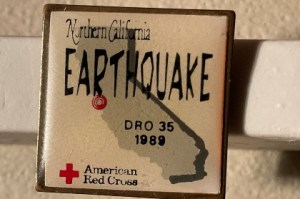
A Red Cross pin, the perfect way of thanking all the dedicated volunteers who helped during the Earthquake Disaster Relief Operation Photo courtesy of Mary H. Lee
“As we were standing outside our newly renovated home in Belmont on October 17, 1989 at 5 pm, we shook hands with our contractor to thank him for a job well done. Moments later the ground shook under us. We looked at our house and smiled as it was still standing. At that time little did we know of the severity of the earthquake.
Late that evening I was called in by the San Mateo Red Cross Chapter to staff a shelter as Disaster Health Service (DHS) Nurse. It was eerie to drive down a darkened highway 101 with no cars on the road to the shelter located in a hotel in Burlingame. The people in the hotel shelter were a tour group that had their trip interrupted. It was a very quiet night.
Dr. Diane Bridgeman is a Licensed Clinical Psychologist who has served as a volunteer with the Red Cross for more than 30 years. In April, Diane received the Clara Barton Honor Award for Meritorious Volunteer Leadership, the Red Cross’ highest honor. A treasured member of the Disaster Mental Health Team in the Santa Cruz chapter, Diane took the time to share about her rich experience with the Red Cross and why this recognition means so much to her.
Dr. Diane Bridgeman
What drew you to the American Red Cross, and what kept you engaged?
I suspect my initial interest in the Red Cross, and why I stayed with it for over 30 years, stems from a matching of my core life tenets and the central mission of the Red Cross. This includes service to others and the importance of fairness and social justice – these are key lenses for my view of the world and similarly coincide with the basic principles that guide the Red Cross. It is why I chose psychology, and clinical psychology specifically, as my career choice and why I resonate with the heart of the Red Cross. The more I learned about the history of the Red Cross and its profound and inspired founder, Clara Barton, the more I embraced and wanted to give time to this humanitarian organization.
30 Years Later, the Loma Prieta Earthquake Response Remains Jim Aldrich’s Most Difficult
Galveston Island had seen better days. Hurricane Jerry had battered the Texas barrier island cum tourist haunt the day before, leaving flooded roads strewn with flotsam and sand dunes pummeled into the mud. Jim Aldrich of the American Red Cross, who was in Galveston as part of the organization’s recovery effort, had just settled in to watch Game 3 of the World Series from his hotel room. The game’s telecast, aired live from San Francisco, suddenly scratched with static as the frame jerked and spasmed. There was confusion, shouting.
“We’re having an earth-” someone said before the live feed cut to black.
An aerial view of the collapsed section of the Cypress Structure. The 6.9 earthquake caused the top deck of the highway to fall onto the lower deck, killing 42 people.
It was October 17, 1989, and Northern California had just experienced a catastrophic event, the Loma Prieta earthquake. The 6.9 tremor ravaged homes, infrastructure, and lives from Monterey Bay through the Bay Area, leaving 66 people dead, thousands injured, and tens of thousands homeless. Like Jim, millions watched the quake strike in real time on live television.
The Red Cross contacted Jim, an employee from St. Louis, within hours of the now-cancelled World Series game; he would trade the Texas Gulf Coast for a new deployment to the earthquake response in California. Having 8+ years with the Red Cross and ample disaster experience under his belt, he felt up to the job. However, as he would learn over the next three months, the Loma Prieta response would be the most challenging of his career. Read more





 Your Red Cross Update