Even before an American Red Cross emergency response vehicle dropped off 100 meals at the Mission Farm RV Park in San Juan Bautista on March 21, eager residents lined up for lunch, happy to get some fuel for the difficult job of trying to clean up the damage done by flooding to their community 11 days earlier.
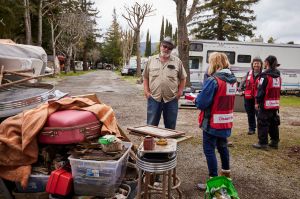
Mission Farm RV Park homeowner, Kerry Dickie, thanks American Red Cross volunteers for the cleanup kits and food delivered to his neighbors. Photo by Jaka Vinsek/American Red Cross
Kerry Dickie was among them. Dickie said he lost his mobile home and about 70 percent of his possessions to the flooding and mud that followed. Dickie said that even before waters from several adjacent creeks and a nearby subdivision’s retention pond started pouring into the park, he and his son found their way out was blocked by flooded streets strewn with large underwater rocks.
As water started to come in, the two tried to move his collections from an enclosed porch into his 1986 Avion mobile home. By the time they got everything into the mobile home, water was knee high.
The two took one of their vehicles to dry land but by the time they came back to move the other, water had already crept inside the mobile home.
While the water receded within about 24 hours, when Dickie returned home, he found 1.5 feet of standing water inside. The enclosed porch was totaled as is his mobile home.
“It’s just a horrible muddy mess,” Dickie said.
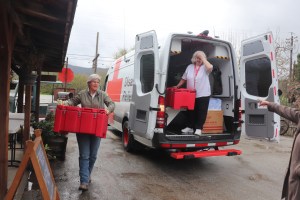
Red Cross volunteer Roberta Jones and Leslie Jordan, mayor of San Juan Bautista, unload meals for residents of the Mission Farm RV Park. Photo by Barbara Wood/American Red Cross
“I’m kind of wondering what my next house is going to look like because this one’s not habitable any more,” Dickie said. He said he will probably look for a used mobile home to replace the one destroyed by the water.
He’s not one to take handouts, Dickie said, but “when you need help, you need help.”
Residents of the park have been helping each other recover from the flooding, which affected some of the recreational vehicles more than others. Kurt Kurasaki, whose father built the park in the 70s, says he tried to come out to assess the storm damage on March 10th, but couldn’t get through the flooded roads. When he trudged in through the water he saw the berm he had built to raise the heights of a nearby creek bed by a foot was about to be overtopped. Kurasaki started going door to door telling residents of the 70 recreational vehicles and mobile homes on the property to evacuate.
Kerry Dickie thanks Red Cross volunteers Mary Marcus and Hideaki Yamazaki for the cleanup kits. Photo by Jaka Vinsek/American Red Cross
Not everyone left. Some people were at work, Kurasaki says, some “opted to ride it out” and some didn’t have a vehicle to get out with.
Kurasaki said the park had flooded once before, but it was two decades ago.
Now, those who had less damage are helping those with more damage to remove their trashed belongings.
Leslie Jordan, the mayor of San Juan Bautista, and other volunteers came in Tuesday and Wednesday to help serve the food and promised to come back as long as the deliveries lasted. Earlier in the week, more San Juan Bautista residents came out for a work party to help their flooded neighbors.
Red Cross Volunteers Bring Hot Meals to RV Campers
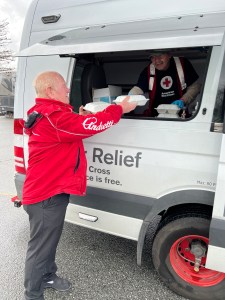
Dave Martin gets hot meals from Red Cross volunteers. Photo by Marcia Antipa/American Red Cross
“They tell you to get out and that’s it.”
Dave Martin and a few dozen other RV Campers have sought refuge in a rain-drenched parking lot in Hollister during the recent California storms. All of them were forced to evacuate RV campgrounds in the area when the floodwaters rose and threatened to swamp their vehicles.
Robin Lewis also brought his camper to this lot after a harrowing few days seeking a safe haven.
“We stayed by the side of the road for a few days, went to another place, came here, and we’re worried about where we’re going to head to next.”
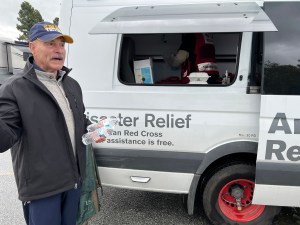
Mario Garcia at the Red Cross response vehicle. Photo by Marcia Antipa
Then, the American Red Cross arrived with hot food and two friendly faces: volunteers Roberta Jones of Silver Creek, Washington, and Felix Rodriguez of Madera, California. The two dished out meals, snacks and bottled water from inside an Emergency Response Vehicle.
“It’s great,” said Robin Lewis after picking up a few meals. “There’s a need for help here, not just us, there’s a lot of people. We’re way better off than a lot of people, for sure.”
Red Cross volunteer Roberta Jones. Photo by Marcia Antipa
Camper Mario Garcia accepted his meals with a big smile, and brought food to another camper, who he said was too shy to accept food. Mario says he makes the most of what could be a dreary experience. He even plans to attend a “Learn to Salsa Dance” event at a Hollister dance club.
Volunteers Roberta Jones and Felix Rodriguez get a little choked up when asked why they volunteer with the Red Cross during a disaster. The reason, Jones says, is simple.
“The people. Everyone is so grateful, and that’s why I do this, because they are just so grateful. Don’t make me cry,” she says, laughing.
The Red Cross needs more volunteers like Roberta and Felix. If you would like to help, please visit redcross.org/volunteer.
Everyone in the family can have an active role in household safety. Prepare with Pedro and The Pillowcase Project – the two American Red Cross educational programs for kindergarten through 5th grade learners – help young students stay safe in case of an emergency.
Zeien Cheung, Red Cross Regional Preparedness Lead – Prepare with Pedro Program, posing next to Pedro the Penguin. Photo courtesy of Zeien Cheung
Fire experts agree that people may have as few as two minutes to safely escape a burning home before it’s too late. This short amount of time is frightening for adults and can be traumatic for children. To help everyone in the household learn how to stay safe before, during, and after an emergency, the Red Cross has created The Pillowcase Project and Prepare with Pedro, two classroom-based programs designed to teach preparedness to students. Prepare with Pedro is designed for kindergartners through second graders, while The Pillowcase Project is geared toward third through fifth graders.
“These programs teach (students) how to act, help them understand what is happening around (them) during an emergency and give them some control over a stressful situation, even when there is not much control possible,” said Ana Romero, Regional Preparedness Manager for the Northern California Coastal Region of the red Cross.
Prepare with Pedro is a 30-to-45-minute storytelling-based presentation designed for students in kindergarten – second grade. Specially-trained Red Cross volunteers visit classrooms and introduce Pedro the Penguin to young students. Reading about Pedro’s adventures in storybooks and with the help of some training exercises, school kids can learn basic preparedness concepts like what a smoke alarm sounds like, what’s important to remember in case of a home fire, protecting themselves during an earthquake, practicing deep breathing to remain calm during an emergency, or how to talk with adults about their feelings after a stressful experience.
Romero explains that the focus of Prepare with Pedro is to build more resilient kids.
“Pedro helps children to develop stronger coping skills. They learn how to manage stress not only during emergencies, but also in their everyday life,” she said. “I was presenting the program in a local school recently when I asked the students if they think that these relaxation techniques, these coping skills, could be applied in some other challenging situations in everyday life, besides an emergency. One of them immediately raised his hand and replied, ‘when we get a vaccine shot!’ and yes, he was right. Those skills are useful in everyday life and the objective of Prepare with Pedro is to build resilient kids prepared to face any unexpected situation.”
Zeien Cheung is the Regional Preparedness Lead for the Prepare with Pedro program, and has been a Red Cross volunteer since 2018. She started her Red Cross journey as a member of the Disaster Cycle Services team helping with the response to the Napa wildfires, but then realized teaching preparedness was a better fit for her. Always passionate about teaching and working with young students, she has vast experience presenting these programs at schools in the Bay Area Chapter. “I believe in equipping young students with knowledge,” she said. “Make them aware of how important preparedness is and how useful learning these things can be.”
The most challenging aspect of presenting these programs, according to Cheung, is capturing the students’ attention. In her role, she oversees volunteers who present these programs at schools and emphasizes that being both a good narrator and able to engage with them are the keys to success.
“Prepare with Pedro is perhaps less involved than The Pillowcase Project, because the students are younger and the activities you can do with them in the classroom are different. But that doesn’t mean that can’t be fun and interactive. I have a Pedro the Penguin stuffed toy that comes with me every time I visit a classroom and the kids love it. It’s an excellent way to connect with them. They ask all kinds of questions about him – where does he live, how old he is, who are his friends – they talk with him and I talk with all of them, using those answers to complement the preparedness knowledge,” Cheung said.
After the presentation, students and their families can continue learning about emergency preparedness through the Prepare with Pedro storybooks, videos and other free resources available for digital download in English and Spanish. There is also a Pedro Fire Safety Challenge for Google Assistant and Alexa-enabled Devices.
“Storybooks and online resources make the children realize that they can have an active role in household safety. Grown-ups at home may not know or not remember how to stay safe during an emergency. We encourage young students to teach others what they learn after Pedro visits their classroom,” Cheung said.
The Red Cross has preparedness programs for all ages: Prepare with Pedro and The Pillowcase Project are for school-aged students and the Be Red Cross Ready presentation is geared toward teens and adults. You can learn more about how to stay safe during emergencies here, or you can sign up to volunteer with the Red Cross and be a preparedness presenter here.
How the tragic loss of their daughter inspired Dennis and Virgie Roy to volunteer for the Red Cross
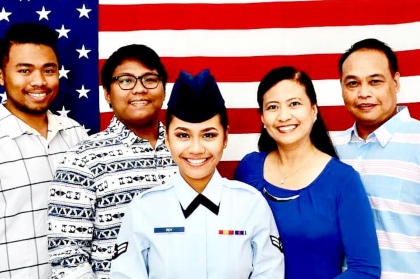
The Roy Family
“I feel so grateful and blessed that God gave us a daughter like that, so I said I will continue what she started. She had a big heart.”
Virgie Roy is talking about her daughter, Patricia. On August 4, 2017, just three days after her 22nd birthday, Patricia Roy died in a car accident. An Airman First Class and Cargo Specialist at Travis Air Force Base, Patricia had plans to become a nurse, following in her mother’s footsteps.
Virgie and Dennis Roy say their daughter was a leader and a shining light in her workplace, the 60th Aerial Port Squadron (APS).
“Every time I would visit her workplace, her colleagues would say, ‘Oh we haven’t seen your daughter angry,’” says Virgie. “She’s always smiling, even if she’s busy and then if there’s a staff who is not happy, my daughter would just approach her and say ‘are you ok? Do you need some prayers?’“
Dennis Roy says those memories of his daughter prompted him to sign up to volunteer for the Red Cross in 2020.
Dennis Roy on assignment with the Red Cross. Photo courtesy of Dennis Roy
“I got inspired by a lot of testimonies coming from the colleagues of Patricia, those virtues of being kind-hearted, service-oriented.”
The Roy family came to the United States from the Philippines in 2014, when Virgie was accepted into a program for foreign-trained nurses.
They were excited for their daughter and two sons to grow up in the U.S.
For Virgie, becoming a nurse was a natural step. Her mother is a doctor in the Philippines, and a Red Cross volunteer. Virgie worked in her mother’s medical clinic and joined in those volunteer missions.
“Since grade school, high school, I was already involved in this,” laughs Virgie. “I’m holding the first aid kit (laughing), I’m doing the vital signs, I was young then but I could do some of the easy jobs.”
Now, Virgie works in the Surgery Center at David Grant Medical Center at Travis Air Force Base in Fairfield, California.
“The 60th APS, the squadron of my daughter, became our second family. So I said I think it will give me comfort if I can see some of her colleagues.”
Dennis works in a skilled nursing facility, supervising the clinical documentation, and assisting the Director of Nursing. He also donates his time to the Red Cross.
“When we came here in the U.S. our orientation was mainly focused on material opportunities, which is basically human nature. We wanted to have a house like this, we wanted travel, we wanted to acquire cars, etc.”
He says the loss of his daughter changed his perspective.
“It made me think to follow that kind of legacy, I should probably give back to communities that have given us so much.”
Last year, Virgie joined Dennis in volunteering for the Red Cross. This year, she walked in the Veterans Day Parade in Fairfield, handing out thank you cards to veterans.
Virgie Roy (right) with Red Cross Regional Service to the Armed Forces Director Nikki Rowe at San Francisco Fleet Week in October 2022. Photo by Nanette Shamieh/American Red Cross
“It’s really heart-warming. I was smiling all throughout, waving and saying ‘thank you for your service, sir,’ and you know, you can see their smiles, they’re also very happy that we appreciate their service.”
Dennis and Virgie both also volunteered with the Red Cross during San Francisco’s Fleet Week in 2022, demonstrating CPR and basic life support. They’ve also helped out at the Air Show at Travis AFB. Now, they’ve become informal “recruiters,” encouraging others to join the Red Cross:
“Some of my colleagues at work want to volunteer with the Red Cross. You know, when you post something on Facebook and they see your pictures, they say, ‘hey, how did you do that?’ So we tell them, you simply go to the Red Cross website and register yourself. It’s easy!”
Now Dennis is applying to nursing school in his daughter’s memory.
“Her hard work and sacrifices really inspired me to push through in pursuing her aspirations.”
The Roys also volunteer with the Red Cross Service to the Armed Forces team at Travis AFB, where they feel a special connection. Every year, they celebrate Patricia’s birthday with her former squadron, and this year, the base named the lobby of the 60th APS Squadron The Patricia Roy Memorial Gateway.
“We are so extremely grateful for all these wonderful opportunities that Red Cross has given to us,” says Dennis, “and for being able to pursue a kind of sweet and honorable legacy of doing service for our community members.”
Story and photos by Alex Keilty/American Red Cross
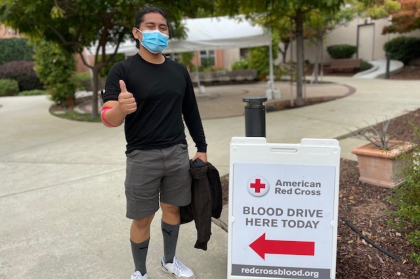
Do you want to give blood but don’t know how? Are you curious about donating blood but aren’t sure what is involved? Join Emmanuel as he goes through the five simple steps of donating whole blood.
1. Book it
The best way to make an appointment is on the American Red Cross Blood Donor app. That is how Emmanuel made his appointment the day before. “It’s too easy with the app,” he says.
You can also make an appointment online at redcrossblood.org or by calling 1-800-RED CROSS.
Pro tip: “Hydrate the day before your appointment,” says Eric Magalued, Team Supervisor at the San Fransisco Blood Center. “The day of the donation: EAT! Have something in your stomach.” Eric has been taking blood donations at the Red Cross for five years. He knows that drinking lots of water the day before and eating before you donate will lesson the chances you will feel dizzy.
2. Check in
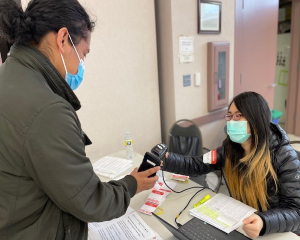
The Blood Donor Ambassador at the front desk asks for your donor card and identification (such as a driver’s license). They scan the QR code on your phone if you have a RapidPass. The Ambassador also gives you some material to read about donating blood.
Pro tip: “Complete the RapidPass,” says Eric. Donors can save time by completing a RapidPass which allows them to complete the pre-donation reading and health history questionnaire online, on the day of the donation, from a mobile device or computer.
3. Health history
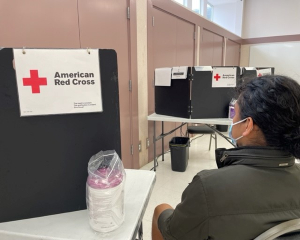
Complete a private and confidential questionnaire with a trained technician in a separate room or a cubicle. The questionnaire covers topics like travel, medications and health.
The technician gives you a brief physical exam, checking your vital signs, blood pressure, temperature and pulse. They also look at your arm veins to see if they appear suitable for donation and prick your finger for a drop of blood to check your hemoglobin levels.
4. Give blood
Lay down on a reclining chair in the blood collection area and a Phlebotomist will disinfect your inner elbow and insert a brand new, sterile needle there. The needle will draw blood through a tube and into a collection bag. Once the bag is full for a whole blood donation – which is one pint in about 10 minutes – the Phlebotomist will remove the needle and bandage your arm. Other types of donations, like plasma, platelets and Power Red can take up to two hours to complete.
Many people wonder if the needle will hurt. The Red Cross recommends you pinch the fleshy underside of your arm to experience a similar feeling. Emmanuel agrees with that description. He says, “It feels like a pinch, just a split-second pinch.”
Pro tip: If you feel faint, Eric recommends squeezing your legs together to force the blood from your legs back to your heart. Tell the Phlebotomist you are feeling dizzy and then cross your legs, squeeze your inner thigh and stomach muscles, stretch your ankles and hold for five seconds. Repeat five times then switch legs.
5. Snack time
Remain for 10 to 15 minutes longer to ensure you are feeling well after your donation. Get refreshed with a free snack and a drink.
6. Bonus!
Please don’t forget to make your next donation appointment on the app before you leave.
Emmanuel will be back for sure. He says, “It’s a wonder to think the blood is going to someone who I will never meet, but it’s going to help them.”
Thank you to blood donors like Emmanuel who show up to provide life-saving blood!
A veteran’s transition to civilian life can be tough and sometimes it becomes hard to find a purpose in serving after leaving the U.S. military. But for many veterans, volunteering and responding to community needs is a way to share comradery and apply their unique skills and talents to the needs of their local neighborhood.
On this Veterans Day, we’d like to recognize all the Red Crossers who continue their service after service across the Northern California Coastal Region.
We are honored to have all of them on our team – across counties and lines of service, and we proudly present some of their unique stories:
Daniella Zapata Regional Business Operations Coordinator
Photo courtesy of Daniela Zapata
At 17 years old, I enlisted in the United States Marine Corps to serve our country. It was my first experience doing something for the greater good and it taught me to think beyond myself and to look out for those around me. On my first day of bootcamp, I was introduced to the Red Cross and its services to our armed forces. A Red Cross card was handed to me to fill out with all the contact information for my unit. This tool would be used by my family if they needed to contact me. The Red Cross would quickly pass on information in case of emergency. Military training was intense, but I had the comfort of knowing that my family could find me if needed.
While in the fleet, I had the pleasure of working as an embark and logistics specialist where I learned valuable skills that continued to be of use after my military service – discipline, hard work and the importance of integrity.
In 2005 Hurricanes Katrina and Rita hit our nation and I felt an overwhelming need to help. The news showed immense devastation and volunteers from the Red Cross were already on-site providing comfort and relief. I immediately checked in with our local Red Cross office, which was buzzing with community members taking various trainings, ready to lend a hand. This was my calling; I knew my experience moving resources in the Marine Corps could be used to help with disaster relief efforts. Within a few weeks, I had taken all the classes needed and was deployed to Texas. The service I was able to provide alongside thousands of other volunteers was immeasurable. We looked into the eyes of those who lost so much and through generous donations from across the nation, we were able to provide hope.
Those moments sparked something in me that has continued to fuel my passion for service through the Red Cross for the past 17 years. Every day I get to work alongside community members who volunteer their time and talents to support our military personnel, assist families after a disaster, provide lifesaving blood, and so much more. I am honored to have the opportunity to continue serving our beloved country.
Semper Fidelis!
Diane St. Denis Pacific Division Disaster Health Services Advisor
Photo courtesy of Diane St. Denis
I spent 3 years in the Navy during the Vietnam War, and it was there that I realized how little I knew about the world. I also saw discrimination and limitations on what I, as a young woman, could expect as far as deployment opportunities, but also made lifelong friends, saw the Blue Angels up close and personal, and met the love of my life, my partner in crime, my Marine, my husband.
As a naive 18-year-old (who thought I was very worldly), I joined the Navy with no idea what to expect – I only knew that I wasn’t ready to do the college thing. After a battery of tests, I was told I was going to Air Traffic Controller “A” school after bootcamp.
I was promoted to AC3, learned how to handle a stressful but exciting job, and how to live on a minuscule paycheck. To this day, Kraft Macaroni & Cheese is a meal near and dear to my heart. All of the experiences I had in the Navy molded much of my future and made me realize how blessed I am to have learned the value of service to others.
After my discharge from the Navy and getting married, I found a job as a police dispatcher, utilizing the skills I learned in my time in service, but I finally recognized that my life was really meant to be in healthcare. Parenthood delayed my nursing education, and it took many years before I finally obtained my nursing license, but it was worth the wait. Nursing is what I was meant to do all along. I joined the Red Cross while I was in Nursing School, and I haven’t looked back.
I have seen many changes in Red Cross over the years. My training in the Navy taught me to deal with adversity, change direction on a dime, value friendships, the importance of organization, and believing in the mission.
I eventually became the Disaster Health Services Lead for my Red Cross Chapter and was later appointed the advisor for the Pacific Division. At some point, I will relinquish the advisor role, and when I do, hope to have more time so that I can become more active in Service to the Armed Forces and serve our military community.
Reflecting on early my life, I learned the value of giving to others from my parents, particularly my mother. The Red Cross allowed me to utilize my nursing skills while helping others in need.
I have devoted myself to a life of service, including volunteering for organizations outside the Red Cross. It all started by serving my country and I continue to do that through my service in the Red Cross. And, like most of us that volunteer, I couldn’t do it without the support of my family. Their support of the mission and my passion allow me to do all that I do.
Kathleen Lenihan Services to the Armed Force Volunteer Partner
Photo courtesy of Kathleen Lenihan
I joined the Army Nurse program in 1970 when I was still in nursing school. After graduation I was lucky to be stationed stateside at Fort Ord, California, for a year and then at Letterman Army Medical Center in San Francisco. I was the first army nurse to have a baby and stay on active duty at the Letterman Army Medical Center.
After I was released from active duty, I joined the Army Reserve and provided medical support to the active duty who were in training. We also set up a combat support hospital in various areas of the U.S. and provided medical care for those who were ill or injured during their time in the field.
While I was on one of these training missions, we had a briefing from a Red Cross volunteer who gave us the number for the Hero Care Center to give to our family members. My son was 17 at the time and staying home alone, having this number was a relief. If he needed to get a message to me, he was able to do it through the Hero Care Center, so in my personal experience, it does work.
One of the highlights of my Army Reserve training was going on a medical mission to a small town in the northern Andes mountains, called Cajamarca (Perú), at 9,000ft height. We went there for two and a half weeks and provided medical care to the local residents. We also brought along our veterinary team to provide veterinary care to the animals. Most people don’t realize the number of medical missions that the U.S. military provides throughout the years to countries that have very little medical or veterinary care.
Kathleen is now the Volunteer Partner for the region’s Service to the Armed Forces team, she is a Red Cross representative at the VA Hospital in San Francisco, and she is a member of the Disaster Health Services team, deploying to support people affected by disasters big and small.
Larry Dietz Regional Public Affairs Volunteer Partner
Photo courtesy of Larry Dietz
I began my military service in September 1963 when I joined Reserve Officers Training Corps at Northeastern University, Boston. It was either ROTC or gym class, and I hated going to the gym, so it was an easy decision.
I was commissioned a 2nd Lieutenant, Military Intelligence, US Army on August 1, 1968. In April 1969 I was assigned to the 509th Radio Research Group in the Republic of Viet Nam, where my first assignment was as a Radio Research Platoon leader in support of the 1st Infantry Division in Quan Loi, Dau Tieng, and Xian.
September 1969 found me reassigned as a Communications Security (COMSEC) Officer and responsible for Crypto Facility inspections. My tour in the Republic of Viet Nam was over in April 1969 and I was released from active duty in September 1970. I served four years in the inactive Army Reserve and was discharged in September 1974.
In 1980 I decided that I wanted to go back into the Reserve and was reappointed as a Captain and commanded the 519th ASA Company, providing support to warfighters such as the Marines and the 7th Infantry Division. Subsequent assignments in the Reserve took me to Dobbins Air Force Base in Georgia.
In August 1989, I joined the Strategic Intelligence section. From July 1997 to February 1998, I served as the Deputy Commander of the Joint Information Campaign Task Force, Sarajevo, Bosnia, and I was promoted to Colonel in November 1998.
After my retirement, in April 2002, I graduated from the US Army War College. I served as a volunteer instructor for deploying personnel at Fort Hunter Liggett in December 2003 and April 2005, and was elected Honorary Colonel of the US Army in 2003, and served in that position until 2010.
In the summer of 1999, I attended a Red Cross Northern California Coast Region Training Symposium in Pebble Beach, Calif. where I was certified as a Public Affairs Associate. I volunteered sporadically until December 2016 when I was assigned as the Volunteer Partner to the Regional Communications Director.
In addition to Public Affairs, I am active in Service to the Armed Forces and serve as an International Humanitarian Law Instructor. I have deployed for the San Jose Flood, numerous wildfires and two mass casualty events.
Being a Red Crosser has certainly afforded me opportunities that I wouldn’t have had otherwise. It’s very refreshing to work for an organization that has a universal humanitarian cause. It feels that you’re actually helping others and Red Cross volunteers are genuinely nice people – they just want to help out and do good.
To learn more about how the Red Cross supports active military, veterans and their families or volunteer to work alongside them to make our communities stronger, visit redcross.org/SAF.










 Your Red Cross Update