Co-authored by Channa Sweet and Jill Feldon LaNouette
October 20, 1957 newspaper clippings of the 4-alarm fire that took place on Fell St. Credit: The San Francisco Examiner // Archives
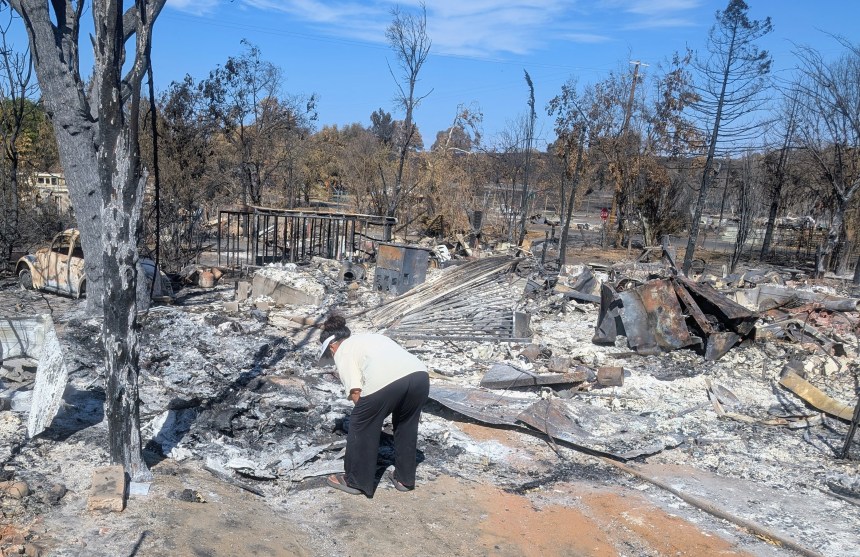
Carol awoke at 2 a.m. to an unimaginable scene unfolding in front of her. She was trapped in a room with smoke burning her nose and flames licking at the door. Unable to leave through her bedroom door, she climbed out her window and escaped from the third floor down an already burning fire escape. With singed hair and bare feet firmly planted on the cold ground, she stood across the street feeling like she was “watching her whole life burn away.”
The Community Adaptation Program team together at the 2025 American Red Cross Northern California Coastal Region Gala. Pictured are Lucy Rojas (left), Gabriela Perez Albarracin (middle) and Maria Magaña (right).
By Mark Phillips, Board Member Central Coast Chapter
The American Red Cross Community Adaptation Program (CAP) is an initiative to enhance the ability of local and hyper-local organizations to provide services during disasters. The Red Cross leverages its expertise, partnerships and network to level up the impact of the grassroots organizations that know their communities best. By building the capability, capacity and continuity of these groups during blue sky periods, they are better able to provide vital services during trying times.
CAP came to Monterey County in July of 2024, when Gabriela Perez Albarracin joined the area from the Lake County, California. Under her leadership, the first year of CAP activity in Monterey County has had a number of successes and laid the groundwork for an impactful year two.
Growing up in the small town of Jagraon in Punjab, India, Amarjot Toor witnessed firsthand what it means to live without access to basic healthcare. In his rural neighborhood, a doctor’s visit was a luxury many families couldn’t afford. People often turned to home remedies or simply endured their suffering in silence. Conditions like Alzheimer’s, which touched Amarjot’s own family, were deeply misunderstood, mislabeled as superstition or dismissed entirely. There were no local specialists, no awareness campaigns, and no lifelines for those silently struggling.
Amarjot enjoys a sunset view of the bay and Golden Gate Bridge.
These early experiences left a mark that wouldn’t fade. When Amarjot moved to the United States in 2017 as a 6th grader, he carried those memories with him. In 8th grade, during a visit to a Red Cross blood drive in Vacaville, something shifted. He saw how a single unit of donated blood could save lives. He watched how people came together to support strangers they’d never meet. For Amarjot, it sparked a powerful realization: that humanitarian service could make a difference—and that he wanted to be a part of it.
“Now, I have a chance to be part of something that does more than just raise awareness, it saves lives.”
“I’m here for the boys,” Marguerite Holtgrieve told the soldier who would eventually become her husband.
It was 1945. Marguerite, who went by Maggie, was one of several thousand women who volunteered with the American Red Cross during World War II. The Red Cross had started a project to boost the morale of American servicemen abroad and give them connection to home while they fought overseas. Young ladies like Maggie joined a brigade of “Donut Dollies” who served coffee, donuts, and light entertainment out of converted GMC trucks outfitted with kitchens.
Stationed on an army base in Nancy, France, 26-year-old Maggie met Ardo Stocks the day after V-E day. The medic was recovering from a gunshot wound that would later earn him Bronze Star and Purple Heart military medals.
Hi! My name is Brad Warren, and I’m a volunteer with the Red Cross here in Alameda County, California. Technically, I’m called a Blood Services Community Outreach Specialist, which is a fancy title that means I give free talks to the public on the urgent need for more blood donors. I’m also a Public Affairs spokesperson, as well as trained to be a Disaster Cycle Services shelter worker to deploy wherever I might be needed to help staff a shelter in times of an emergency, such as a flood, earthquake, fire, etc. But today I want to focus on why and how to become a donor, because “Ve Vant Your Blood!”
Brad donating blood in the San Leandro office
Before I go any further, let me briefly explain how I became a volunteer. I’m a former business coach, speaker and trainer, and after a 40+ year career, I semi-retired and found myself with a lot of time on my hands. So, I called my local Red Cross office and said I wanted to volunteer, and that my best skill was as a public speaker. And guess what? They told me there wasn’t any such position available! Well, being a rather assertive person (just ask my wife), I asked to speak to someone further up the corporate ladder. To make a very long story very short, two weeks later they called me back. They said, “Brad, we’ve created a new position just for you called a Community Outreach Specialist” and so began my volunteer work doing speaking engagements with the express purpose of getting more people to roll up their sleeves and donate.
Volunteers with Hope Crisis Response Network help clean up the muck in resident’s homes.
“Pajaro was a really good project,” said Kevin Cox, CEO of Hope Crisis Response Network (HCRN).
In the city of Pajaro, California, HCRN managed the cleanup after the floods, deploying teams from United Methodists, Team Rubicon and others. Compared to other agencies they’ve partnered with in the past where “we were just a conduit,” the American Red Cross relationship was a true partnership characterized by mutual trust.
First, they formed Hope City Resource Village, a place to collaborate with partners and register families for cleanup.