April Thacker, 2022 Heart of the Valley Chapter winner of the Clara Barton Award for Meritorious Volunteer Leadership
When glancing through the list of April Thacker’s many American Red Cross volunteer roles, it’s easy to see why her peers describe her as “the Red Cross mission in action.”
“I love working with people and the community,” she says. “I’m motived by knowing I’m making a difference in someone’s life, one family at a time. I love to share our mission and what all the Red Cross has to offer.”
A Merced County resident, April has been a Red Crosser for two decades; she volunteers alongside her mother, Molly, to lead the local Disaster Action Team (DAT). She also guided the Merced County DAT through an organization realignment in 2019, and helped her team learn the ins and outs of RC Care during the implementation of this new disaster response program software.
Through it all, she says her favorite part of the work is being there for families affected by disasters – providing care and comfort in their time of need.
April’s dedication and compassion for those impacted by disasters has also translated to her work as a preparedness educator, where she meets with local communities and county partners to create disaster preparedness plans.
“Through the years I’ve had the opportunity to work with amazing people who have now become part of my everyday life,” April says of the friendships that she has made with local families and community partners along the way. “I cherish them.”
Because she brings so much to the table, so often, she was recognized in June 2022 with the Red Cross Heart of the Valley Chapter’s top honor, the Clara Barton Award for Meritorious Volunteer Leadership. Named after the founder of the Red Cross, this special award recognizes a volunteer for their years of service in various leadership positions.
“I was pretty speechless when I heard I got the Clara Barton Award,” she recalls. “It’s such a prestigious award in the Red Cross world. It’s such an honor to be chosen for it.”
But, in typical volunteer fashion, April says she couldn’t do what she does without her Heart of the Valley team members. “It takes a village to do all we do and I’m so thankful for each and every one of them.”
To anyone interested in becoming a part of this team and carrying out the same type of fulfilling work that April does, she urges them to do it. To learn more. To “find what tugs at your heart and go for it.”
“There are so many different opportunities and areas to help within the Red Cross,” she said. “It is so rewarding in so many ways.”
It is the work of volunteers like April that bring the Red Cross mission to life every minute of every day.
“I strive to make a positive impact in the world every day. Whether it’s just a smile, hug or just a listening ear.”
Stuart Chessen knows the value of preparedness, but also the power of helping people in their darkest moments.
Photo courtesy of Stuart Chessen
“I’ve always been one willing to help,” he says. “I like to talk and listen to people when they’re having a problem. You may help them further along by listening to what their problems are and I am good at listening.”
As the Specialty Vehicle Lead for the American Red Cross Pacific Division, Stuart oversees the maintenance of Emergency Response Vehicles, or ERVs, Mission Ready Vehicles and sheltering trailers. He also leads specialty vehicle driver training, getting both the fleet and people ready to respond and reach communities in times of need. He was recently honored with the Clara Barton Award for Meritorious Volunteer Leadership for the Silicon Valley Chapter of the Red Cross. This is the highest honor of volunteer achievement at the chapter level, highlighting the significant contributions of someone who serves in a series of leadership positions held over a period of years.
Stuart was an active volunteer in his community for many years before he joined the Red Cross in 2009. When asked about what it’s like being a Red Crosser, he responds humbly, “That is our mission in action. I like the way we all work together to help people. We are there to ease some of their pain in difficult situations, where they just don’t know which way to go because their world’s been turned upside down.”
Stuart Chessen in an Emergency Response Vehicle
Stuart has deployed to disaster responses multiple times, both throughout Northern California and nationwide; he even crossed the country to New York as an ERV driver after Hurricane Sandy in 2012.
“We took the vehicle here in San Jose and drove it all the way to the East Coast. We had a small delay in Pennsylvania avoiding bad weather and we reached our destination on Long Island after five days. We did mobile feeding around the neighborhoods where people had no gas or power. They were in cold homes, waiting for us to arrive with a hot meal.”
On the preparedness side of Stuart’s Red Cross contributions, his background as a First Aid & CPR instructor makes him an excellent Be Red Cross Ready presenter and he enjoys teaching disaster preparedness in communities across Santa Clara County. In addition to his many roles, Stuart also works as a trainer and coach for Logistics and Disaster Action Team members, recovery caseworkers, ERV drivers and new volunteers.
Stuart is an extremely dedicated volunteer who wears many hats within the Silicon Valley Chapter and the region. He exemplifies the Red Cross values of compassion, collaboration, creativity, credibility, and commitment. Congratulations on this well-deserved award, Stuart, and for all you do on behalf of the Red Cross.
Marcia Antipa on assignment as a public affairs volunteer during the Caldor Fire in South Lake Tahoe, California in 2021.
If you’ve ever wondered what it’s like to volunteer for the American Red Cross during a disaster – take a look back with me at my first deployment experience – to the Caldor Fire in California.
I am a Public Affairs volunteer with the Northern California Coastal Region. After retiring from a career in broadcast journalism, I now tell stories for the Red Cross.
Late last August, I received the call. I would deploy the next day to the Caldor Fire. I admit, my adrenaline spiked a bit when I got that phone call, but I was excited to put my career skills and Red Cross training to work.
My first stop was Sacramento, and the offices of the California Gold Country Region. This was the headquarters for the Red Cross response to the Caldor Fire and it was a hive of activity. Staffing Services, Public Affairs and seasoned disaster volunteers all gave me valuable advice. Then I hit the road for my assignment: a massive Red Cross shelter in Reno, Nevada.
Growing up in Northern California, I’d spent many vacations in the Sierra Nevada. But as I rounded the last turn on Highway 80 and looked across the Lake Tahoe Basin, a murky curtain of smoke blocked the usually stunning views.
In Reno, I arrived to more smoky skies and 95-degree weather. Armed with my notebook, pen and cell phone, I stepped inside the cavernous Reno-Sparks Convention Center. It was filled with hundreds of cots, evacuees, and volunteers in red vests working nonstop to meet the needs of the shelter residents.
In no time, one of the volunteers walked up and greeted me with a smile. I knew I had found my first story.
Walter Roberts, Junior is a volunteer from Missouri, with Red Cross Disaster Mental Health Services. Walter wears a lanyard that is covered with pins – all commemorating the disasters where he has volunteered for the Red Cross. In 2005, he deployed to Hurricane Katrina in New Orleans, Louisiana.
“I have never left New Orleans in many ways,” he said. “I have worn a fleur-de-lis around my neck for 16 years in remembrance of Katrina and the difficulties, the hardships that people faced.”
This time, Walter was working with fire evacuees. His job was to help people stay calm in an extremely stressful situation, “defusing, deescalating tension. Everyone here – staff, management, has the positive right attitude, focusing on serving the residents.”
Deborah Towers, Disaster Health Services Volunteer
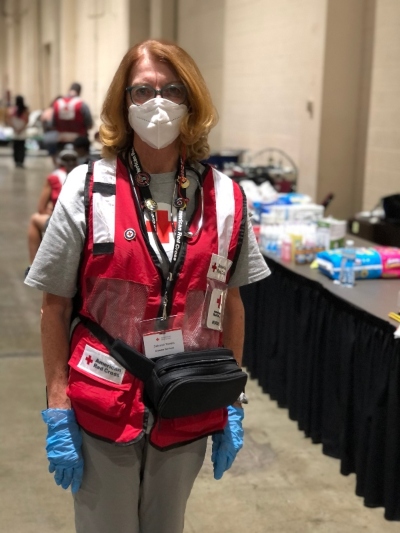
I then met volunteer Deborah Towers, a retired nurse who seemed to be everywhere at once: at the bedside of medically-fragile shelter residents, checking in volunteer doctors, or giving a job to a newly-arrived volunteer nurse. Deborah joined the Red Cross four years ago. Since then she has deployed to hurricanes, wildfires and other disasters.
“We get compliment after compliment about the love that we exude during an emergency. They feel so well-cared-for and so well-provided-for, that it’s just an amazing experience.”
Sometimes it takes a village to meet the needs of a shelter resident. Take the case of Russell Barton. In the 1960’s, Russell answered his country’s call and served in the U.S. Navy in Vietnam. When he arrived at the Reno shelter, his country, and the Red Cross repaid this veteran for his service. The shelter provided Russell with a cot, blankets, food, water restrooms and showers. He told me, “It reminds me of boot camp, but without the bunk beds!”
But Russell had other critical needs. That’s where a team from the Veterans Administration – including a nurse, a pharmacist and a social worker – stepped in. They arranged for supplemental oxygen and prescription medications.
Every day I witnessed acts of kindness just like that. Two veteran Red Cross volunteers who had been evacuated from their own home spent the day cleaning cots, handing out laundry bags, or simply talking with people who needed a friendly face. Another volunteer organized a talent show among the residents to boost morale.
Then one afternoon, the good news swept through the shelter: fire officials had lifted the mandatory evacuation order for South Lake Tahoe.
Whole families quickly packed up their belongings and headed out. Those with cars were on the road within minutes. Others lined up for a free ride home aboard a regional transit bus. Red Cross volunteers gave all the evacuees a boxed lunch and water for the trip. One bus rider was Reed Wells of South Lake Tahoe. He had a joyous reunion with his little dog, “Peepers,” who had been cared for at a local animal shelter.
Caldor Fire shelter resident, Reed Wells
Many people stopped to thank the Red Cross volunteers who gave them shelter, food and comfort during a frightening time. I heard one man say simply, “I love you,” to the workers.
The next day, a Public Affairs colleague and I drove to South Lake Tahoe to see how the Red Cross was helping those who returned home. The lake was blanketed with smoke, and teams of firefighters still headed to the front line, but people were happy to be back.
Two Red Cross volunteers handed out water, meals and snacks from a large truck and people stopped by to share their incredible stories. Jeffrey Grell said his house was in pretty good shape – except there was a bear swimming in his pool!
As we cope with another fire season, I will remember these stories, of the people who survived last summer’s fires, and the Red Cross workers who helped them. Despite those butterflies on the first day, I was not alone on this deployment. Many Red Cross staff and volunteers had my back – keeping me fed, sheltered and well-informed. But my secret weapon was the dynamic duo of Dan Halyburton of Texas, and Kim Mailes of Missouri – two seasoned, talented, Public Affairs volunteers who welcomed me onto their team.
Now my bag is packed and I am ready to deploy again.
To find out how you can help during a disaster, visit: redcross.org.
By Martin Gagliano, Alex Keilty, Jenny Arrieta & Marcia Antipa
Photo by Jenny Arrieta/American Red Cross
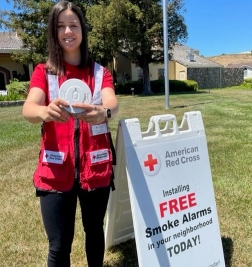
Home fires claim seven lives every day in the U.S. and remain one of the most frequent disasters across the region — but having working smoke alarms can cut the risk of death by half. That’s why over three weekends in May, American Red Cross Northern California Coastal Region volunteers and partners installed 1,217 free smoke alarms and made 450 homes safer as part of the Sound the Alarm program.
Launched in October 2014, the Red Cross Home Fire Campaign aims to prevent deaths and injuries from home fires. Sound the Alarm is a critical part of this campaign. Working with local fire departments and other community partners, Red Cross volunteers visit high-risk neighborhoods, install free smoke alarms and provide residents with safety education on how to prevent home fires, what to do if a fire starts and how to create an evacuation plan.
“Sound the Alarm is a meaningful way to be part of a larger movement while directly helping local families,” said Ana Romero, Red Cross Regional Preparedness Manager. “In just one day, our teams could help save a neighbor’s life.”
Richmond, Calif. 05.07.22. Photo by Brenda Dawson Dove/American Red Cross
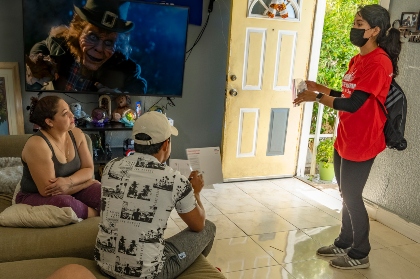
Isabel Oliva and Julio Hernandez are two of many Richmond residents who received a visit from Red Cross volunteers and the Richmond Fire Department on a Saturday morning in early May.
With the help of local volunteer Yvette Cuellar, Isabel and Julio learned how to prevent home fires and create an evacuation plan to keep their family safe.
Volunteers like Yvette are the heart and soul of this lifesaving program. After four successful Sound the Alarm events across the Bay Area Chapter in May, 396 free smoke alarms were installed, making 132 homes and 392 residents safer in Richmond, Oakland, San Bruno and San Francisco.
Oakland, Calif. 05.14.22. Photo by Kane Wong/American Red Cross
Novato, Calif. 05.21.22 – Photo by Marcia Antipa/American Red Cross
Marin County sisters Angel and Alisa Zhou are two of the dozen Red Cross volunteers who gifted their time to help install smoke alarms and share safety information at the Novato Sound the Alarm event on May 21 in the North Bay Chapter.
“It’s important that for their own safety, and the safety of the children as well, that there are alarms installed,” Angel said.
Alisa chimed in, “It was so much fun meeting these people and getting to know more about our local community.”
Across the chapter in May, Red Crossers made 118 homes and 251 residents of Santa Rosa, Fairfield and Novato safer by installing 270 free smoke alarms.
Fairfield, Calif. 05.14.22 – Video produced by Nanette Shamieh/American Red Cross
Las Lomas, Calif. 05.14.22. Photo by Jenny Arrieta/American Red Cross
Las Lomas, Calif. 05.14.22. Photo by Jenny Arrieta/American Red Cross
On May 14, Red Cross volunteers, local Seaside High School Students and partners from the Monterey County Fire Department came together on a bright, sunny morning in Las Lomas, Calif.
After briefings by the Fire Department, Red Cross Disaster Program Manager Patsy Gasca, and remarks by Monterey County Supervisor Phillips, the teams spread out into the neighborhood to install free smoke alarms and share home fire safety information.
During two weekends of Sound the Alarm events in the Central Coast Chapter, 78 homes and 339 residents from Las Lomas and Watsonville were made safer with the installation of 229 free smoke alarms by our volunteers and partners.
Modesto, Calif. 05.14.22. Photo by Martin Gagliano/American Red Cross
The Heart of the Valley Chapter had a busy Saturday morning on May 14 when Red Cross volunteers and staff gathered at the Modesto Mobile Home Park for a Sound the Alarm event alongside the Modesto Fire Department and local community partners.
In this community, Red Crossers, including long-time volunteer Tracey Singh, visited 23 homes and installed 48 free smoke alarms. Tracey is an experienced volunteer who enjoys helping equip residents like Martha Guerrero with the knowledge needed to keep her family safe in event of a home fire.
Martha is one of the 89Modesto residents that was provided with safety information and had free smoke alarms installed in their home during this Sound the Alarm event.
“I dealt with people who have been through fires or floods in their homes and these fires are really fast,” said German Barajas, who used to work at a restoration company. “With a plan in hand already, everyone gets out safely and nothing really bad happens, besides the property being damaged, and that’s always replaceable.”
German was happy to receive a visit from Red Cross volunteers at his home in San Jose on May 21 as part of the region’s signature Sound the Alarm event. In just one day, Red Cross volunteers from the Silicon Valley Chapter installed 274 free smoke alarms, making 99 homes safer and helping 329 residents.
San Jose, Calif. 05.21.22 – Video produced by Alex Keilty/American Red Cross
“My stepdad has been a fireman for 27 years, so we have always talked about fire preparedness, prevention, escape plans and what to do in case of emergencies. It’s definitely been drilled into me from a young age how important these things are,” says Megan, a volunteer for the Red Cross Sound the Alarm program.
San Jose, Calif. 05.21.22 Photo by Alex Keilty/American Red Cross
Megan was one of 297 local Red Cross volunteers that helped with the Sound the Alarm events across the Northern California Coastal Region this May.
In addition to these larger Sound the Alarm events, the Red Cross will continue this work across the region throughout the year, installing free smoke alarms and conducting home fire safety educational visits with individuals and families on an appointment basis. Residents who need assistance or would like to schedule a visit with Red Cross volunteers can sign up at SoundTheAlarm.org/NorCalCoastal.
The Red Cross Home Fire Campaign has helped save at least 1,275 lives across the U.S. since its launch, including 24 lives saved right here in the Northern California Coastal Region. As part of the campaign, the Red Cross, along with partners, has installed more than 2.3 million free smoke alarms and made 982,369 households safer nationwide.
This work is made possible thanks to generous financial donations from regional partners: Pacific Gas and Electric Company; E. & J. Gallo Winery; Arista Networks; Silicon Valley Bank; and State Farm.
For a full suite of photos from the month’s events, visit the full Northern California Coastal Region album. To watch additional videos from the month’s events, visit YouTube.
The U.S. Air Force hosted their annual Wings Over Solano Air Show at Travis Air Force Base on May 14 and 15. The show was open 11 a.m. to 3 p.m. on both days and featured a wide range of aircraft from the Pitts Special S13, right on through to state-of-the-art aircraft such has the B-2 Spirit Stealth Bomber and the F-35 Lighting multirole combat aircraft.
Red Cross volunteers converged on Travis from all of the Northern California Coast Region Chapters – Silicon Valley, Bay Area, Central Coast, Heart of the Valley and North Bay. Under the leadership of Liz Dietz and Marilyn Byington, volunteers offered training, minor first aid supplies such as band aids, water and ear plugs. They also informed show goers about the Red Cross mission and spoke to service members about services the Red Cross offers to them and their families.
Volunteer Stuart Chessen managed logistics for the effort. More than a dozen additional Red Cross volunteers supported the event, and volunteer Salma Samar took great photos and videos.
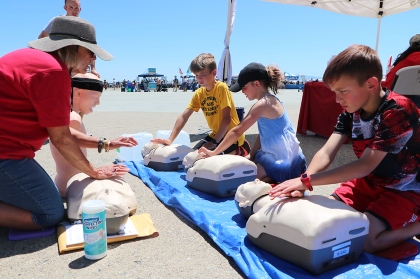
Mary Ann “Stormy” Reilly and Stuart Chessen taught hands-only CPR, which is a relatively new technique introduced to help save lives through CPR where people are reluctant to give rescue breaths, especially in the COVID-19 era. On these two wonderfully warm days, there were kids aged 7-14 years old and some older adults who stopped by to observe, practice and learn about ‘Hands Only CPR’ and what to do if someone is choking on something. These people got down on their knees to practice, and worked hard to do what they needed, to help save someone’s life.
Photo by Samar Salma/American Red Cross
Peg Geringer taught ‘Stop the Bleed.’ If you are involved in an incident where there is a severe, bleeding wound, the first thing to do is to call ‘911’. After that, Peg explained that you use direct pressure to stop the bleeding by putting your two hands over the wound and pressing down hard with your upper body. If you have a roller gauze, take the end of it and start stuffing the injury with as much gauze as you can. Tie off the roll over the wound and if you have a tourniquet handy, apply it 2-3 inches above or below the wound, but NOT over a joint. Turn the stick or windlass as tight as you can to stop the bleeding. Tourniquets are used as a LAST resort to stop the bleeding. Cover them to prevent shock. You may put a large ‘T’ on their forehead with a Sharpie, so the medics know the person has a tourniquet on their body.
Together these two seasoned volunteers trained about 60 people during the weekend event.
The Red Cross presence at Wings over Solano was another example of Red Cross Service to the Armed Forces support. The Red Cross provides the military services with emergency communications services, support to Military Hospitals and Veterans Affairs (VA) Health Facilities as well as by building strong families and resilient communities.
After retiring, some people play golf and some people play bridge, but Christine Medeiros plays amateur detective.
Christine is a volunteer caseworker and Pacific Division Lead for Restoring Family Links – a program of the Red Cross and Red Crescent networks that reconnects loved ones separated by international crises. Tracking down missing people here and overseas takes lots of old fashioned detective work plus some technical savvy – and Christine has both.
Christine started volunteering for the American Red Cross in 2018. Her first case (before the COVID-19 pandemic) called for her and a teammate to go door to door in San Francisco searching for an elderly gentleman whose last known address was in the Tenderloin neighborhood and whose family in Ukraine had no word from him.
“We found him!” she says. And that’s a pretty typical result for Christine. After working 40 cases locally and consulting on approximately 30 cases in other Red Cross regions around the country, she is confident about her ability to find people whose last known whereabouts is the West Coast of the United States. As she says, “When they are here [on the West Coast], I can usually find them.”
Once COVID-19 hit, all her work went remote and she became “an online detective,” as she calls it. Nowadays she works from home in Marin County at any time of the day, evening or weekend that suits her schedule.
Although it may seem unrelated, her professional background (she retired from the technology industry where she worked in marketing and partnerships) has actually been an asset to her part-time sleuthing work as a Restoring Family Links caseworker. Being comfortable doing computer searches, completing online forms, writing letters, being organized, speaking in front of audiences – these are all skills she honed in her previous work life. She says speaking languages in addition to English can be an asset to the role as well. Caseworkers must also be compassionate and offer comfort to family members who may be distressed.
“It takes a little bit of social work because people can be very upset, even angry,” she says.
Christine Medeiros
Families seeking a missing relative can submit requests to the Restoring Family Links program online or by phone. When a Red Cross caseworker is assigned, they gather as much information as possible about the sought person – including full name, date of birth, names of parents, last known address, last known contact location, past telephone numbers, email addresses, any languages spoken, occupation, religion, and a photograph. This information is uploaded to an international case management system that is accessible to the Red Cross and Red Crescent network worldwide. And then the case will be assigned to another volunteer caseworker who is in the country where the individual is being sought.
So Christine may be gathering information from a family member who lives here, or she may be looking for a missing individual who was last seen in this area.
When the missing person’s last known location is here, Christine will use the information provided by the family overseas to begin a search. She will call all previous phone numbers, send letters to all previous addresses, reach out to former employers, and connect with religious and immigrant groups to see if they know this person. She will also look for Facebook accounts and use Google Earth maps to look for and eliminate addresses and mailboxes. The Red Cross also has access to databases which can provide consumer information and public records. Caseworkers may also do some cultural and historical research to put the missing person’s experience in context and provide more leads as to their current whereabouts.
So who are these missing people? Some cases go back as far as World War II. A majority of the cases come from Central America and Africa, though globally there are 100 armed conflicts and 90 million people displaced due to war, climate change, persecution, violence and poverty.
To protect these vulnerable people, the program is totally confidential and the only people who can initiate requests are family members, not government or other organizations. Once the individual is located by a Red Cross caseworker, they can choose if they want to reconnect with their family or provide no information at all – not even a message that they were found. The American Red Cross respects their privacy.
To access the Restoring Family Links program, the family member must have been separated internationally as a result of conflict, disaster, migration or other humanitarian emergency; must have already tried normal channels of communication to reconnect; be able to provide essential information about the sought person, and must have been in direct contact with the sought person before the crisis occurred.
Some cases are resolved quickly and happily; perhaps an individual in a war zone is able to send word to family overseas, or the person is located through the dogged investigative work of the caseworkers. But sometimes the result is sad news that the person has died or is unable to be found.
“Searches can go on for years,” says Christine. And while all cases are important, some haunt her and can’t be forgotten. Like one case she had years ago where she was seeking a person who had fled from South Vietnam.








 Your Red Cross Update