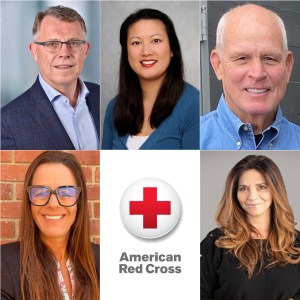
At the heart of the Red Cross’s vast network lies an essential role: that of the Board of Director’s Chair for a local chapter. These individuals play a pivotal part in guiding community leaders and leading their respective chapters to fulfill the organization’s mission to alleviate human suffering.
Our region’s five Chapter Board Chairs share their inspiration for joining the Red Cross below, and the critical responsibilities and significant contributions they hope to make in the community. We thank all our Board Members for their dedication, commitment and impact to ensure the Red Cross remains a beacon of hope and support when it is needed most.
To learn more about our chapters within the Northern California Coastal Region and our Board Members, visit: redcross.org/norcalcoastal
“What you guys are doing, you reassure us that people are out there and care.”
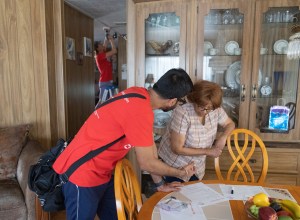
Lucie Tison and her husband Tom at his house in San Rafael. Photo by Marcia Antipa / American Red Cross
Lucie Tison and her husband Tom have lived in the Contempo Marin Mobile Home Park in San Rafael for 17 years. On a recent Saturday morning, teams of volunteers from the Red Cross fanned out across this community of 400 homes to install free smoke alarms for residents. This Sound the Alarm event is part of the Red Cross Home Fire Campaign, a national program designed to save lives from home fires through installation of free smoke alarms and fire safety education.
As of August 23rd, the Red Cross announced that since the start of the Home Fire Campaign in October of 2014, volunteers have installed more than 2.5 million free smoke alarms with almost 2,000 documented lives saved thanks to those smoke alarms and fire safety education.
The Volunteer of the Year Award honors individuals who best exemplify the humanitarian spirit of volunteerism.
It’s the highest honor a volunteer can achieve within our chapters, meaning that they made significant contributions to the American Red Cross over the last calendar year. These volunteers worked in multiple roles alongside fellow volunteers and staff, providing support to all lines of service. In short, they exemplify the Red Cross mission, and we are proud to share the 2022 award winners.
Paulina Munoz, lead for the winning team Photo courtesy of Paulina Munoz.
Story by Richard Payne
Creating a successful campaign focused on International Humanitarian Law (IHL) that is fun, engaging, and educational would seem like a daunting task. Doing it with a virtual team of high school students who never met face-to-face would seem doubly difficult. Yet, the winning team in the 2022-2023 Northern California Coastal Region (NCCR) IHL Youth Action Campaign did just that.
In Northern California, 8 teams, comprised of nearly 40 high school students, participated in IHL training. Each team then developed and delivered IHL awareness campaigns at their schools during the academic year. As a culmination of the campaign, a symposium was held to showcase each team’s work, the struggles they faced and the efforts they took to overcome those challenges. A panel of judges scored each campaign on a series of factors and chose the team that demonstrated the best problem-solving and leadership skills.
Razi Aftab and Paulina Munoz led the winning team, which included students from two of the region’s Red Cross chapters – the North Bay and the Heart of the Valley Chapter, covering Stockton and the surrounding area. Because the team members lived far apart, they only met virtually in weekly calls.
Paulina believed the bond they formed was one of the team’s greatest strengths. “The best part of the campaign was being able to work as a team throughout the term. We got to know the other team members and felt connected. As a result, we were a lot more productive,” she said/
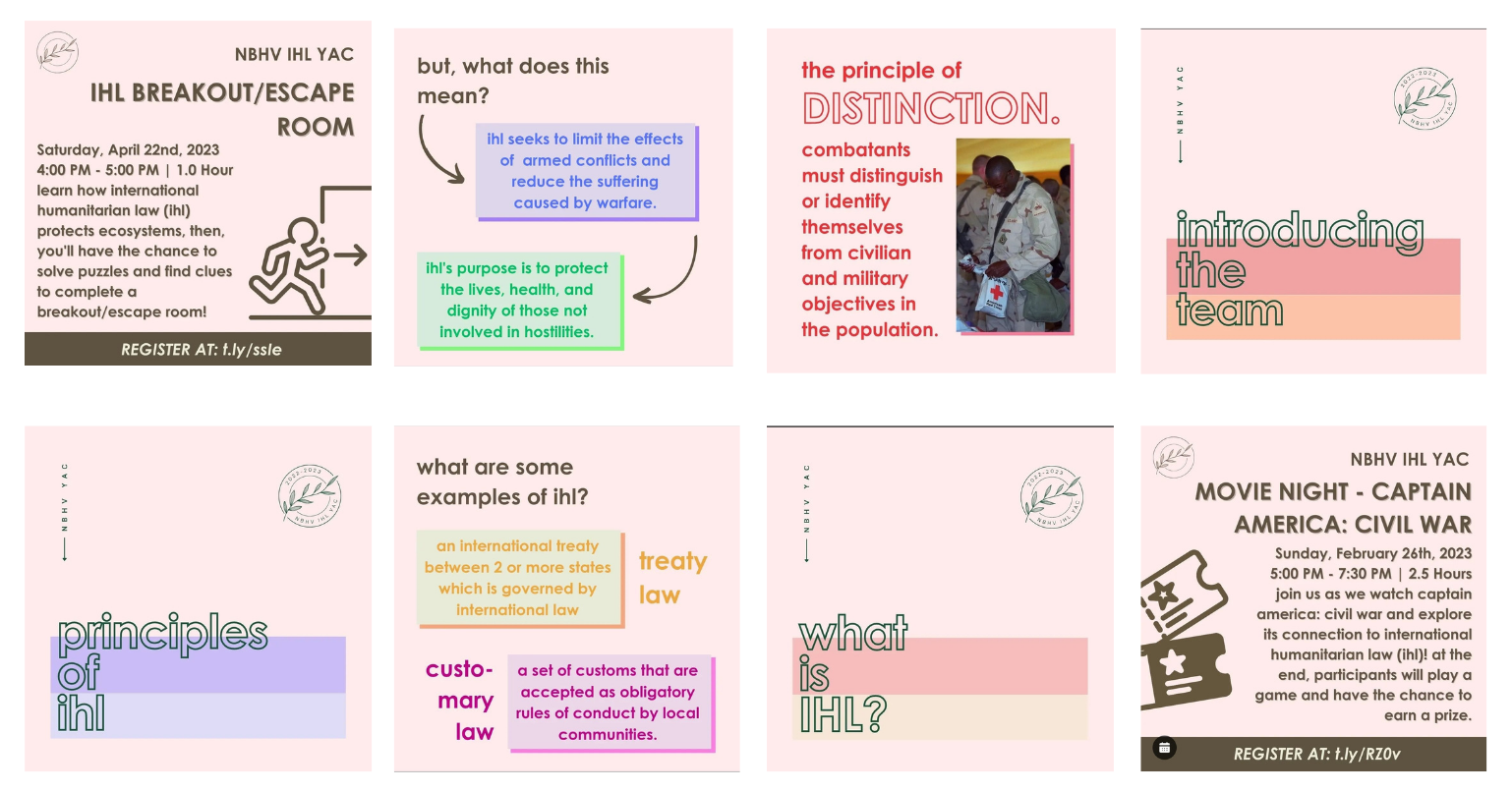
A screenshot from the Instagram account of the team, showing the activities they planned for the campaign.
In building their campaign, the team members identified that their peers had limited knowledge of the Red Cross or International Humanitarian Law. That’s why the team felt that engaging students had to be their number one priority.
“Attracting youth to be involved in the campaign was a challenge. That’s why we focused on having activities that we thought our peers would enjoy as opposed to approaching this campaign from a teaching perspective,” Razi explained.
During the academic year, each team member organized and hosted events at their school around the topic of IHL. The team also created activities and events such as interactive question-based games that tested the advocate’s knowledge on IHL.
“Probably the most distinct event was our escape room,” Razi said. “We had case studies on International Humanitarian Law and asked the advocates to work through those examples. They had to review the scenarios and apply the information they had learned to come up with the best option. We had very good engagement with that!”
In summarizing their personal experiences with the campaign, Razi shared: “Our greatest takeaway was that we were able to foster a sense of community. The program felt like a group effort rather than an academic exercise. It was voluntary and each person contributed to reaching the end goal of increasing the understanding of International Humanitarian Law.”
Paulina had similar sentiments about this experience: : “A lot of the students who participated in the campaign came into it with no idea what international humanitarian law was about. Through their participation in the campaign, they took away an understanding of IHL and the knowledge that international humanitarian law and services were more available to them than they thought. It was a great way to get them to know their community, the Red Cross, and what we stand for as a society.”
Congratulations to these incredible teams on formulating a thoughtful campaign and for spreading awareness about IHL!
Red Cross volunteer John Gee has installed more than 2,000 free smoke alarms in homes across the region since the launch of the Sound the Alarm campaign in 2014. Photo by Ashish “Ash” Mantri/American Red Cross
Home fires claim seven lives every day in the U.S. and remain one of the most frequent disasters across the region — but having working smoke alarms can cut the risk of death by half. That’s why, over five weekends in April, volunteers with the American Red Cross Northern California Coastal Region, along with local fire departments and community partners, installed 1,294 free smoke alarms and made 462 homes safer as part of the annual Sound the Alarm campaign.
“A working smoke alarm can be the difference between survival and tragedy when a home fire strikes,” said Ana Romero, Red Cross Regional Preparedness Manager. “That’s why the Red Cross is teaming up with community partners to help ensure local residents, especially those most vulnerable, have these lifesaving devices.” Sound the Alarm events are part of the Red Cross Home Fire Campaign which has helped save at least 1,664 lives nationwide since launching in October 2014. Working with local fire departments and community partners, Red Cross volunteers visit high-risk neighborhoods, install free smoke alarms and provide residents with information on common causes of home fires, how to prevent them, what to do if a fire starts and how to create an escape plan.
This work is made possible thanks to generous financial donations from our regional Sound the Alarm campaign partners: Pacific Gas and Electric Company; Arista Networks; CSAA Insurance Group, State Farm; and Gloria and Mike Ipson.
Red Cross volunteers and partners installed 396 free smoke alarms and made 190 homes safer in April across the Bay Area Chapter. More than 500 residents of San Francisco, San Bruno, Brentwood and Hayward are now better prepared to face emergencies after receiving education about home fire prevention.
“Every day, our department sees first-hand the damage and destruction that home fires can have on a community,” said Willie McDonald, Fire Chief for the Alameda County Fire Department. “This is why campaigns, like Sound the Alarm, are so important. A little home fire prevention can go a long way toward keeping families and the community safe, and a smoke alarm is one of the most effective tools we have to do that. We are proud to partner with the Red Cross for this very important event.”
Photo by Nanette Shamieh American Red Cross
Heart of the Valley Chapter
71 homes were made safer in the Heart of the Valley Chapter after two Sound the Alarm events in Stockton and Los Banos.
Red Cross volunteers and community partners installed 169 free smoke alarms and helped 210 residents to create an escape plan and be better prepared in case of a home fire
North Bay Chapter
Photo by Nanette Shamieh American Red Cross
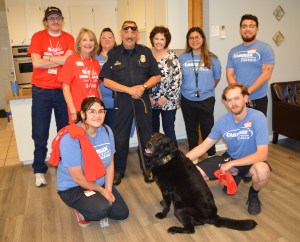
Community partners and Red Crossers installed 354 free smoke alarms and made 116 homes safer in the North Bay Chapter. Over the three events in Sonoma, San Rafael and Vacaville, the teams shared home fire prevention educational information with more than 230 residents to make the community safer.
Captain Drew Kostal and his K-9 “Kepi” from the Vacaville Fire Department attended the installation event on Saturday, April 29. He spoke with the team about the importance of working smoke alarms.
Silicon Valley Chapter
Photo by Atul Trviedi American Red Cross
Red Crossers and community partners gathered at Millpond Mobile Home Park on Saturday, April 29 to install 205 free smoke alarms in 85 homes to make more than 140 residents safer.
Red Cross Board and Tiffany Circle Members participated in Sound the Alarm events across the region to help make their community safer.
Sound the Alarm – Signature Event in Hayward (CA) – April 29, 2023 Photo by Martin Gagliano – American Red Cross
Story and Photos by Marcia Antipa, Public Affairs Volunteer
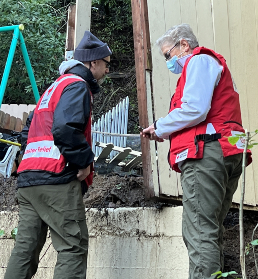
Joe Baldi and Dianna Soula inspect damaged Marin County building Photo by Marcia Antipa / American Red Cross volunteer
After weeks of heavy rain and high winds, the sun has come out again in California. However, the American Red Cross disaster response continues. More than 800 trained Red Cross volunteers from nearly all 50 states have been supporting people in the affected communities. Eighty shelters were opened during the disaster, and the Red Cross, working with community partners, distributed thousands of meals and relief items such as comfort kits and cleaning supplies. Now, as people slowly move toward recovery, volunteer Red Cross Disaster Assessment Teams are spreading out through storm-ravaged communities, taking stock of damage to homes.
“The assessment gives us information on the homes that were destroyed or had major damage,” says DA volunteer Joe Baldi of Sacramento.
Baldi and fellow volunteer Dianna Soula of Lancaster, Ohio recently visited an apartment complex in Marin County, California. During the heavy rains, a mud-soaked hillside slammed into one of the buildings, making it uninhabitable. The two walked through thick mud to view the home, then documented the damage using guidelines from the Federal Emergency Management Agency (FEMA). That information helps the Red Cross and its partner agencies provide assistance for those displaced by the disaster.
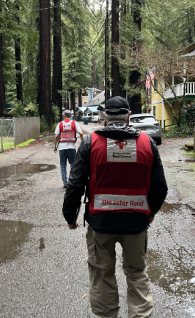
Al Gharibian and Howard Wilkens doing Disaster Assessment in Guerneville Photo by Marcia Antipa / American Red Cross
Right now, more than a dozen of Disaster Assessment teams have “boots on the ground” in California. Volunteers Howard Wilkens of Kansas City, MO and Alan Gharibian of Glendale, CA, took a preliminary Disaster Assessment tour of the Sonoma County town of Guerneville along the Russian River. After days of heavy rain, the river was swollen, muddy and threatening to crest its banks. The two men visited the Guerneville Fire Department to get information on which neighborhoods were hardest hit. Wilkens, who has deployed for the Red Cross to 30 disasters across the country in five years, explains just some of the damage they look for after a storm.
“For example, we look for water lines on the side of the house, broken joists on the roof decking, or homes where the winds have blown off the siding or the roof shingles.”
Alan Gharibian recently deployed to Hurricanes Nicole and Ian in Florida. He says the devastation and the suffering in the wake of the hurricanes was “heartbreaking, to say the least.” But he says he is happy to volunteer again, using his 37 years of experience in the insurance business to help assess the damage in California.
Ultimately, Disaster Assessment volunteers are the heart of the Red Cross mission to prevent and alleviate human suffering in the face of emergencies.
“It’s the Red Cross’s goal to assist them in any way they can,” says Dianna Soula, “to get them into a recovery state, someplace where they’re safe, have comforts and feeding, and medication that they needed, and just try to get their life back on track as quickly as we can.”
To find out how you can help those hit by the California storms, visit redcross.org.






 Your Red Cross Update