Tag Archives: biomed

Getting Blood to Babies in Need

By Alex Keilty, American Red Cross volunteer

Across the top of the box is a typed address label for a local hospital and a simple handwritten note: “Pediatric Order.” Down the side is the American Red Cross logo and the words “Human Blood.”

Volunteer Claudia Langley loads the white box into the trunk of a Red Cross van, along with the rest of the boxes packed with blood products she is delivering to four hospitals today.

As she starts the engine and types the address of the hospital into the GPS on her cell phone she says, “The sad part is there are not enough donations.”

It’s true, she’s right. Certain kinds of blood are rarer than others. For example, this pediatric order she is carrying today – blood destined for babies – must be screened for a flu-like virus called CMV that is very common and mild in adults but can be fatal to infants. Only about 15 percent of American adults have not been exposed to CMV and therefore are able to donate to newborns. Plus, blood products have a limited shelf life so there is always a need for more donations to replenish the supply.

But today, there is blood available for a tiny patient in MarinHealth Medical Center, thanks to blood donors and volunteers like Claudia, a blood transportation specialist.

Retired from a career in art direction and graphic design, Claudia has been doing this role for the Red Cross for 2.5 years. To get trained, she completed a course online and then shadowed a fellow volunteer until she felt comfortable going alone. Now she does a four-hour shift once a week by herself.

As she drives across the Richmond Bridge over San Francisco Bay she plays music on the radio – “anything but country” – and explains how her volunteer role gives her faith in the good in others.

“It makes me feel better about people in general. You run across people who are trying to help,” she says.

Half an hour after setting off from the Red Cross Oakland Blood Center, she pulls up to the front of the hospital, stacks some of the Red Cross boxes on a cart and rolls them to the lab. Clinical laboratory scientists will match the blood types of the donated blood to patients’ blood types and then give it to the doctors and nurses who are treating the babies and other patients awaiting these blood products.

Everyone she interacts with mentions how grateful they are for her efforts, including Red Cross staff, laboratory staff and even strangers in the hospital.

“Sometimes random people walk by and say thank you for doing this,” she says.

Claudia has encouraged friends and acquaintances to begin volunteering as Red Cross blood transportation specialists because of how positive her experience has been.
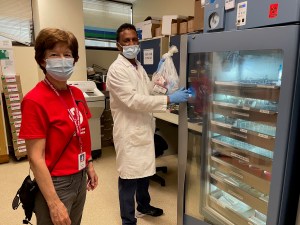
“It’s not strenuous or super challenging, but it’s something you can do that’s helpful,” she says. “I am thrilled with the way they treat me and the way they are organized for the drivers and deliveries.”

From Marin she will do deliveries to hospitals in Richmond, Alameda and then back to Oakland where she will hand in the keys to the van and head home before traffic gets busy.

She describes her role as “getting the blood to where it needs to be” and today she definitely delivered blood to where it needed to be: to a tiny patient waiting in hospital for life-saving treatment.

The Red Cross relies on volunteers like Claudia to ensure patients have lifesaving blood products when they need them – and more volunteers are needed. Learn more and submit a volunteer application at redcross.org/volunteertoday.
From Donor to Distribution: A trip through the blood lab

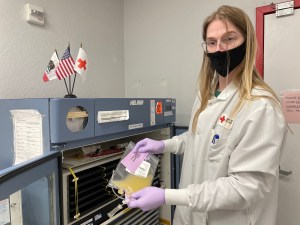
The request arrives from a local Kaiser Permanente hospital just before lunch: a patient needs platelets STAT! “Stat” means immediately; if you watch hospital dramas, you might already know that. But this is no fictional TV show, it’s a real assignment for Nataly Breisath, a Hospital Services Tech in the American Red Cross blood lab in San José.

Nataly Breisath prepares a unit of platelets. Photo by Alex Keilty/American Red Cross.

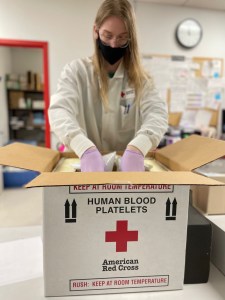
Nataly grabs a clear bag of the yellowish platelets from the agitator – a machine whose shelves slide back and forth constantly to keep the platelets full of oxygen. She packs the bag into a box bearing the Red Cross logo and marked “Rush: Keep at Room Temperature.” It will be driven to the hospital immediately.

Although the order form doesn’t say who the patient is or why they need platelets, that component of blood can be essential to surviving surgeries, fighting cancer, chronic diseases and traumatic injuries.

Is it stressful for Nataly fulfilling orders for blood products from local hospitals?

Once an order for blood products comes in to the lab, techs like Nataly Breisath carefully pack them for delivery. Photo by Alex Keilty/American Red Cross.

“There is usually some amount of pressure (and a little anxiety),” she says. “Even more so with stat orders.”

The most challenging ones are when orders for a massive transfusion protocol come into the lab – when a patient needs approximately 10 units of blood within 24 hours – which is roughly equivalent to the volume of blood in an average adult. It can be tough hearing details later on the news about a tragedy and figuring out that is what led to the transfusion. But Nataly says she is glad she can “possibly save their life and help with recovery.”

Although Nataly doesn’t meet the patients who receive the blood she prepares at the lab, she does know someone personally whose life was saved by blood donations, someone who had a “significant need after giving birth.” So Nataly knows for sure that giving blood saves lives.

Before blood can get to a hospital patient from a Red Cross lab it needs to undergo many steps:

Red blood cells are stored in special refrigerators for up to 42 days. Photo by Alex Keilty/American Red Cross.
  1. The donation: People go to a donation center to give blood.
  2. Processing: After giving blood at a local drive, it is packed on ice and taken to a blood manufacturing laboratory where it can be separated it into transfusable components, such as red blood cells, platelets and plasma.
  3. Testing: As the donation is processed, test tubes with blood samples that were taken at the time of donation go to a testing laboratory where a dozen tests are performed to determine the donor’s blood type and check for infectious diseases. These results are transferred to the processing center. If any diseases are found, the donor will be notified and the blood is discarded.
  4. Storage: Once testing is complete, the processed donation will be labelled and stored. Red cells are stored in special refrigerators for up to 42 days; platelets are stored at room temperature for up to five days while being continuously agitated to prevent them from clumping together; and plasma can be stored in freezers for up to one year.
  5. Distribution: Hospitals keep some blood products on their shelves, but the Red Cross is on standby to replenish those supplies and respond in case of an emergency.

Learn more about the blood donation journey: https://www.redcrossblood.org/donate-blood/blood-donation-process/what-happens-to-donated-blood.html

Story, reporting and photos by Alex Keilty

Recent Entries »