Category Archives: Homepage Posts — Other

Service to the Armed Forces Volunteers Support ‘Wings Over Solano’ at Travis Air Force Base

By Larry Dietz, Public Affairs Officer
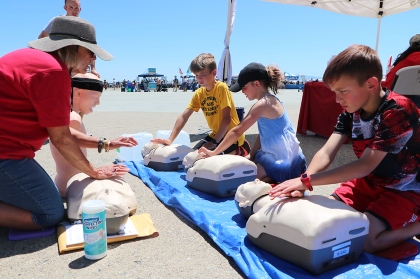
Photo by Samar Salma/American Red Cross

The U.S. Air Force hosted their annual Wings Over Solano Air Show at Travis Air Force Base on May 14 and 15. The show was open 11 a.m. to 3 p.m. on both days and featured a wide range of aircraft from the Pitts Special S13, right on through to state-of-the-art aircraft such has the B-2 Spirit Stealth Bomber and the F-35 Lighting multirole combat aircraft.

Red Cross volunteers converged on Travis from all of the Northern California Coast Region Chapters – Silicon Valley, Bay Area, Central Coast, Heart of the Valley and North Bay. Under the leadership of Liz Dietz and Marilyn Byington, volunteers offered training, minor first aid supplies such as band aids, water and ear plugs. They also informed show goers about the Red Cross mission and spoke to service members about services the Red Cross offers to them and their families.

Volunteer Stuart Chessen managed logistics for the effort. More than a dozen additional Red Cross volunteers supported the event, and volunteer Salma Samar took great photos and videos.

Mary Ann “Stormy” Reilly and Stuart Chessen taught hands-only CPR, which is a relatively new technique introduced to help save lives through CPR where people are reluctant to give rescue breaths, especially in the COVID-19 era. On these two wonderfully warm days, there were kids aged 7-14 years old and some older adults who stopped by to observe, practice and learn about ‘Hands Only CPR’ and what to do if someone is choking on something. These people got down on their knees to practice, and worked hard to do what they needed, to help save someone’s life. 

Photo by Samar Salma/American Red Cross

Peg Geringer taught ‘Stop the Bleed.’ If you are involved in an incident where there is a severe, bleeding wound, the first thing to do is to call ‘911’. After that, Peg explained that you use direct pressure to stop the bleeding by putting your two hands over the wound and pressing down hard with your upper body.  If you have a roller gauze, take the end of it and start stuffing the injury with as much gauze as you can. Tie off the roll over the wound and if you have a tourniquet handy, apply it 2-3 inches above or below the wound, but NOT over a joint.  Turn the stick or windlass as tight as you can to stop the bleeding. Tourniquets are used as a LAST resort to stop the bleeding.  Cover them to prevent shock.  You may put a large ‘T’ on their forehead with a Sharpie, so the medics know the person has a tourniquet on their body.

Together these two seasoned volunteers trained about 60 people during the weekend event.

The Red Cross presence at Wings over Solano was another example of Red Cross Service to the Armed Forces support. The Red Cross provides the military services with emergency communications services, support to Military Hospitals and Veterans Affairs (VA) Health Facilities as well as by building strong families and resilient communities.
Missing But Never Forgotten: Red Cross Program Reconnects Families

By Alex Keilty

After retiring, some people play golf and some people play bridge, but Christine Medeiros plays amateur detective. 

Christine is a volunteer caseworker and Pacific Division Lead for Restoring Family Links – a program of the Red Cross and Red Crescent networks that reconnects loved ones separated by international crises. Tracking down missing people here and overseas takes lots of old fashioned detective work plus some technical savvy – and Christine has both.

Christine started volunteering for the American Red Cross in 2018. Her first case (before the COVID-19 pandemic) called for her and a teammate to go door to door in San Francisco searching for an elderly gentleman whose last known address was in the Tenderloin neighborhood and whose family in Ukraine had no word from him.

“We found him!” she says. And that’s a pretty typical result for Christine. After working 40 cases locally and consulting on approximately 30 cases in other Red Cross regions around the country, she is confident about her ability to find people whose last known whereabouts is the West Coast of the United States. As she says, “When they are here [on the West Coast], I can usually find them.”

Once COVID-19 hit, all her work went remote and she became “an online detective,” as she calls it. Nowadays she works from home in Marin County at any time of the day, evening or weekend that suits her schedule. 

Although it may seem unrelated, her professional background (she retired from the technology industry where she worked in marketing and partnerships) has actually been an asset to her part-time sleuthing work as a Restoring Family Links caseworker. Being comfortable doing computer searches, completing online forms, writing letters, being organized, speaking in front of audiences – these are all skills she honed in her previous work life. She says speaking languages in addition to English can be an asset to the role as well. Caseworkers must also be compassionate and offer comfort to family members who may be distressed.

“It takes a little bit of social work because people can be very upset, even angry,” she says.

Christine Medeiros

Families seeking a missing relative can submit requests to the Restoring Family Links program online or by phone. When a Red Cross caseworker is assigned, they gather as much information as possible about the sought person – including full name, date of birth, names of parents, last known address, last known contact location, past telephone numbers, email addresses, any languages spoken, occupation, religion, and a photograph. This information is uploaded to an international case management system that is accessible to the Red Cross and Red Crescent network worldwide. And then the case will be assigned to another volunteer caseworker who is in the country where the individual is being sought.

So Christine may be gathering information from a family member who lives here, or she may be looking for a missing individual who was last seen in this area. 

When the missing person’s last known location is here, Christine will use the information provided by the family overseas to begin a search. She will call all previous phone numbers, send letters to all previous addresses, reach out to former employers, and connect with religious and immigrant groups to see if they know this person. She will also look for Facebook accounts and use Google Earth maps to look for and eliminate addresses and mailboxes. The Red Cross also has access to databases which can provide consumer information and public records. Caseworkers may also do some cultural and historical research to put the missing person’s experience in context and provide more leads as to their current whereabouts.

So who are these missing people? Some cases go back as far as World War II. A majority of the cases come from Central America and Africa, though globally there are 100 armed conflicts and 90 million people displaced due to war, climate change, persecution, violence and poverty.

To protect these vulnerable people, the program is totally confidential and the only people who can initiate requests are family members, not government or other organizations. Once the individual is located by a Red Cross caseworker, they can choose if they want to reconnect with their family or provide no information at all – not even a message that they were found. The American Red Cross respects their privacy. 

To access the Restoring Family Links program, the family member must have been separated internationally as a result of conflict, disaster, migration or other humanitarian emergency; must have already tried normal channels of communication to reconnect; be able to provide essential information about the sought person, and must have been in direct contact with the sought person before the crisis occurred.

Some cases are resolved quickly and happily; perhaps an individual in a war zone is able to send word to family overseas, or the person is located through the dogged investigative work of the caseworkers. But sometimes the result is sad news that the person has died or is unable to be found.

“Searches can go on for years,” says Christine. And while all cases are important, some haunt her and can’t be forgotten. Like one case she had years ago where she was seeking a person who had fled from South Vietnam.

“The Canadian Red Cross could not find him, but I still look every once in awhile,” she says.  To learn more about the Red Cross Restoring Family Links program visit your local Red Cross chapter, call 844-782-9441 or complete the online form at https://www.redcross.org/about-us/our-work/international-services/reconnecting-families.html.

Disaster Response: From Behind the Scenes to the Front Lines

By Alex Keilty

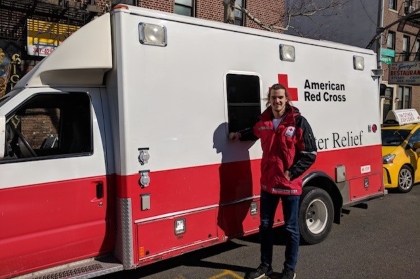
Cameron with an Emergency Response Vehicle in New York City in 2019, which is used to deliver food and water to the site of a disaster.

When Cameron Bochman was completing his accounting degree in North Carolina, did he ever imagine his work would take him to a meeting with FBI agents who were investigating a helicopter crash in New York City? No he didn’t, because his career path has been anything but predictable.  

Cameron, an American Red Cross employee, studied accounting because he had a natural talent for it. He says, “I took accounting because it clicked with me. But I didn’t really feel it was my passion.”

He found that passion after a two-year stint as a Peace Corps volunteer teaching English in China.

“I knew I wanted to do something in humanitarian work,” he says. “And the Red Cross really stood out.” And so this Boston hometown boy packed his bags for New York City three and a half years ago to start his job as a Disaster Response Manager working the overnight shift from midnight to 8 a.m.

Part of a Disaster Action Team – a group of employees and volunteers who are the first, on-the-scene, Red Cross contacts at the site of disasters – Cameron observed the “power of volunteers,” as he calls it. His volunteers responded to countless home fires within an hour of getting a call from the fire department. On site, they provided a shoulder to cry on for those displaced by the fire, and financial assistance in the form of a prepaid debit card that residents could use for shelter at a hotel, groceries, replacing clothing or any other expenses. Then the residents would be referred to Red Cross caseworkers for help with further recovery. 

But back to that meeting with the FBI agents… In addition to home fires, there were unexpected emergencies like when a helicopter crash landed on the roof of a Manhattan building, tragically killing the pilot and erupting in flames.

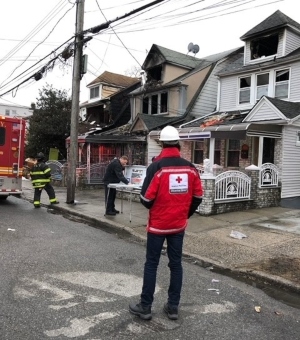
Cameron at the site of one of his first Disaster Action Team responses in New York City, responding to a multi-family fire in Brooklyn. 

On that freezing cold day, Cameron and his team brought a van loaded with meals, snacks and water to feed first responders as they worked at the site. Cameron also attended meetings with the intelligence agents who were investigating the crash to determine if it was a terrorist act.

Working in New York was never boring, but after a year Cameron wanted to work with the community in a different way. Running public engagement events and prevention programs appealed to him. And so did the sunny skies of California!  

So he moved to Alameda County, to become a Disaster Program Manager, where he helps organize the Home Fire Campaign including the Sound the Alarm program to install free smoke alarms in homes across the county, and the nation.

Cameron and his team of employees and volunteers are also ready to respond to small and large scale tragedies, like when a lightning storm in the summer of 2020 sparked fires across Northern California. Cameron’s team facilitated the opening of an evacuation center and set up a shelter where evacuees from Livermore could sleep, get hot meals, access mental health support and receive the latest information from emergency responders.

Not predictable but definitely rewarding, Cameron says of his work: “You walk away feeling like you did something good.”

A Welcoming Presence

Ebony Jean Daniel has served as a Red Cross Blood Donor Ambassador – and friendly face – at the Oakland Blood Center for two and a half years, much of that time spent during the COVID-19 pandemic.

“When looking at the good that is done through this role – every two seconds, someone needs blood,” she said. “That’s why I choose to give the time that I have given at the Red Cross, especially during the pandemic. I had the free time and felt that it was worth it to give the hours I give every week – to take the burden off others.”

As a Blood Donor Ambassador, Ebony Jean helps donors check in for their appointments, ensures COVID-19 health and safety guidelines are being followed and keeps the waiting area and canteen tidy. Perhaps most importantly, she is a welcoming presence and the first and last person donors see at their appointments, thanking them for their time and their lifesaving gift.

“People don’t really understand how vital blood products are for women giving birth. When people deal with terminal illnesses on a daily basis, the blood products they require are so important. These are some of the multiple different reasons why I chose to volunteer with the Red Cross.”

Prior to the pandemic, Ebony Jean was also a Red Cross Humanitarian Services volunteer, navigating the disaster recovery casework process in order to support families affected by disasters big and small, and helping local youth prepare for emergencies through The Pillowcase Project.

Ebony Jean Daniel, Blood Donor Ambassador at the Red Cross Blood, Platelet and Plasma Donation Center in Oakland.

“Under the umbrella of the Red Cross, there is so much good that takes place,” she said. But eventually, Red Cross Blood Services is where Ebony Jean decided to focus her time and talent.

“As far as Blood Services – people just don’t realize that in the time it takes to snap your fingers, that’s how often people require blood for survival. I never know what could come down the line in my future – I might need to be a recipient someday. We knock on wood that this kind of thing doesn’t happen, but you just never know.”

The Red Cross collects about 40% of the nation’s blood, which is precisely why volunteers like Ebony Jean are so critically important to the overall donation process.

“Looking at the whole picture – coming in, giving my time, taking the burden off other Red Cross workers so they can concentrate on their jobs and we can gather more donations – I focus on customer service, so donors have a pleasant experience. I feel there is a personal obligation, but also it is a pleasant experience for me. I have had a lot of positive interactions, and I definitely enjoy that.”

Thank you, Ebony Jean, for all you’ve done and continue to do for the Red Cross and the community. We are lucky to have you as a volunteer and we know countless blood recipients are grateful for the part you play in the blood donation process.

A Track Record for Saving Lives

By Alex Keilty

There was that one time Ian Wigley gave CPR to a gentleman at a card game, and then there were those other times — at a wedding, a family gathering, and a restaurant — that he helped people who were choking. It’s fair to say that Ian, an Instructor Trainer with the American Red Cross, has a great track record for saving lives. 

American Red Cross Instructor Ian Wigley

Ian teaches frequent first aid classes and says the training is important because, “You CAN help somebody. It will give you the skills and confidence to help until the Emergency Medical Service arrives.”

Ian’s classes include adult and child CPR, choking, how to stop life-threatening bleeding and how to use a defibrillator.

In addition to the people Ian has helped directly, there are also his students who go on to save the lives of others. 

One especially rewarding experience was when a student he had previously taught rushed to tell him how they had been able to assist a coworker who went into cardiac arrest. That man recovered and eventually went back to work.

“I was kind of emotional,” Ian said. “I was excited they were able to help somebody. They had managed to keep calm and do what needed to be done.” 

Class participants Andreina Pardo (left) and Gabrielle Valdez (right)

Gabrielle Valdez and Andreina Pardo attended a recent class taught by Ian. They were on a quest to get certified in first aid for their new jobs in child care.

“Before the class I felt nervous,” Gabrielle said. “Now I feel much more confident.”

They learned how to perform CPR, treat choking, and stop life-threatening bleeding. The Red Cross course they opted for was conducted partly online and partly in person.

“It’s important because you can save someone’s life,” Andreina said. “It’s to be better prepared.”

If you want to feel more confident that you can handle a first aid emergency, you can sign up for Adult and Pediatric First Aid/CPR/AED skills courses at www.redcross.org.

The Cost of War

Red Cross teen volunteers spread awareness about the impact of armed conflict

By Marcia Antipa

“It’s just better for humanity that everyone knows about it.”

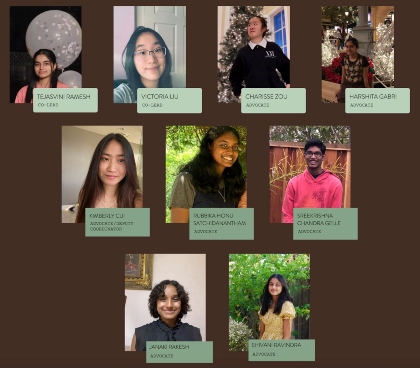
IHL In the Bay, a Youth Action Campaign team from the East Bay.

Bay Area teen Janaki Rakesh is talking about International Humanitarian Law (IHL), a set of rules developed under the Geneva Conventions designed to limit the impacts of armed conflict.

Rakesh and 40 other students in the Northern California Coastal Region are studying IHL through the Red Cross Youth Action Campaign (YAC).   

Kimberly Cui says she signed up for YAC because  “I just wanted to explore more about what other people in the world were facing.”

In past years, the campaign has focused on the effects of war on healthcare workers and on education. This year’s theme is cultural property.

“The destruction of cultural property’s permanent, so when it’s damaged or when it’s destroyed it has a direct impact on that particular community,” says Sarina Vij, Coordinator for the Bay Area YAC.

Vij says cultural property “is something that is of great importance to a particular community. It could be a statue; it could be a monument. “

For example, she cites the Taliban’s destruction in 2001 of two giant Buddha statues in Afghanistan that were 1600 years old.  

Some teens are surprised to learn that the Red Cross is involved in International Humanitarian Law.

Harshita Gabri says, “Initially when I heard about Red Cross I thought of it as an organization that was in charge of blood donations.”

Priyanka Supraja Balaji

“Before I knew anything about the details about Red Cross, I always thought of it as an organization that provides humanitarian aid,” says Priyanka Supraja Balaji. “I wanted to be a part of spreading that mission and really being one of the people who is helping others.”

And Rubikka Satchidanantham says, “I thought this campaign was the perfect opportunity. Not only am I able to learn more about IHL, but I’m also able to educate others.”

Janaki Rakesh said she is passionate about teaching others about IHL, because she has followed the story of Malala Yousafzai. Malala is an outspoken advocate for girls’ education who survived being shot by the Taliban, and won the Nobel Peace Prize at age 17.

“I read all of Malala’s books. She’s a girl from Pakistan. Her life was destroyed by war.”

The YAC teams spread awareness about IHL through Instagram posts and Zoom game nights, where participants answer questions about war and cultural property.

Sreekrishna Gelle posted on the group’s Instagram feed about a firebombing during World War Two, “where American and British bombers basically flattened the entire city of Dresden in Germany which was a center of cultural, architectural and artistic history.”

 “I have never seen a more creative group of individuals,” says Sarina Vij. “They are very good at coming up with different ways to navigate and problem-solve. “

One team held an online scavenger hunt, sharing food, clothing, and souvenirs from other countries. Victoria Liu says that made her appreciate her own Chinese heritage – and what cultural property means to others. “It represents a lot about people and if you destroy these properties, you’re destroying peoples’ identities.”

And the work doesn’t end when the games do. “We used feedback forms and heard back from people that they want to make it more engaging,” says Shivani Ravindra. “So we’re working on improving those for the next event.”

YAC presentations are all virtual for now,  but team member Tejasvini Ramesh says that is their secret weapon.

“We’re able to spread awareness about it a lot quicker than we would through in-person events because with the power of social media we can reach lots of people from different parts of the world.”

Beyond teaching their classmates about IHL, several teens say they find the concepts comforting.

“During war, we think it’s all chaotic,” says Charisse Zou, “but I found it really fascinating how there were actually laws to protect the people and cultural property.”

“It gives me a really safe feeling,” says  Priyanka Supraja Balaji. “Things that have such a personal attachment to you like a place of worship or anything like that won’t get targeted.”

Anyone can learn about IHL and take part in the teams’ online events.  Just visit:

https://ihlinthebay.wixsite.com/ihlinthebay

https://www.redcross.org/humanityinwar/international-humanitarian-law-youth-action-campaign.html

« Older Entries Recent Entries »