A wildfire deployment shows the Red Cross mission at work on both sides of the border
“I like helping the community and giving back, so when I saw the opportunity to deploy outside the U.S., it grabbed my attention.”
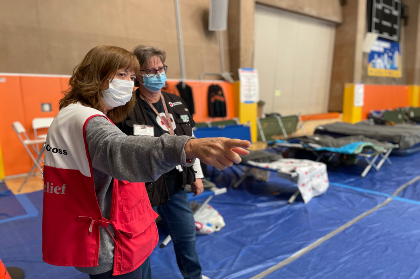
Lucy in a wildfire shelter in Winnipeg.
Lucy Rojas is no stranger to disaster work. The Red Cross veteran, based in Monterey County with the Northern California Coastal region, recently finished a deployment to Canada to assist with the Canadian Red Cross response to the 2025 wildfires. But her initial disaster response was stateside in 2018.
“In 2018, I was deployed to the Parkland shooting; I was an intern at the (Red Cross) Broward County Chapter in Florida when it happened,” she said. The Red Cross was one of many humanitarian organizations that responded to the Feb. 14 mass casualty event at Marjory Stoneman Douglas High School. Seventeen people lost their lives that day. The Red Cross provided on-site support at the Family Assistance Center.
“Then I was deployed to a shelter the Red Cross opened in response to a fire at a local senior living complex. Just as that was wrapping up, the Florida International University pedestrian bridge collapse happened, and I was part of that response. All of this happened within three months.”
Santa Cruz county resident, mental health professional and longtime Red Cross volunteer Jill Hoffman recounts her Loma Prieta earthquake experience 35 years later, including what she’s learned about earthquake safety.
Collapsed roadways were a common sight after the earthquake. Photo credit: U.S.G.S.
“I have been a volunteer in Santa Cruz since 1980 and was part of the Loma Prieta Earthquake Red Cross response in 1989.
I was at work with clients at 5:01p.m. on Oct. 17, 1989 when the earthquake struck; I though we were being bombed, the noise and shaking were so severe. We were just six miles from epicenter. I remember saying very quietly and calmly “door frame! door frame!” (We know now not to do that, and instead to drop to the floor, cover yourself with something sturdy like a table, and hold on until the shaking stops. Doorways are not any more structurally sound than elsewhere in a building and not a safe place to go to during an earthquake.)
“I though we were being bombed, the noise and shaking were so severe.”
I was one of the lucky ones in that I had no major damage to my home, just books falling off shelves and glass breaking. My boss at the County Mental Halth Services (CMHS) came by about an hour and a half after the earthquake via bicycle instead of her car since the route to my neighborhood was no longer driveable. We immediately joined the team working at a disaster shelter at the Civic Center in downtown Santa Cruz.
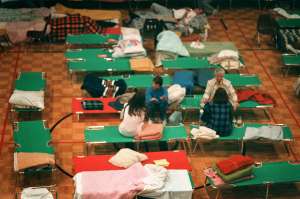
At a Red Cross shelter, residents displaced by the Loma Prieta earthquake sit and talk.
I wore two hats during most of the response: I volunteered at the shelter and did community outreach for Red Cross. Within a few weeks, I assumed the role of the Clinical Mental Health Director for a FEMA grant, a position which was extended to 18 months. We saw 25,000 people during that time.
In Santa Cruz county, (the epicenter of the earthquake) CMHS led the long term mental health care response, taking over from the Red Cross. FEMA hired six full time and 34 contracted mental health care workers.
A washed out road in Santa Cruz county. Photo credit: U.S.G.S.
I met with the couple I had been seeing that day about five weeks later and they said “Jill! You were so wonderful, you were yelling at the top of your lungs “Door frame! Door frame!” So much for my perception of the event at the time.
When we had an aftershock 6 months later I had I had the flight vs. fight response and bolted out of my chair at a restaurant and stared running before my colleague stopped me.”
Thank you, Jill, for sharing your story, your service then, and your continued service now. To learn more about disaster preparedness, including how to be prepared for an earthquake, visit redcross.org/prepare.
Thirty-five years later, a Red Cross volunteer recalls his experience during the 1989 Loma Prieta earthquake.
Red Cross volunteer photographer Larry Brazil remembers where he was during the Loma Prieta earthquake in 1989, 35 years ago today. The 6.9-magnitude earthquake rocked Northern California, with the Bay Area and Central Coast bearing the brunt of the impact. The epicenter was approximately eight miles north-northeast of Santa Cruz and 50 miles from downtown San Francisco. The quake lasted 15 seconds and struck during the peak of evening rush hour. The resulting catastrophic damage and loss of life forever changed the landscape, infrastructure and people of the Golden State. Sixty-six people lost their lives, 2,400 were injured and more than 10,000 homes were left uninhabitable. Larry shares what that fateful day was like, and what happened next:
The aftermath of the Bay Bridge following the earthquake. Photo credit: U.S.G.S.
“October 17,1989 was going to be a special day. Little did I know how memorable that day would end up being. It was special because a friend and I had tickets to Game 3 of the World Series that evening. We got to the game early and had a little tailgate party. We were just getting ready to head into the game when all of a sudden, time seemed to stand still, but the earth surely wasn’t standing still! The parking lot was literally rolling in waves. Cars were swaying back and forth, up and down, with their tires almost coming off the ground. It seemed to last for a long time, but it was probably about 15 seconds. When the shaking stopped, there was a loud roar from inside the stadium. We didn’t yet know the extent of damage and thought that the game would proceed after a delay. While trying to get into the stadium, someone had a little TV and we saw that the Bay Bridge had collapsed. It really sunk in then.
The Bay Bridge was our way home, and we knew we were in for a long night. The only way back home to Pleasanton was to go all the way around the Bay as the other bridges were closed for damage inspection. It took 9 hours to get home at 3a.m. We were transfixed by the images we saw of the widespread devastation. That was our first glimpse into the enormity of the situation.
“The next few days were a blur; it was not business as usual. We were pretty much glued to the TV, watching the drama unfold on the Cypress Freeway collapse and Marina fires.”
The bi-level Cypress Freeway, collapsed onto itself, was a sobering reminder of the quake’s intensity. Photo credit: U.S.G.S.
I was a member of a professional photographers group, the Peninsula Advertising Photographers Association. The Red Cross had reached out to our group looking for photographers to document the recovery efforts. I and two other photographers volunteered; I spent the next couple of days photographing Red Cross recovery efforts, mostly in Santa Cruz county.
I was with them day and night; at night we went out to highway workers in the Santa Cruz Mountains on Highway 17 offering them coffee, snacks, and moral support. During the day I photographed the shelter at the county fairgrounds in Watsonville. I was able to document the many services the Red Cross provided as well as much of the physical damage to the earth and buildings. I was grateful that I was able to contribute in some small way to the recovery efforts.
Landslides and destroyed roads were a common sight near Santa Crus. Photo credit: U.S.G.S.
It took another crisis time (the pandemic) for me to get involved again with the Red Cross. After being laid off due to COVID, I joined Blood Services team as a transportation specialist. I have delivered blood all over the greater Bay Area for the past four years. I have transitioned to doing some sheltering and logistics work in addition to my blood deliveries. I have recently joined the Red Cross communications team and look forward to once again providing the Red Cross with timely photos.”
Thank you for sharing your story and your service, Larry! To learn more about disaster preparedness, including earthquake preparedness, visit redcross.org/prepare.
This information was last updated on Tuesday, January 31 at 11:00 a.m.Please check back regularly for updates.
American Red Cross volunteer Diana giving an update to Shelter Supervisor Peggy at the Seven Trees shelter in San Jose. Photo by Alex Keilty / American Red Cross
As Californians continue cleaning up after the weeks of severe weather at the beginning of January, the American Red Cross is helping and will also be there in the days and weeks to come, supporting people as they move towards recovery.
This online story map offers a look at the ongoing response to the California floods. Since New Year’s eve:
Almost 800 trained Red Cross disaster workers are supporting people in California.
The Red Cross and partners have provided more than 9,300 stays in more than 80 shelters, more than 62,400 meals and snacks, and distributed more than 14,700 relief items such as comfort kits and other relief supplies.
Trained Red Cross volunteers are helping families cope during this challenging time and replacing prescription medications, eyeglasses or critical medical equipment like canes and wheelchairs.
Teams on the ground are also conducting damage assessments to determine the impact of these storms and which communities will need additional support moving forward. Preliminary damage reports indicate that of the 5879 total assessments done to date, 134 homes were either destroyed or suffered major damage.
We Need You!
While trained Red Cross volunteers and staff continue to manage the response efforts, we are looking for additional volunteers to help with disaster response and recovery activities, including feeding, supply distribution, clean-up kit building and more. Apply online to become a Red Cross volunteer by visiting tinyurl.com/ARC2023FloodsApplication if you are interested in helping with this response or responses like this in the future.
Blood During Disasters
The Red Cross is working to maintain a stable blood supply amid the threat of storms and winter weather across the country, as severe weather often causes widespread blood drive cancellations. Where it is safe to do so, we encourage donors to make and keep blood donation appointments by using the Red Cross Blood Donor App, visiting RedCrossBlood.org or calling 1-800-RED CROSS (1-800-733-2767).
Help Those in Need
You can help people affected by disasters like floods, fires and countless other crises by making a gift to Red Cross Disaster Relief.Donations for Disaster Relief enable the Red Cross to prepare for, respond to and help people recover from disasters big and small. Visit redcross.org, call 1-800-RED CROSS, or text the word REDCROSS to 90999 to make a $10 donation..
Stay Up-to-Date on Social Media
Updated information on the Red Cross response to this storm, and preparedness information is continually updated on regional social media channels:
A shark bite survivor reflects on the people – and blood donors – who saved him.
“Hold my ankle!”
Steve Bruemmer heard the command but struggled to comply. Issued by a stranger, repeatedly, the words were out of focus, fleeting. Hold my ankle. Yet Steve knew he had to try; his life depended on it. Facedown on a surfboard, he reached for the stranger’s ankle as his body floundered. A froth of bloody seawater churned around him, while somewhere – below? nearby? – the great white shark that had bitten him only moments before lurked beneath the surface.
“It’s very, very rare that great white sharks bite humans, so I was quite unlucky to have been bit, but very lucky in that I didn’t die.”
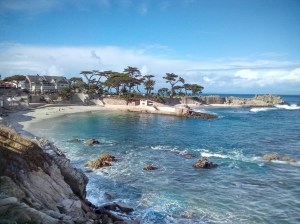
Lover’s Point Beach. Photo courtesy of Steve Bruemmer; editorial use only.
June 22, 2022 was a splendid California summer day. Blue skies and a calm, clear sea beckoned for an open water swim. An experienced swimmer and athlete, Steve, 62, donned his wet suit and set out from Lover’s Point Beach in Pacific Grove for an out-and-back, one and half mile swim. Paddleboarders, beach goers, and a small group of surfers learning water safety dotted the area.
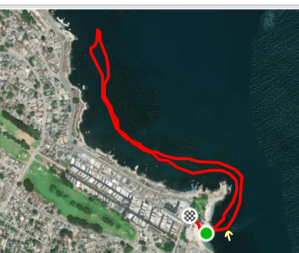
A mere 150 yards from shore on the return leg of his swim, a 15-foot, 2,000-pound Great White shark pummeled him with a bomb-like blast so forceful that he didn’t immediately register he’d been bitten. Likely mistaking him for a seal, the shark had sliced into both of Steve’s thighs and abdomen, delivering near-fatal injuries that rendered him unable to swim.
“After I was bit, I tried to float on my back and looked at my legs. Where there should’ve been wet suit and skin, there was just red.”
A volunteer with the Monterey Aquarium, Steve is deliberate with his choice of words: the shark bit him, it did not attack him. There is no lingering resentment, and he chalks up his encounter to bad luck. Yet the uncanny string of the right people in the right place at the right time that all aligned to save his life that day can only be described as incredibly good luck.
The paddleboarders – a vacationing couple from Folsom, in town to celebrate their anniversary – heard Steve’s cries for help, as did several of the surfers on the beach. One surfing instructor, Heath, grabbed his board and a spare board and immediately paddled out to Steve.
“As Heath approached me, he was looking around for a shark and could see, as he put it, a ‘cloud of blood’ around me, about the size of a car. I was bleeding profusely.”
The route snapshot from Steve’s Strava that day. The yellow arrow denotes where he was bitten. Photo courtesy of Steve Bruemmer; editorial use only.
Heath helped him up onto the spare board and instructed Steve to hold onto his ankle while he paddled them both back to shore. The Folsom couple – Paul and Aimee – had also paddled over to help. Paul, a police officer, dialed 9-1-1 from his paddleboard; Aimee, a nurse, helped Steve.
“Aimee recognized that I was going to fall off the board, I couldn’t control my legs. She jumped off her paddle board and onto the back of my surfboard to hold my legs and help paddle us to shore. Blood is pouring off me, the water is red; she thought she was chumming the water with her own legs.”
Once on shore, with paramedics en route, Steve’s luck continued: of the beach goers, one was a physician and two were ICU nurses. They wasted no time cutting off Steve’s wet suit and securing three makeshift tourniquets. Fading in and out of consciousness, Steve was deathly pale; Paul tried and failed to find a pulse as the ambulance arrived.
Steve was transported to Natividad Hospital, a Level II Trauma Center in Salinas, California. Within 19 minutes of his arrival, he was in surgery. His internal temperature was 91 degrees. He would go on to spend a total of three weeks at Natividad, including time in the ICU. Remarkably, he suffered no broken bones, internal bleeding, or organ damage. Miraculously, the shark missed his pelvic iliac artery by millimeters, skirting certain death.
In addition to a skilled medical team, 33 units of blood helped save his life.
“I knew I was very, very badly hurt and there was a lot of blood. I didn’t connect that with ‘Oh I’m going to need blood’ but I knew I was in grave danger of dying.”
Recovering at Natividad Hospital. Photo courtesy of Steve Bruemmer; editorial use only.
When asked if he’d been a blood donor prior to the shark bite, Steve responded “No, I’d given blood a couple of times before, but I was not a regular blood donor.” He’s quick to add, slightly chagrinned, “That’s a mistake that I will rectify going forward.”
According to the American Red Cross, a 150-180 lb. adult will have approximately 1.2-1.5 gallons (or 10 units) of blood in their body, comprising approximately 10 percent of an adult’s weight. Having arrived at Natividad nearly exsanguinated, Steve was in dire need of a transfusion. During his hospital stay, he would receive 13 units of plasma, 18 units of packed red blood cells and two units of platelets. The experience has changed his perception of blood donation and blood donors.
“I was lucky in that anonymous, good Samaritan blood donors had done the selfless work of giving of themselves to save a stranger.”
In the U.S., the need for blood is constant with someone needing blood on average every two seconds. The blood supply is nearly always chasing demand, as, like Steve used to, many Americans don’t make blood donation a priority in their day-to-day lives. In recent years, largely due to upheaval caused by the COVID-19 pandemic, organizations like the Red Cross have faced blood shortage emergencies and struggled to motivate the public to roll up their sleeves when lockdowns were prevalent and open blood drives were scarce. Even today, when much of American life has found its post-Covid pace, it can still be a challenge to stock the shelves with an adequate supply of blood and blood products. Steve wants to change that and is using his story to inspire others into action.
The October picnic featuring the to-scale cutout of the shark that bit Steve. Photo courtesy of Steve Bruemmer; editorial use only.
“I have a great support system – just unmatched.”
Following his ordeal in June, Steve’s family, friends and community rallied around him, delivering meals, offering support, and in August, donating at a Red Cross blood drive in his honor. Later in October, Steve and his wife Brita hosted a thank-you picnic for everyone who played a part in his rescue and recovery: the Natividad medical staff, friends, family, church members, members of his running, swimming and cycling groups. In all, about 200 people turned out for Steve and Brita; also in attendance was a to-scale cardboard cutout of the great white shark. In a group photo from that day, the cutout is held up in front by nine people. It is an enormous animal.
During the picnic, Steve asked the group how many were blood donors.
“Lots and lots of hands went up,” he recalled. He followed that up by asking those with their hands raised how many had given five or more gallons of blood. Three hands stayed up, including Steve’s brother-in-law.
Now more than six months later from that fateful day, Steve continues to make steady progress with his recovery. He attends physical therapy twice per week and is navigating the transition from using special leg braces to walking with supportive poles. His muscles have healed and are getting stronger; his nerves will take longer to recover. That he was in excellent shape before the incident has proven to be a huge advantage for both his survival and recovery. Still, Steve credits his rescuers, the Natividad medical team and the anonymous blood donors for making his survival possible.
Steve smiles during a break while on a walk; he continues to get stronger as he recovers. Photo courtesy of Steve Bruemmer; editorial use only.
“The unnamed heroes these days, in most trauma cases, it’s the blood donors,” he said.
A second blood drive in Steve’s honor is scheduled for January 12 in Pacific Grove. The three then-strangers who pulled him to safety on June 22, Heath, Paul and Aimee, will be recognized at the drive with Lifesaving Awards on behalf of the Red Cross for their heroism. Steve will be in attendance, and he hopes he’ll be cleared to donate blood – his first donation following the shark bite, and hopefully one of many donations he plans to make moving forward.
When asked what he’d tell someone considering making a blood donation, he paused for a moment.
“It’s easy to say, ‘It could be you.’ You should donate blood because some day you might need it. But that’s not the right answer.” He paused again.
“We are best when we take care of each other, when we come together as a community, take care of each other, and love one another,” he said, emotion giving his voice a husky depth. “We do that when we give blood. I can’t think of a more tangible, meaningful, important way of caring for each other.”
Jamshid Kiani’s path to the American Red Cross is a familiar one for many volunteers: he was led by a spirit to serve others. Media coverage of a Red Cross disaster response in 2015 had piqued his interest, so he sought to learn more.
“A few months after retiring from my job as a chef at a private resort, preparing up to 1200 meals per day, I saw a news item showing Red Cross volunteers providing food and other items to affected clients. I was moved, and I thought to myself ‘I have the knowledge and ability to help with this,’ so I went online to see what the Red Cross is all about.”
Kiani presenting at a Fire Safe event in Santa Cruz County.
That online foray kicked off a humanitarian journey that recently culminated in one of the top honors for a volunteer: this past June, Kiani was awarded the Central Coast Chapter’s Disaster Cycle Services Exceptional Leadership Award. In his seven years as volunteer, Kiani has achieved both experience and leadership in multiple disaster roles, including 46 disaster response deployments, two of those as extended deployments in the Virgin Islands and Oregon. In Northern California, he works with the Regional Response Management Team, and is a disaster response instructor for new Red Cross disaster teams and volunteers.
In short, Kiani has made good on that spirit to serve. But his initial intent to apply his culinary skills on a disaster back in 2015 didn’t quite go to plan. After taking online Red Cross training courses and learning more about the organization, he visited his local chapter office.








 Your Red Cross Update