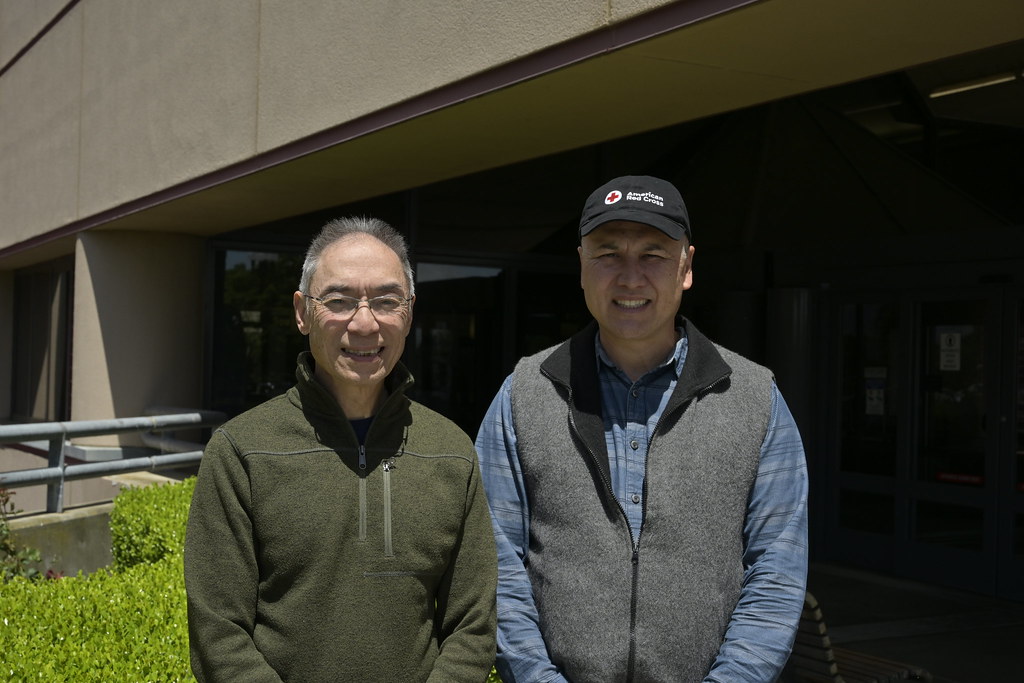
Can you imagine how eager a sports fan would be to hang out with their favorite team for the weekend? That’s how Dan Canlas, MD, retired Lt. Col. of the U.S. Air Force, describes his volunteer role for the American Red Cross. He is keen to spend his free time hanging out with his team of aircrew and operational personnel!
His role as a volunteer flight surgeon is part of a partnership the Red Cross has with the David Grant Medical Center at Travis Air Force Base in California. Dr. Canlas and his fellow Red Cross colleagues volunteer their time and medical expertise at the flight medicine clinic, treating the aircrew and other military members involved in the flying mission.
From left – Red Crossers Aerial Chen, Alzinia Pailin, Dr. Justin Nast, Dr. Dan Canlas, with Col Alexei Kambalov at the flight medicine clinic at David Grant Medical Center at Travis Air Force Base, site of a unique partnership between the American Red Cross and U.S. Air Force. (Photo by Roderick Tapnio)Read more
Baby Ripley needed blood transfusions to recover from open heart surgery.
“He was turning blue when he was crying,” recalls Hayes Shair, about his son. Baby Ripley needed open heart surgery but he was only a newborn.
Ripley’s parents knew before he was born that he had a congenital heart defect called Tetralogy of Fallot. It was identified during his mom’s 20-week ultrasound. But they didn’t expect the operation to happen so fast. Ripley was rushed into open heart surgery at just 30 days old.
“The speed at which it had to be done was unexpected,” Hayes says.
Unfortunately, baby Ripley’s situation is not rare. According to the US Centers for Disease Control and Prevention, heart defects affect nearly 1% of births, or about 40,000 babies, each year in the United States. Congenital heart defects affect how blood flows through the heart and out to the rest of the body. Babies with critical heart defects need surgery or other procedures in the first year of life.
After the surgery to repair the hole between his heart’s left and right ventricles, baby Ripley needed multiple blood transfusions to recover. He stayed in hospital for about two weeks.
But you wouldn’t know it today! An active 8-year-old now, he gets checkups every year but is cleared to do regular kid activities.
Ripley is a healthy and active 8-year-old now.
“He’s a handful, but he’s a fun handful!” says Hayes, a father of two.
Hayes was so thankful for the lifesaving blood his son received that he decided he wanted to donate himself. With some encouragement from his wife (a long-time blood donor), Hayes gave blood for the first time more than four years ago. Now a regular, he gives blood to the American Red Cross every two months.
He says it’s a positive experience, “It feels good. People here are very friendly.”
The Red Cross appreciates blood donors like Hayes, who have learned through personal experience how important blood donations are to saving the lives of children like Ripley. Thank you, Hayes and all our regular blood donors!
If you too are inspired by Baby Ripley to donate lifesaving blood or platelets, make your appointment at redcrossblood.org today!
Meet Alvin Ehiriodo, American Red Cross blood donor, former volunteer and current employee. When it comes to the Red Cross, Alvin has done it all!
“I believe in the mission [of saving lives],” Alvin says of his commitment to the Red Cross. “I want to work for an organization that cares about the work they do.”