
The Detective of Disaster Zones: How a Red Crosser Reunites Lost Families
She still remembers her first missing persons case from eight years ago. An older woman was frantically looking for her daughter and granddaughter who had disappeared after Hurricane Harvey hit Texas and Louisiana. Kathy Kennard, an American Red Cross volunteer, was assigned to track them down, and eventually located the pair!
“She sobbed and sobbed when I told her they were safe in a shelter,” remembers Kathy, who is a Reunification supervisor for the Red Cross. “It’s the most rewarding thing.”
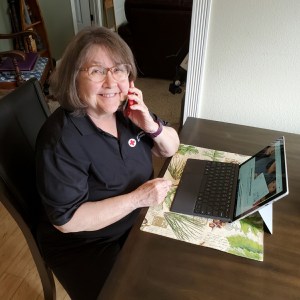
Much of Kathy’s reunification volunteer work can be done remotely with a computer and a phone.
Kathy lives in Washington State and gave a presentation about her role to Red Cross volunteers in the Northern California Coastal Region. As a Reunification volunteer, she explained, she reconnects individuals as fast as possible after a disaster, including war, natural disaster and forced migration. Many of her cases have happy endings like the family separated after Hurricane Harvey.
“Most of the people are just not able to communicate with their families,” says Kathy. But they are fine.
How does Kathy track down these missing people? It all starts when a loved one telephones the Red Cross call center. They are asked to provide as much information as they can about their missing friend or family member: name; age; address; physical description; are they likely to have stayed at home after a disaster or sought shelter with others; do they have medical or mental health conditions? These questions help Reunification volunteers who are working remotely to prioritize the calls and give them a place to start looking.
After the wildfires in Hawaii in 2023, they had many people inquiring about loved ones. Calls came in from France, Italy, Brazil and more, seeking missing residents or vacationers. “We had hundreds and hundreds of missing people from all over the world,” says Kathy.
Volunteers called neighbors, hospitals, coroners, and shelters. Some cases were solved quickly, like that of an elderly lady who was trying to reach her sister-in-law in Maui, Hawaii, but the phone number she had wouldn’t connect. With some research, Kathy realized the woman was dialing the wrong area code and was able to reach the family with the correct number.
Sometimes Reunification volunteers need to get creative, like using social media. For another case in Maui, Kathy was seeking a 25-year-old Brazilian man who had been vacationing there. She messaged his account on Instagram and he messaged her back. He was safe and had left two days before the fire.
“It’s very exciting to be able to find your clients,” says Kathy.
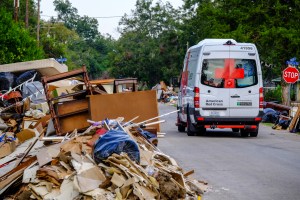
If the Reunification volunteers have no luck with phone calls and online research, they pass the case to a colleague on-site at the disaster. Reunification volunteers working in the disaster zone can go on a door-to-door to search, sometimes finding people at home, who are cut off from communication, and unable to contact family.
Many cases like these have happy endings and Kathy is able to deliver a lot of good news. But some disasters are exceptions.
“The Texas floods were my toughest deployment but I knew that going in,” says Kathy, of her role responding to the aftermath of the deadly floods in 2025. In Texas, 90 per cent of the people she sought had died. “It was the hardest reunification deployment I have been on.”
Kathy is grateful for the few they were able to find alive in Texas. “It was a blessing,” she says of being able to deliver good news to worried relatives.
Although Kathy doesn’t deliver death notices to families – the police or coroner do that – it is still very hard to support anguished families waiting for news of their loved one.
“It breaks your heart when you talk to someone and they can’t find their grandchild or their grandparent,” she says.
Lorraine Jacobs, a Red Cross disaster instructor, explains why Kathy is so good at what she does: “Kathy is sensitive, compassionate, and has years of experience as a Reunification volunteer. It is hard work. Kathy has the calm, reassuring presence needed during these disasters.”
The Red Cross offers specialized training for these volunteers through their Integrated Care and Condolence Team and Psychological First Aid programs. For the affected families and volunteers who need support themselves, there is also disaster mental health support available. Kathy, in particular, calls upon her 20 years of experience as a biblical counsellor to comfort worried families.
If you are interested in finding out more about the Red Cross Reunification program, please visit redcross.org.
 Your Red Cross Update