
Red Cross Volunteer Brought Hope and Housing Help to LA Fire Survivors and Others

What happens when you have nowhere to go after a disaster? What if your neighborhood is destroyed, or your home is no longer safe? For those affected by the January 2025 fires in Los Angeles, Calif., the American Red Cross was there to supply safe shelter, food, relief supplies, financial assistance, comfort and a specific service that only Sue Trautman and her team can provide.
Sue, a Red Cross Northern California Coastal Region volunteer, arrived in LA about a week after the fires devastated communities across the city. She set up shop in the Red Cross offices downtown and got right to work. Sue served on the Shelter Resident Transition Team — a group of volunteers that helps evacuees in shelters create a plan to move into more stable long-term housing.
“We coach them,” Sue explains. “We work together to find their next steps.”
Transition team members meet with shelter residents in person or by phone to identify barriers to finding a place to live. These roadblocks can include transportation, medical needs, income challenges or even something as simple as a missing ID. Maybe their car tires melted in the fire. Maybe they lost their glasses or walker while evacuating. Maybe their phone broke or they struggled with language barriers.

Once the team understands the challenges, they help residents build an action plan. This includes connecting them with appropriate community resources and offering needs-based financial assistance to help overcome specific obstacles. Every two days, the team checks in to track progress and troubleshoot any new issues.
“What was amazing about LA was how many people in the community stepped up,” Sue says. “So many offered places to live. It was easier to place people because of that generosity.”
Like many of her fellow volunteers, Sue didn’t come from a disaster response background. She was a reading tutor and stay-at-home mom to three kids, now grown. However, that didn’t keep her from finding a new vocation in a new field that she feels passionately about.
“I find it really satisfying,” she says. “The results are measurable, and you build a deeper connection with the clients.”
Sue says volunteers need patience, flexibility and a sense of humor — “You never know what’s going to go on,” she laughs — along with compassion, empathy, and a willingness to learn. To develop these soft skills, as well as other competencies, Red Cross provides up to 25 hours of free training for this role.
Sue spent three weeks in LA before returning home. She’s done this work many times — dozens of deployments, both in-person and virtually — since joining the Red Cross in 2014.
One of her earlier deployments in this role was to Florida after Hurricane Ian in 2022. “It was pretty overwhelming,” she recalls. Many were living in temporary rental housing, and the Red Cross helped them work toward longer-term solutions. One man needed help repairing his flooded van so he could get back to his daily routine. Another family needed to relocate to live with relatives in Texas, and the Red Cross helped them find a trailer and funded their cross-country move.
After the storms that caused flooding and landslides across California in winter 2022/23, Sue helped an older man earn his driver’s license. His previous ride to the doctor and grocery store was no longer available, and getting licensed meant he could live independently again.
Some cases are more complex, but others are surprisingly straightforward. After Hurricane Helene in 2024, a disabled woman in Florida just needed someone to remove plywood from her windows and clear debris from her yard. “Then she was able to go home,” Sue says. “Sometimes it’s pretty simple.”
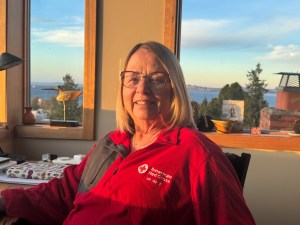
Beyond housing help, the Red Cross offers compassion. “People come to us for comfort and care,” Sue says.
One young woman found that support after the California storms in 2022/23. Sue helped her transition out of a shelter, and six months later, the woman called to proudly share that she was living in her own apartment. Eighteen months after their first meeting, she called again to tell Sue how far she had come and how much she appreciated her help.
“I am so happy. Thank you, thank you,” she told Sue.
Sue’s voice catches as she recounts the moment.
When people can’t go home after a disaster, they can count on Sue and her team to help them take the next step toward finding a home.
Interested in volunteering to help people affected by disasters? Visit https://www.redcross.org to find a rewarding and exciting opportunity.
 Your Red Cross Update