
“A Very Different Beast”: Red Cross Volunteer Recalls the Devastation of Los Angeles Wildfires
It had been a children’s playground in Altadena, Calif. Now, a melted toy sat upon a melted jungle gym. Scraps of canopy were whipping in the wind. Now, it was just burned wreckage in the wake of the wildfire. Dave Crocker remembers it clearly almost a year later. “It stopped me short,” he says.
He was in Los Angeles —the place where he was born, had grown up and gone to college. Where wildfires were a fact of life. Dave is an American Red Cross volunteer who has seen the aftermath of numerous wildfires first-hand. But this fire: it had been unusual.
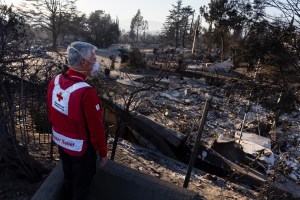
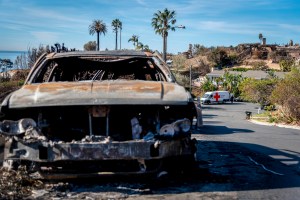
“A very different beast,” says Dave. “The extent of the damage was massive. I was used to seeing a wildfire randomly jump over houses and burn another down the block. This one destroyed everything in Altadena and in Pacific Palisades.”
In January 2025, these devastating fires in Los Angeles burned for days. By the time the fires were contained, more than 17,000 homes had been destroyed or severely damaged, with over 200,000 residents forced to evacuate. Hundreds of Red Cross volunteers and employees worked with community partners to immediately open shelters and travel through the burned-out neighborhoods, delivering meals, water, relief supplies, basic health services and emotional support for residents facing heartbreaking loss.
Dave had driven down from his home in Sunnyvale, Calif. to help his fellow Red Cross volunteers. He was Deputy Director for Information and Planning—a section of the disaster response that collects assessment and operational data, including information about the scope of the disaster and the effectiveness of the response, organizes it and then provides it to the Red Cross responders, most familiarly through the daily Incident Action Plan (IAP).
“Our job is to help all lines of activity do their job by providing the information they need,” he explains. Some information gathering is done in the field—sending people out to assess the damage to homes and understanding the situation visually—by mapping the affected area using geographic information system (GIS) technology. Another big piece is documentation, by creating reports like the IAP, a daily operational summary about the disaster response which can run from ten to more than 50 pages. All this data allows the Red Cross to be dynamic in its response and adjust quickly, such as relocating a shelter when a wildfire path veers toward it.
Dave describes it as: “facilitating the headquarters information flow… In general, our job is to help the other functions at headquarters to deliver services.”
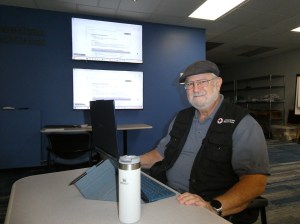
Although a technology background isn’t required for this activity, it can be helpful for the mapping side of things. Dave himself has a lot of technology experience. Dave first learned about computers as a pre-teen when his brother taught him to program. Then Dave worked in tech starting in the 1970’s “before there was an Internet,” he says.
Retired now, it wasn’t his tech skills that brought him to the Red Cross 14 years ago; he started by taking a first aid course. That led to becoming a disaster dispatcher, where he would send Red Cross volunteers out to help people whose homes had burned down. He also spent some time working in local shelters. Seeing the different sides of the Red Cross has been useful for his experience in information and planning.
“The more I understand other lines of activity, the better,” he says.
Much of the information and planning role can be done remotely; however, being on site is often necessary for facilitating communication on a large-scale disaster, like in Los Angeles.
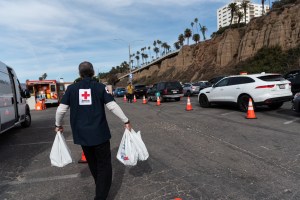
Dave spent three weeks helping in LA. Near the end of his time there, he went out to a stretch of beach just north of the Santa Monica Pier where the Red Cross had set up a site to distribute emergency supplies.
“That entire parking lot, at least a quarter mile long, was full of people waiting for us,” he says. Cars full of residents waiting for assistance lined up four lanes wide, stretching into the distance. “It was like that every day since the fire and showed no signs of stopping.”
The need for help was great in LA, and the need continues across America as disasters become more frequent. If you are curious about what it takes to help people who are affected by disasters, Dave has some advice for you. “Give it a try and everyone will help you,” he says. There is plenty of support to learn the ropes, with colleagues eager to mentor newcomers. Dave says, “We don’t throw people out there with no help.”
 Your Red Cross Update