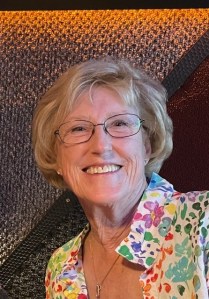
Bill Sinn spent 35 years working for Alta Bates Summit Medical Center, 20 of which as the hospital’s blood bank manager or, officially, the blood bank’s lead technologist. Highly respected for his expertise in testing, matching, and preparing blood for transfusion to meet a variety of the hospital’s patients’ needs, Sinn is now a quiet, humble, and extremely skilled volunteer serving with the American Red Cross Biomedical Services department as a Transportation Specialist.
“He’s the blood bankers’ blood banker,” said Michael Gregory, a Red Cross board member and former staff member. “If I were having surgery, I would want the best person in charge of identifying the right match for my blood transfusion. That would have been Bill Sinn.”
Red Crossers Sophie Rebecca (left) and Eleanor Najjar greet Fleet Week visitors. Photo by Alex Keilty – American Red Cross
By Alex Keilty
She was sprawled on the ground with her arms and face covered in bruises. “I remember the firefighter scooping me up,” says Sophie Rebecca Najjar. She was just 6 years old and it was her introduction to the American Red Cross. Lucky for Sophie, the firefighter was real, but the bruises were not. She had been painted with makeup to look like a victim for a disaster practice exercise she attended with her mom. She had a great time that day!
Santa Cruz county resident, mental health professional and longtime Red Cross volunteer Jill Hoffman recounts her Loma Prieta earthquake experience 35 years later, including what she’s learned about earthquake safety.
Collapsed roadways were a common sight after the earthquake. Photo credit: U.S.G.S.
“I have been a volunteer in Santa Cruz since 1980 and was part of the Loma Prieta Earthquake Red Cross response in 1989.
I was at work with clients at 5:01p.m. on Oct. 17, 1989 when the earthquake struck; I though we were being bombed, the noise and shaking were so severe. We were just six miles from epicenter. I remember saying very quietly and calmly “door frame! door frame!” (We know now not to do that, and instead to drop to the floor, cover yourself with something sturdy like a table, and hold on until the shaking stops. Doorways are not any more structurally sound than elsewhere in a building and not a safe place to go to during an earthquake.)
“I though we were being bombed, the noise and shaking were so severe.”
I was one of the lucky ones in that I had no major damage to my home, just books falling off shelves and glass breaking. My boss at the County Mental Halth Services (CMHS) came by about an hour and a half after the earthquake via bicycle instead of her car since the route to my neighborhood was no longer driveable. We immediately joined the team working at a disaster shelter at the Civic Center in downtown Santa Cruz.
At a Red Cross shelter, residents displaced by the Loma Prieta earthquake sit and talk.
I wore two hats during most of the response: I volunteered at the shelter and did community outreach for Red Cross. Within a few weeks, I assumed the role of the Clinical Mental Health Director for a FEMA grant, a position which was extended to 18 months. We saw 25,000 people during that time.
In Santa Cruz county, (the epicenter of the earthquake) CMHS led the long term mental health care response, taking over from the Red Cross. FEMA hired six full time and 34 contracted mental health care workers.
A washed out road in Santa Cruz county. Photo credit: U.S.G.S.
I met with the couple I had been seeing that day about five weeks later and they said “Jill! You were so wonderful, you were yelling at the top of your lungs “Door frame! Door frame!” So much for my perception of the event at the time.
When we had an aftershock 6 months later I had I had the flight vs. fight response and bolted out of my chair at a restaurant and stared running before my colleague stopped me.”
Thank you, Jill, for sharing your story, your service then, and your continued service now. To learn more about disaster preparedness, including how to be prepared for an earthquake, visit redcross.org/prepare.
Mary H. Lee, Red Cross Disaster Health Services Volunteer, shared her memories of the Loma Prieta Earthquake.
A Red Cross pin, the perfect way of thanking all the dedicated volunteers who helped during the Earthquake Disaster Relief Operation Photo courtesy of Mary H. Lee
“As we were standing outside our newly renovated home in Belmont on October 17, 1989 at 5 pm, we shook hands with our contractor to thank him for a job well done. Moments later the ground shook under us. We looked at our house and smiled as it was still standing. At that time little did we know of the severity of the earthquake.
Late that evening I was called in by the San Mateo Red Cross Chapter to staff a shelter as Disaster Health Service (DHS) Nurse. It was eerie to drive down a darkened highway 101 with no cars on the road to the shelter located in a hotel in Burlingame. The people in the hotel shelter were a tour group that had their trip interrupted. It was a very quiet night.
They say, “practice makes perfect.” And dozens of American Red Cross volunteers had the opportunity to do just that as they perfected their skills during a disaster simulation exercise held in Contra Costa County in September. The scenario was centered around how to operate a shelter in the wake of a major earthquake should one hit the San Francisco Bay Area.
Bruce Richardson and Hanna Malak, Regional CEO during the award ceremony. Photo: Virginia & Albert Becker – American Red cross
October is Sudden Cardiac Arrest Awareness Month, a time to reflect about the critical nature of sudden cardiac arrest and the importance of life-saving training. This month, we honor the stories of those who have trained and stepped up in such critical moments.
On February 6, 2023, Bruce Richardson witnessed a man collapse in the parking lot of an auto parts shop in Los Gatos, California. Without hesitation, he sprang into action, demonstrating the true spirit of heroism.
The individual in distress, a long-term employee of the shop, was experiencing cardiac arrest. As his coworkers called 911, Bruce began performing CPR on the unresponsive man. His decisive actions were crucial in those critical moments.
Bruce worked as a national ski patrolman for 20 years. As part of his professional training, he learned CPR and advanced first aid. However, it was his determination and courage to face this life-threating situation what really sustain the man’s life until emergency responders arrived.
For this heroic and lifesaving action, Bruce received the Red Cross Certificate of Extraordinary Personal Action in a ceremony in San Jose.
“The Certificate of Extraordinary Personal Action is given to individuals like Bruce, who step up in an emergency situation and help save or sustain a life,” said Ken Toren, Executive Director for the Red Cross Silicon Valley Chapter. “He exemplifies the mission of the Red Cross to prevent and alleviate human suffering in the face of emergencies.”
Bruce Richardson’s story is an inspiring example of how training, combined with a willingness to act, can save lives.