Tag Archives: International

Empowering Young Hearts

Fifth Graders Fundraise for Turkey-Syria Earthquake Relief

By Pooja Klebig

The students in Ms. Mary Horath’s 5th grade class at Gateway School in Santa Cruz were moved to help when they heard about the 7.8 magnitude Turkey-Syria earthquake on February 6, 2023. The quake impacted an area nearly the size of Germany, affecting 14 million people and leaving 1.5 million homeless; nearly 60,000 people lost their lives.

Gateway School students pose with their donation “check,” Red Cross Chapter CEO Michele Averill (center) and teacher Mary Horath (right). Photo by Virginia Becker/American Red Cross

“We were studying about the earthquake in our current events. That’s when we decided to help,” said student Rachel Fisher when asked what motivated the class to help.

The students held a school-wide walk-a-thon to raise money for disaster relief and response efforts. They went door-to-door to collect pledges, put up posters, and encouraged their classmates to participate. They even bought, sliced, and passed out orange slices to the walk-a-thon participants. All of their hard work paid off: They raised more than $15,000, which they were eager to donate to the American Red Cross.

Michele Averill, CEO of the Central Coast Chapter of the Red Cross, and Violet Nguyen, Regional Red Cross Philanthropy Officer, had the pleasure of accepting this generous gift through a check presentation at the school earlier this month.

Smiles all around for disaster relief! Photo by Virginia Becker/American Red Cross

“The joy in these kids’ hearts was simply overwhelming and inspiring,” said Michele. “Hearing their motivation of why they created the fundraiser and walk-a-thon filled my heart.”

The journey to recovery continues in Turkey and Syria for the millions affected by one of the biggest disasters to impact the region in years. Turkish Red Crescent and Syrian Arab Red Crescent workers continue to provide people with food, clean water and essential hygiene and relief supplies. As a response of this magnitude requires a team effort, National Red Cross and Red Crescent Societies from around the world continue to provide aid, including the American Red Cross. Earlier this year, two U.S. disaster responders were deployed to the relief efforts, specializing in communications and information management; the organization continues to assess ongoing needs.

The Red Cross and Red Crescent will continue earthquake recovery efforts in the months and years to come thanks to volunteers and the generosity of donors just like the Gateway School students. We are very grateful for their hard work to raise vital funds to support these relief efforts by engaging our local community and making a difference worldwide.  These young humanitarians are an inspiration to us all. On behalf of those we serve, thank you Gateway School for your compassion and philanthropic spirit!

Missing But Never Forgotten: Red Cross Program Reconnects Families

By Alex Keilty

After retiring, some people play golf and some people play bridge, but Christine Medeiros plays amateur detective. 

Christine is a volunteer caseworker and Pacific Division Lead for Restoring Family Links – a program of the Red Cross and Red Crescent networks that reconnects loved ones separated by international crises. Tracking down missing people here and overseas takes lots of old fashioned detective work plus some technical savvy – and Christine has both.

Christine started volunteering for the American Red Cross in 2018. Her first case (before the COVID-19 pandemic) called for her and a teammate to go door to door in San Francisco searching for an elderly gentleman whose last known address was in the Tenderloin neighborhood and whose family in Ukraine had no word from him.

“We found him!” she says. And that’s a pretty typical result for Christine. After working 40 cases locally and consulting on approximately 30 cases in other Red Cross regions around the country, she is confident about her ability to find people whose last known whereabouts is the West Coast of the United States. As she says, “When they are here [on the West Coast], I can usually find them.”

Once COVID-19 hit, all her work went remote and she became “an online detective,” as she calls it. Nowadays she works from home in Marin County at any time of the day, evening or weekend that suits her schedule. 

Although it may seem unrelated, her professional background (she retired from the technology industry where she worked in marketing and partnerships) has actually been an asset to her part-time sleuthing work as a Restoring Family Links caseworker. Being comfortable doing computer searches, completing online forms, writing letters, being organized, speaking in front of audiences – these are all skills she honed in her previous work life. She says speaking languages in addition to English can be an asset to the role as well. Caseworkers must also be compassionate and offer comfort to family members who may be distressed.

“It takes a little bit of social work because people can be very upset, even angry,” she says.

Christine Medeiros

Families seeking a missing relative can submit requests to the Restoring Family Links program online or by phone. When a Red Cross caseworker is assigned, they gather as much information as possible about the sought person – including full name, date of birth, names of parents, last known address, last known contact location, past telephone numbers, email addresses, any languages spoken, occupation, religion, and a photograph. This information is uploaded to an international case management system that is accessible to the Red Cross and Red Crescent network worldwide. And then the case will be assigned to another volunteer caseworker who is in the country where the individual is being sought.

So Christine may be gathering information from a family member who lives here, or she may be looking for a missing individual who was last seen in this area. 

When the missing person’s last known location is here, Christine will use the information provided by the family overseas to begin a search. She will call all previous phone numbers, send letters to all previous addresses, reach out to former employers, and connect with religious and immigrant groups to see if they know this person. She will also look for Facebook accounts and use Google Earth maps to look for and eliminate addresses and mailboxes. The Red Cross also has access to databases which can provide consumer information and public records. Caseworkers may also do some cultural and historical research to put the missing person’s experience in context and provide more leads as to their current whereabouts.

So who are these missing people? Some cases go back as far as World War II. A majority of the cases come from Central America and Africa, though globally there are 100 armed conflicts and 90 million people displaced due to war, climate change, persecution, violence and poverty.

To protect these vulnerable people, the program is totally confidential and the only people who can initiate requests are family members, not government or other organizations. Once the individual is located by a Red Cross caseworker, they can choose if they want to reconnect with their family or provide no information at all – not even a message that they were found. The American Red Cross respects their privacy. 

To access the Restoring Family Links program, the family member must have been separated internationally as a result of conflict, disaster, migration or other humanitarian emergency; must have already tried normal channels of communication to reconnect; be able to provide essential information about the sought person, and must have been in direct contact with the sought person before the crisis occurred.

Some cases are resolved quickly and happily; perhaps an individual in a war zone is able to send word to family overseas, or the person is located through the dogged investigative work of the caseworkers. But sometimes the result is sad news that the person has died or is unable to be found.

“Searches can go on for years,” says Christine. And while all cases are important, some haunt her and can’t be forgotten. Like one case she had years ago where she was seeking a person who had fled from South Vietnam.

“The Canadian Red Cross could not find him, but I still look every once in awhile,” she says.  To learn more about the Red Cross Restoring Family Links program visit your local Red Cross chapter, call 844-782-9441 or complete the online form at https://www.redcross.org/about-us/our-work/international-services/reconnecting-families.html.

The Cost of War

Red Cross teen volunteers spread awareness about the impact of armed conflict

By Marcia Antipa

“It’s just better for humanity that everyone knows about it.”

IHL In the Bay, a Youth Action Campaign team from the East Bay.

Bay Area teen Janaki Rakesh is talking about International Humanitarian Law (IHL), a set of rules developed under the Geneva Conventions designed to limit the impacts of armed conflict.

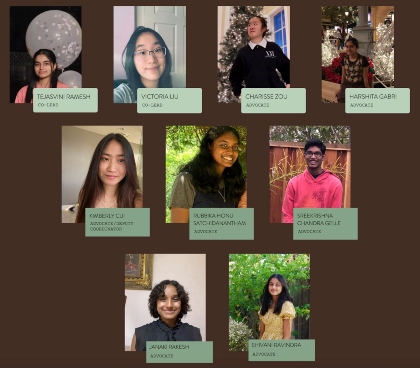
Rakesh and 40 other students in the Northern California Coastal Region are studying IHL through the Red Cross Youth Action Campaign (YAC).   

Kimberly Cui says she signed up for YAC because  “I just wanted to explore more about what other people in the world were facing.”

In past years, the campaign has focused on the effects of war on healthcare workers and on education. This year’s theme is cultural property.

“The destruction of cultural property’s permanent, so when it’s damaged or when it’s destroyed it has a direct impact on that particular community,” says Sarina Vij, Coordinator for the Bay Area YAC.

Vij says cultural property “is something that is of great importance to a particular community. It could be a statue; it could be a monument. “

For example, she cites the Taliban’s destruction in 2001 of two giant Buddha statues in Afghanistan that were 1600 years old.  

Some teens are surprised to learn that the Red Cross is involved in International Humanitarian Law.

Harshita Gabri says, “Initially when I heard about Red Cross I thought of it as an organization that was in charge of blood donations.”

Priyanka Supraja Balaji

“Before I knew anything about the details about Red Cross, I always thought of it as an organization that provides humanitarian aid,” says Priyanka Supraja Balaji. “I wanted to be a part of spreading that mission and really being one of the people who is helping others.”

And Rubikka Satchidanantham says, “I thought this campaign was the perfect opportunity. Not only am I able to learn more about IHL, but I’m also able to educate others.”

Janaki Rakesh said she is passionate about teaching others about IHL, because she has followed the story of Malala Yousafzai. Malala is an outspoken advocate for girls’ education who survived being shot by the Taliban, and won the Nobel Peace Prize at age 17.

“I read all of Malala’s books. She’s a girl from Pakistan. Her life was destroyed by war.”

The YAC teams spread awareness about IHL through Instagram posts and Zoom game nights, where participants answer questions about war and cultural property.

Sreekrishna Gelle posted on the group’s Instagram feed about a firebombing during World War Two, “where American and British bombers basically flattened the entire city of Dresden in Germany which was a center of cultural, architectural and artistic history.”

 “I have never seen a more creative group of individuals,” says Sarina Vij. “They are very good at coming up with different ways to navigate and problem-solve. “

One team held an online scavenger hunt, sharing food, clothing, and souvenirs from other countries. Victoria Liu says that made her appreciate her own Chinese heritage – and what cultural property means to others. “It represents a lot about people and if you destroy these properties, you’re destroying peoples’ identities.”

And the work doesn’t end when the games do. “We used feedback forms and heard back from people that they want to make it more engaging,” says Shivani Ravindra. “So we’re working on improving those for the next event.”

YAC presentations are all virtual for now,  but team member Tejasvini Ramesh says that is their secret weapon.

“We’re able to spread awareness about it a lot quicker than we would through in-person events because with the power of social media we can reach lots of people from different parts of the world.”

Beyond teaching their classmates about IHL, several teens say they find the concepts comforting.

“During war, we think it’s all chaotic,” says Charisse Zou, “but I found it really fascinating how there were actually laws to protect the people and cultural property.”

“It gives me a really safe feeling,” says  Priyanka Supraja Balaji. “Things that have such a personal attachment to you like a place of worship or anything like that won’t get targeted.”

Anyone can learn about IHL and take part in the teams’ online events.  Just visit:

https://ihlinthebay.wixsite.com/ihlinthebay

https://www.redcross.org/humanityinwar/international-humanitarian-law-youth-action-campaign.html

Lisa Ann Rohr, American Red Cross Service to the Armed Forces (SAF) Program Manager Returns from Iraq

Narrated to Lawrence D. Dietz, Public Affairs Officer, Red Cross Northern California Coastal Region

SAF Mobile Staff, Team 44
(Masks required in Germany)

Lisa Ann Rohr was one of nine Red Cross SAF Mobile personnel who left the U.S. for overseas duty from August 2020 to April 2021. Lisa Ann was one of two Red Crossers initially stationed in Iraq, at the diplomatic post Baghdad Diplomatic Support Center (BDSC).

Lisa Ann’s core U.S. roles and responsibilities for SAF in the Northern California Coastal Region of the Red Cross are Follow-up Casework, Military Treatment Facility (MTF) programs, including Licensed Medical Volunteer placement, and Military Entrance Processing Station Briefing program management.

As for deployments, Red Cross SAF Mobile Staff are assembled into rotating deployment teams from Continental US and Outside Continental U.S. Red Cross regions for a six-month mission. Lisa Ann, with her eight colleagues, were known as Team 44.

Read more

Our region’s Int. Srvs. classes, discussions now offered online

is-virtual-classes_420x279
To see more regional stories and other content related to the Red Cross response to the coronavirus pandemic, please see this blog post.
_____

Like many other American Red Cross activities, the classes and discussion groups that have been hosted in our region by our International Services program are a service that has been re-engineered because of COVID-19 social-distancing requirements.

“When it became clear that this pandemic would be with us for a while, we started to rethink the way we were making our classes and other educational opportunities available,” says Go Funai, Director of the Service to the Armed Forces and International Services programs for the Northern California Coastal Region (NCCR).

So, beginning late last month, with an introductory course that is part of the International Humanitarian Law (IHL) series, Funai’s International Services (IS) team has begun to deliver its educational offerings virtually.

Read more

The work of the Red Cross continues – no matter what

The past six weeks have been unusually quiet in Northern California. The COVID-19 outbreak has forced much of the population indoors on shelter-in-place orders. For many, the 9-to-5 workday is a recent memory; classrooms are eerily silent. Parking lots nationwide sit empty; all but essential storefronts are closed indefinitely. The entire country has seemingly ground to a halt.

And yet, there are segments of the American workforce that forge on stronger than ever: intrepid healthcare workers, food service employees, first responders, and American Red Cross volunteers and employees. As the largest humanitarian aid organization in the country, the work of the Red Cross is constant, as is our commitment to helping those that need us.
Read more

« Older Entries