Midday Sunday, on Presidents’ Day weekend, 2025, anyone driving along I-880 near Oakland, Calif.’s Laney College would have seen a large black plume of smoke dangerously close to the freeway, billowing towards Lake Merritt. An RV fire had erupted on that dry but overcast day, its flames marking the beginning of an unusual reunification story involving at least two organizations, some very dedicated people, and a cat.
Marsha sleeping soundly under the care of her “good samaritan”
Found After Flames
A day or two after the smoke cleared, “a good samaritan,” as Red Cross Northern California Coastal Region volunteer Jessica Shobar recently said, “found a lost kitty in San Leandro…hiding under a car, badly burned, and covered in soot.” Though the kitty’s wounds were substantial—with blackened and singed paws, face, and body—she was alive. And though the distance from the fire was exceptional and the kitty didn’t have a microchip, her luck would later be viewed as extraordinary because the good samaritan and San Leandro’s Animal Control coaxed her into a carrier and took her to a local clinic. This was especially fortunate because if she’d been found in Oakland, she might have been sent to a shelter and never would have landed where the key ingredients for reunification were available.
A Tender but Strong Love Becomes the Foundation of Gratitude and Giving
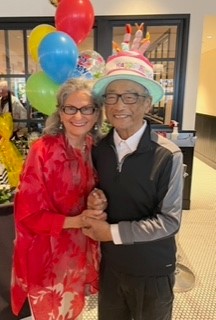
When Phillip Wong, a math professor at Contra Costa College, met Lisa Lemus—a K-12 teacher—at a church dance on Valentine’s Day in 1996, everything changed. As divorcees, they both understood what it meant to spend a life together, yet they also understood what it meant to live alone (coincidentally, they’d both been single for 17 years). Most of all, family was everything to them. Phillip had three grown children, and Lisa had two. But living on their own had left them open to dating, and their meeting was unforgettable.
“I was born to help people. That’s what brings me the most joy.” Caro (Carolina) Dratva, a Red Cross Northern California Coastal Region’s Disaster Cycle Services Team member and Communications volunteer, heard the call to help others early. When she was 12 and still living in Colombia, a volcanic eruption buried a close friend’s hometown, Armero. “I could only watch TV, listen to the radio, and follow up with my friend,” whose parents had died in the disaster with 23,000 others. Responders with the Red Cross emblem arrived to rescue victims and remove debris during an operation that she would remember later when, at age 15, she noticed the same emblem among response teams in San Francisco in the aftermath of the Loma Prieta earthquake, which she witnessed. At that time, she revealed, “I didn’t realize that the Red Cross was mainly run by volunteers.” It was only after she asked how much responders were paid that she understood that most rescuers offered their unpaid time and effort to save others, a fact that must have deeply moved this scuba diver, surfer, conservationist, and explorer to dive deep and dedicate more than two decades to volunteering.
After all, when Caro set off for the Bahamas several years ago on a dolphin trip with her closest friend, she couldn’t have predicted that her life would be deeply impacted again. “During the night,” she recently shared, “I went to swim with dolphins 85 miles out on a boat. We were anchored, and I was the only one swimming. Everyone else was on the boat. So, I went off with the dolphins. There was a full moon, and I lost my sense of direction. But because of the moonlight reflecting on the water, I couldn’t find the boat. I couldn’t see it. For the first time, I felt panic, like, ‘I’m going to die here.’ But the dolphins were still hanging with me. So, I literally spoke to them: ‘Could you please bring me back to the boat.’ And then, one pushed me on one side, the other pushed me on the other, and they brought me right back to the boat.’” This profound moment of trust and connection with the dolphins helped her realize the power of relying on others during moments of crisis. Just as the dolphins guided her to safety, Caro felt compelled to help guide others through challenging times, which ultimately led her to dedicate her time to lifesaving organizations such as the American Red Cross.
Photos courtesy of Caro Dratva
“There has to be a way that I can volunteer.” The real work began with 9/11, when the Twin Towers came down in Manhattan’s Battery. She needed to help, so she joined the Red Cross. “I thought, if I have to deploy to New York, I’ll do it. But then, I realized I needed training.” Getting that training during such a fraught time for the country and those who’d lost loved ones required sensitivity and an ability to ask the right questions.
“My first training was in San Francisco,” she recalled, “connecting the missing people on lists with their families.” Mainly, she conducted interviews meant for search and rescue teams, gathering descriptions of missing people, noting the floors they worked on and what they were wearing the last time they were seen. Even now, twenty-two years later, Caro remembers one moving experience when she used her native language skills to search for a distraught woman’s husband who’d worked in the Towers. “She spoke Spanish, and the good news was that the woman’s husband was alive and able to reconnect with her.”
Later, after a one-year hiatus in Europe, she continued to dedicate herself to helping others, getting involved in Red Cross blood drives, donation collection campaigns, and numerous disaster relief operations, including the aftermath of Hurricane Katrina.
Caro and Red Cross Volunteers supporting communities affected by wildfires in North Bay, 2017
Since then, Caro has watched the Red Cross grow even more effective, learning from hard knocks like Katrina. Better organizational tools have improved efficiency before, during, and after disasters, allowing volunteers like her to give time even when time is sometimes hard to spare. Holding down two jobs—one focused on ocean conservation and the other on architectural design—Caro still finds time to volunteer in numerous ways. “Because of good organization and how the Red Cross has grown, I can be on standby for the Disaster Action Team (DAT). I’m also trained for sheltering, and I’m part of the Public Affairs and Communications team.”
All this volunteering has added up over the years. From one training session to another, Caro has developed expertise through online and real-world experience. With every exposure she’s had to disasters, shelters, and blood drives, she has noticed, listened to, and recognized others as they face some of the most challenging moments of their lives. This may be one reason why she still swims for life, giving a great gift to others along the way: how to save others while saving oneself.
One August morning in 2023, Katie “Sully” Sullivan awoke to the first news segments about the Maui wildfires. An experienced American Red Cross Disaster Program Manager for Alameda County, she soon realized things were going to get bad. Later, the phone rang. It was American Red Cross national headquarters asking her to deploy. “Over the six years I’ve been with the Red Cross, I’ve seen the aftermath of large-scale disasters, from hurricanes to tornadoes to floods. Each brought unique challenges,” she recently said when remembering the disaster nearly a year later. But for Sully, this one stood out.
Hurricane Dora crashing into Maui’s tinder-dry foliage on August 8, 2023, meant there was little warning for what would become the worst natural disaster in the archipelago’s recorded history. The result: the historic district of Lahaina was virtually vaporized—as were sections of Palehu and the smaller Upcountry community of Kula—causing approximately 100 fatalities. A year later, the effort to heal and rebuild is still underway.
Veronica Oberholzer has read thousands of letters during the five years she has been with the American Red Cross. But as a Development Operations Manager she knows that each donation letter that arrives at her desk in the fundraising department has a meaningful backstory, like the one that still touches her.
When Catalina Ramirez-Vaughn was five years old and living in Mexico, something unforgettable happened to her younger sister, who was just a toddler at the time. Catalina was so affected by witnessing the incident and its aftermath that it has become her main motivation for organizing blood donation campaigns that support the American Red Cross.
It was 1964, and her mother had just given birth to a younger brother. Grandma was looking after the children while drawing a bath of stove-boiled water because, as Catalina said, “We didn’t have running water.”
“My sister,” Catalina recalled, “didn’t listen to Grandma’s warnings to stay out of the hot water.” It happened so quickly that no one had time to stop the toddler, who stumbled into the scalding bath water.




 Your Red Cross Update