Story and photos by Alex Keilty/American Red Cross
American Red Cross Blood Donor Ambassador Volunteer Yichen Shi
Our Volunteers
As an American Red Cross Blood Donor Ambassador, Yichen can easily fit volunteering into her schedule as a pre-nursing student. “It’s really flexible and convenient to sign up for the time you want to do it,” she says.
She greets people who arrive to give blood at the Red Cross Blood, Platelet and Plasma Donation Center in San Jose and she keeps the donors’ snack table full of juice and cookies.
For Yichen, volunteering for the Red Cross looks good on her resume, and she also feels good about helping an important cause.
American Red Cross Blood Services Phlebotomist Astrid Savov
Our Staff
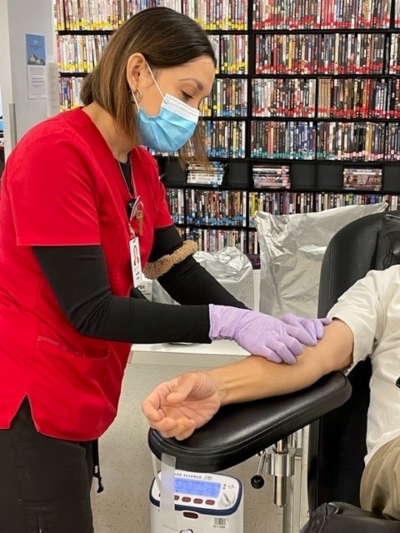
“The best part is when donors are happy,” says Astrid as she prepares to collect blood from a donor in San Jose. “When they say, ‘That was painless,’ it feels good.”
As a Red Cross Phlebotomist, Astrid collects blood from donors who visit the blood donation center. She admires those who donate because, as she says, “It’s people trying to do good.”
American Red Cross Blood Donor John Ahn
Our Donors
“I saw in the news that there is a nationwide shortage,” said John, as he gives blood in San Jose recently.
John is right, the Red Cross recently faced its worst shortage in more than a decade. Such bad news is what prompted John to make an appointment to donate.
During his donation appointments, John puts on earphones and enjoys the streamed shows available at the blood donation center.
Join us!
If you are interested in volunteering your time in support of your community, visit redcross.org/volunteer.
If you’re interested in joining the Red Cross – where your career is a force for good – visit redcross.org/careers.
To make an appointment to donate blood, platelets or plasma, use the Red Cross Blood Donor App, visit RedCrossBlood.org or call 1-800-RED CROSS (1-800-733-2767).
American Red Cross Volunteer Mo Ghandehari is an incredible example of the Red Cross mission – and of the caring and dedicated individuals who do what it takes to accomplish that mission.
Mo started with the Red Cross in 2000, first in Las Vegas, then in Salt Lake City, before moving to California and joining the Silicon Valley Chapter in 2007.
Mo Ghandehari on a Disaster Action Team response.
One of Mo’s first positions as a Red Cross volunteer was on his local Disaster Action Team (DAT). In this role, he responded to the full range of disaster calls ranging from fires in homes, mobile homes, condos, and even a ski resort. He even had the unique experience of responding to a home fire where he and the team installed smoke alarms only a few months earlier.
Red Cross volunteers from the Northern California Coastal Region respond to between 30 and 40 disasters a week where a small handful of local DAT volunteers are some of the first on scene to assist families that have been affected.
The first job of the DAT volunteer on site is to help make the affected residents comfortable and to get them the immediate assistance or materials they might need. This could include simple things like blankets or water. Though, the needs of those affected varies from disaster to disaster, and DAT volunteers also help arrange lodging or financial assistance, which allows families to pay for immediate needs and get back on their feet.
DAT volunteers are also general volunteers and can work in other Red Cross areas. In particular, they can work in their local chapter to perform inventories or make sure that supplies and vehicles are ready to go where they are needed.
There are constant training opportunities for DAT volunteers to learn more about the latest in Red Cross systems, or improve skills with courses like Psychological First Aid: Helping Others in Times of Stress.
DAT volunteers are committed. Many sign up for frequent shifts and are always ready to answer the call, no matter what time of the day or night. When disaster strikes, speed is of the essence, whether it is a major wildfire or a single-family home fire. DAT volunteers have the enthusiasm and confidence to deal with a variety of situations.
Mo advises new DAT members to be proactive in seeking initial training. You can start with your chapter’s DAT lead, or the workforce engagement lead, or the Disaster Program Manager for your area to enroll in training. Though, he says there is no substitute for being on-call and responding.
“It is truly gratifying to help a family that needs a place to stay for a few days, before figuring things out,” he said. “When you are on the scene it is very important to be patient, and respectful of those who were affected and to work closely with your supervisors and managers.”
While the core of being a DAT volunteer is at the local level, there are also many opportunities to expand one’s volunteer career path and deploy to a major disaster as a shelter volunteer as well. It comes as no surprise that Mo has seized many opportunities to deploy and lend his talents across the nation.
When asked about which of his deployments captured the essence of really being on a deployment, he said his time as a shelter supervisor during Hurricane Katrina in 2005 would have to be the one. It was Mo’s first assignment as a shelter supervisor on a disaster response. The shelter was in an elementary school in Pearl River, Louisiana.
“The experience taught me to treat shelter residents just like you would treat your own house guests,” he said. “Our crew did just that! The shelter experience was a team effort between the Red Cross and local volunteers. They opened and operated this shelter for two to three days, and were exhausted and very happy to see us. Residents had already been pitching in – helping the team to prepare breakfast, cleaning the bathrooms, and doing other chores. We had no electricity and water for the first few days. The new shelter team, which consisted of four volunteers, plus residents (before others arrived), were literally like a family (the shelter had about 50-80 residents), helping each other to make it through.”
Not only did Mo develop is shelter management skills and style on this deployment, it also taught him about the satisfaction of serving.
“As I was leaving the job – after two weeks – I noticed a hand-written thank you note on the board, on behalf of the shelter, saying that I provided good care during my two weeks as shelter manager,” he recalls. “This, to me, was heartwarming – a very good rewards for two weeks of hard work.”
When asked about what it takes to be a successful shelter manager, Mo said, “Being compassionate, friendly, and able to relate to people from all walks of life, able to establish trust with supervisors and shelter workers, and being a coach and mentor to other team members.”
Mo is a shining example of a Red Cross volunteer. He has won a number of awards, including the Chapter International Services Award (2021), the Extraordinary Commitment and Dedication Award for Chapter Disaster Cycle Services (2016) and the Chapter Clara Barton Award (2012).
You too can become a Disaster Action Team or Sheltering Volunteer and serve your community in their time of need. Visit redcross.org/volunteer to learn more.
Every two seconds, someone in the U.S. needs blood for surgeries, cancer treatments, chronic illnesses or traumatic injuries. Because less than 38 percent of the population is eligible to give blood or platelets, hospitals in the U.S. are very dependent on donations from those that are eligible to donate.
Elizabeth Crisafulli with her daughter, born prematurely at 28 weeks.
Every blood donor is motivated to do so for different reasons. Elizabeth Crisafulli discovered her personal motivation 22 years ago, when her daughter was born very prematurely at 28 weeks. The baby weighed just 2.5 pounds and needed an emergency blood transfusion. In addition to tapping into the blood products the hospital had on hand, some of Elizabeth’s friends donated blood. Her daughter is now a healthy 22-year-old.
When you speak with her, you get the impression that Elizabeth is on a mission. She has battled cancer twice, which temporarily postponed her ability to donate blood. Once she was cleared to do so, however, she was right back at it. She got frustrated once when she couldn’t donate because “something was too low.”
Like many of us, Elizabeth receives email notifications for blood donations which remind her to schedule her next donation. She goes to the same San Jose red Cross Blood Donation Center each time and sometimes brings her daughter along (her husband is not eligible to donate). Needles don’t bother her but she says, “I don’t watch it going in.”
Elizabeth praises the American Red Cross Blood Donor mobile app, stating that she “loves it,” adding that “it makes donating so simple.” The mobile app is extremely user friendly and helps you find local blood drives and donation centers, schedule and reschedule appointments and keep track of your donation history. “It even tells you where your blood went and how many lives it impacted,” Elizabeth said. “I’ve shared the app with my friends who have used it to donate.”
This writer was unfamiliar with the mobile app (called “Blood Donor American Red Cross” in the App Store and “Blood Donor” in Google Play). I downloaded the app after speaking with Elizabeth and have a feeling I will be donating more frequently, much like the others Elizabeth has influenced to do the same.
The impact of donating blood is huge – one donation can potentially save more than one life. Unfortunately, today the Red Cross is experiencing the worst blood shortage in over a decade. The blood supply is dangerously low, which has forced some hospitals to defer patients from major surgeries, including organ transplants.
It’s hard to say how many lives Elizabeth Crisafulli’s donations have impacted over the past 22 years, but it’s clear she will positively affect many more in the years to come. Thank you for your life saving donations, Elizabeth!
About the author: John Lindner is a Public Affairs volunteer with the Bay Area Chapter of the American Red Cross.
The American Red Cross is facing a national blood crisis – its worst blood shortage in more than a decade. Dangerously low blood inventory levels are posing a concerning risk to patient care and forcing doctors to make difficult decisions about who receives blood transfusions and who must wait until more blood products become available. The Red Cross has issued a plea for blood and platelet donors to give now to help prevent further delays in vital medical treatments.
In recent weeks, the Red Cross had less than a one-day supply of critical blood types and has had to limit blood product distributions to hospitals as a result of the shortage. At times, as much as one-quarter of hospital blood needs are not being met.
When there’s not enough blood
Blood recipient Kala Breder and family.
Kala Breder knows all too well how dire a blood shortage can be. In July 2020, hours after the birth of her son by emergency Cesarean section, Kala developed a complication and began hemorrhaging. As doctors fought to control her bleeding, the blood supply was exhausted at the hospital and those within a 45-mile radius. Ultimately, she was air lifted to another hospital because there wasn’t enough blood locally.
Kala credits the 58 different blood products she received with helping save her life. “Without one of those, I probably wouldn’t be here,” she said. “I needed every last unit.”
Please schedule an appointment now by using the Red Cross Blood Donor App, visiting RedCrossBlood.org or calling 1-800-RED CROSS (1-800-733-2767).If there is not an immediate opportunity to donate, please make an appointment in the days and weeks ahead to ensure the Red Cross can replenish and then maintain a sufficient blood supply.
Rush in to give blood or platelets Jan. 1-31 and you’ll automatically get a chance to score an exciting Super Bowl LVI getaway in LA for you and a guest! Plus, the Red Cross will give you a shot at a home theater package and $500 e-gift card in January. Terms apply; visit RedCrossBlood.org/SuperBowl for more information.
Historic Red Cross youth conference pivots to create increased access for students
Youth development conference screenshot. Photo courtesy of LDC 2021.
This year, the American Red Cross Northern California Coastal Region hosted a four-day virtual youth development conference from June 21-24, attended by more than 225 student delegates and 20 youth staff. While this year’s Leadership Development Center (LDC) was modified due to the COVID-19 pandemic, it still provided an opportunity for youth ages 13-18 to develop and cultivate core leadership skills such as teamwork, public speaking and diversity awareness through virtual presentations, workshops and small group discussions.
The staff prepared for seven months to plan the curriculum and activities for the conference, all from scratch. Camp directors Emily Elmore and Gaby Azcarate led the process, and while the directors and youth staff were afraid that some of the camaraderie that delegates get in their small groups would be lost in this modified format, they worked hard to make sure that planned activities included opportunities for delegates to get to know each other and work as a team, even in a virtual environment.
“A positive note on the virtual conference is that it opened the door to have students attend who otherwise may not have been able to spend a full week with us in person,” said Allie Parker, Red Cross Volunteer and Youth Services Manager. “We were also able to invite more guest speakers to join us who may have had more difficulties attending an event in person.”




 Your Red Cross Update