
American Red Cross NCCR Volunteers Provide Relief to Thousands of Alaskan Survivors of Typhoon Halong
When American Red Cross volunteer Karl Matzke, from Santa Clara County, received the call to organize a team and deploy to Alaska, there was no hesitation in his decision to go. As one of the Divisional Leads for Operations Management, he ran the operations for the first shelter that opened in Alaska just three days after Typhoon Halong devastated the region on October 12.
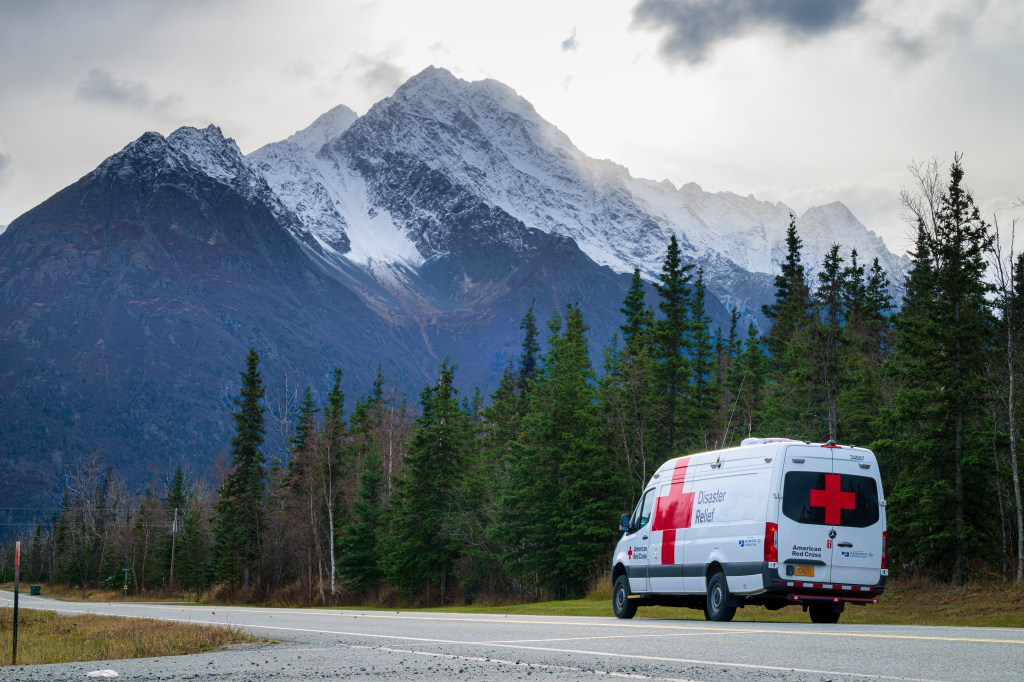
The American Red Cross deployed hundreds of Red Cross disaster workers from across the country to help during what could be a prolonged relief response from Typhoon Halong.
Typhoon Halong was one of the worst storms to hit western Alaska since the 1960s. The typhoon brought storm surges that reached up to 16-feet and catastrophic flooding to over a thousand miles of coastline in the Yukon-Kuskokwim (YK) Delta, destroying hundreds of homes and displacing over 2,000 people. The Red Cross and its partners responded quickly to offer relief to those affected.
Drawing on his two decades of experience, which includes responding to Hurricane Katrina, the Southern California wildfires and Hurricane Sandy, Karl was tasked with forming a leadership team to respond.
Karl described the first steps taken to move the displaced people from their villages to Anchorage.
“There were primarily three different villages that were completely evacuated. The Coast Guard and Alaska National Guard flew helicopters out to the coastal communities to pick up the people and bring them to Bethel,” he said. [The Alaska National Guard] only had 262 people on the first flight from Bethel to Anchorage, but the plane was pretty packed. The people were bussed from there to the Alaska Airlines Center arena at the University of Alaska Anchorage, which was the first shelter we opened.”
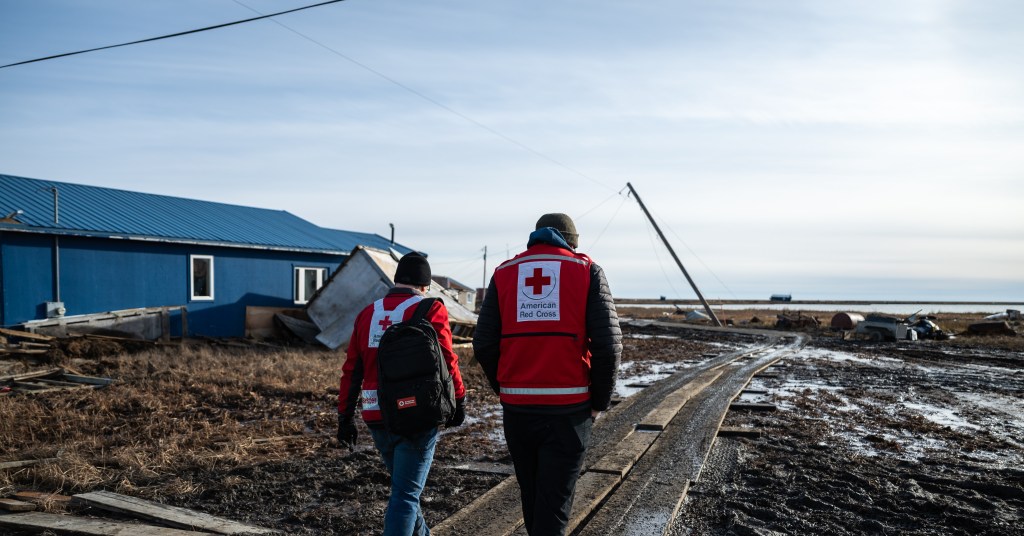
The Red Cross helped in Alaska as officials staged one of the largest airlifts in the state’s recent history, evacuating entire villages that were left in ruins that weekend.
According to Karl, a lot of the displaced residents had friends and relatives in Anchorage who offered them a place to stay, so not everyone who was evacuated stayed at the shelter.
“Because they evacuated an entire village, everybody in the shelter knew each other. They were their neighbors. They worked together,” Karl said. “For example, the postmaster for the village was there and said, ‘I might as well set up the post office.’ So they set up the post office in the shelter and collected the mail.”
The damage that Typhoon Halong caused in Alaska was extreme: approximately 90% of the buildings in Kipnuk and 35% of the buildings in Kwigillingok were destroyed. The school in Kipnuk is the largest building in the community, which became surrounded by floodwater. Instead of roads, the villages have boardwalks, and the villagers use ATVs or snow machines to get around. Since there are no roads from the big city directly to these villages, helicopters were needed to bring the people impacted out of the area.
“Kipnuk is primarily a barter economy, where people harvest seals and fish and caribou and reindeer, whatever is in season,” Karl said, “So when this population moved to Anchorage, it was a big difference. They don’t really see cars. They see planes arriving at their local airport, but they go around by ATV. They call it subsistence living where most of their income is in products they harvest. It’s not a retail commercial district.”
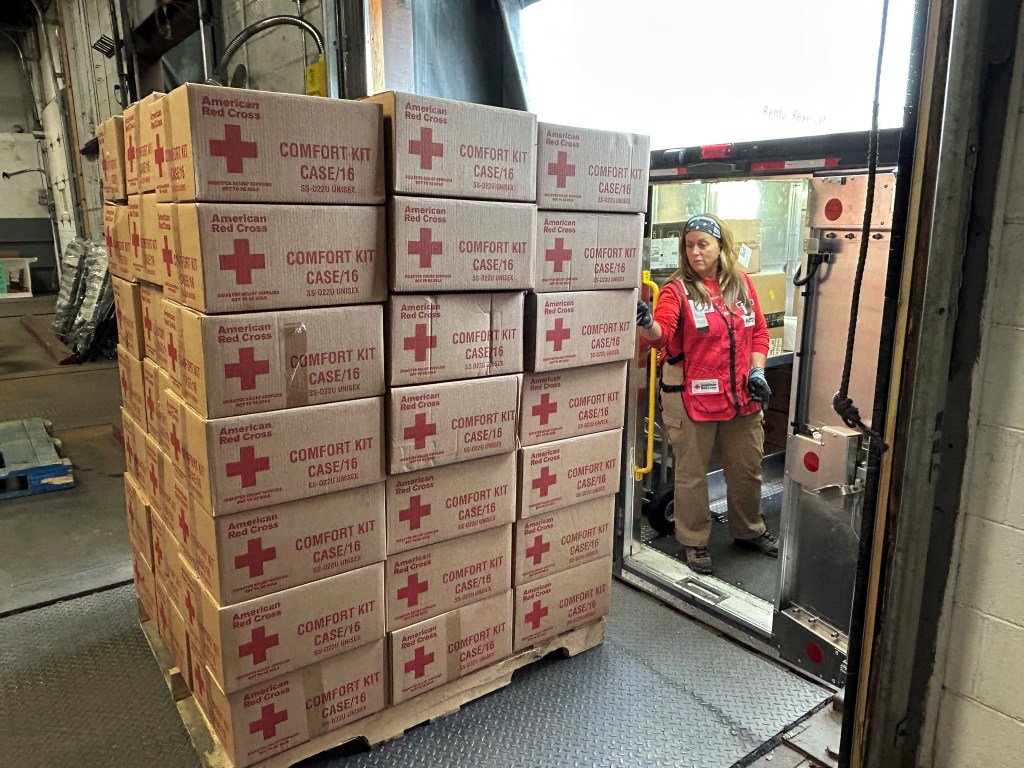
“We’re excited to be able to help, when there is a need for help. We are excited to be the ones able to go… we don’t want a disaster; we want to be the people to help when there is one.” Warehouse Supervisor Jennifer Barry said.
The relief efforts in the villages, managed by Karl after transferring from his initial leadership role, required an unprecedented logistics operation. Without roads connecting the delta communities, supplies had to be shipped commercially to Anchorage, flown to Bethel and then loaded onto small planes for the nine affected coastal villages.
The supplies themselves were non-traditional disaster items, focused on the immediate needs of subsistence hunters and fishers whose winter stocks were ruined by the flood.
“We provided things like chest freezers for them to put their harvest materials in the deep freezer so they could keep it through the season,” Karl said. “We supplied them with materials like caulk and so forth to help them winterize their homes after they’ve been buffeted by the storms.”
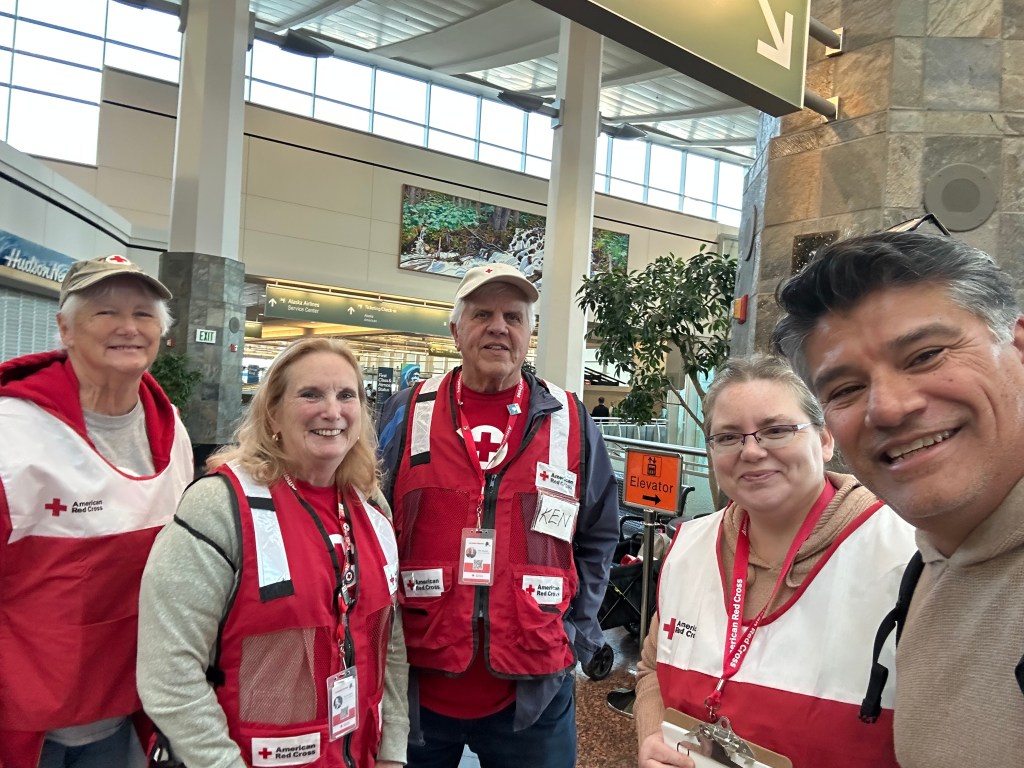
John Ruiz, regional disaster officer of the Northern California Coastal Region, highlighted the type of support provided by the Red Cross volunteers at the sheltering operations in Anchorage. Referred to as “platinum sheltering,” the Red Cross ensured that the people they served had the resources they were accustomed to in their lifestyle. It was particularly important for the volunteers to connect with the residents, considering that the majority of them speak Yup’ik as their first language.
“We went out of our way to make sure that everyone had what they needed. [The volunteers] brought in the food from local vendors, things like fish head soup and reindeer stew,” John said. “They had cultural dancers. They allowed for religious ceremonies. They had potlucks on Fridays and Sundays. They did everything they could to make these people feel at home.”
The Red Cross brought in national teams that had experience supporting previous large shelters requiring cultural sensitivity, such as in response to the wildfires affecting native tribes in Canada, to ensure they were meeting the needs of the residents best.
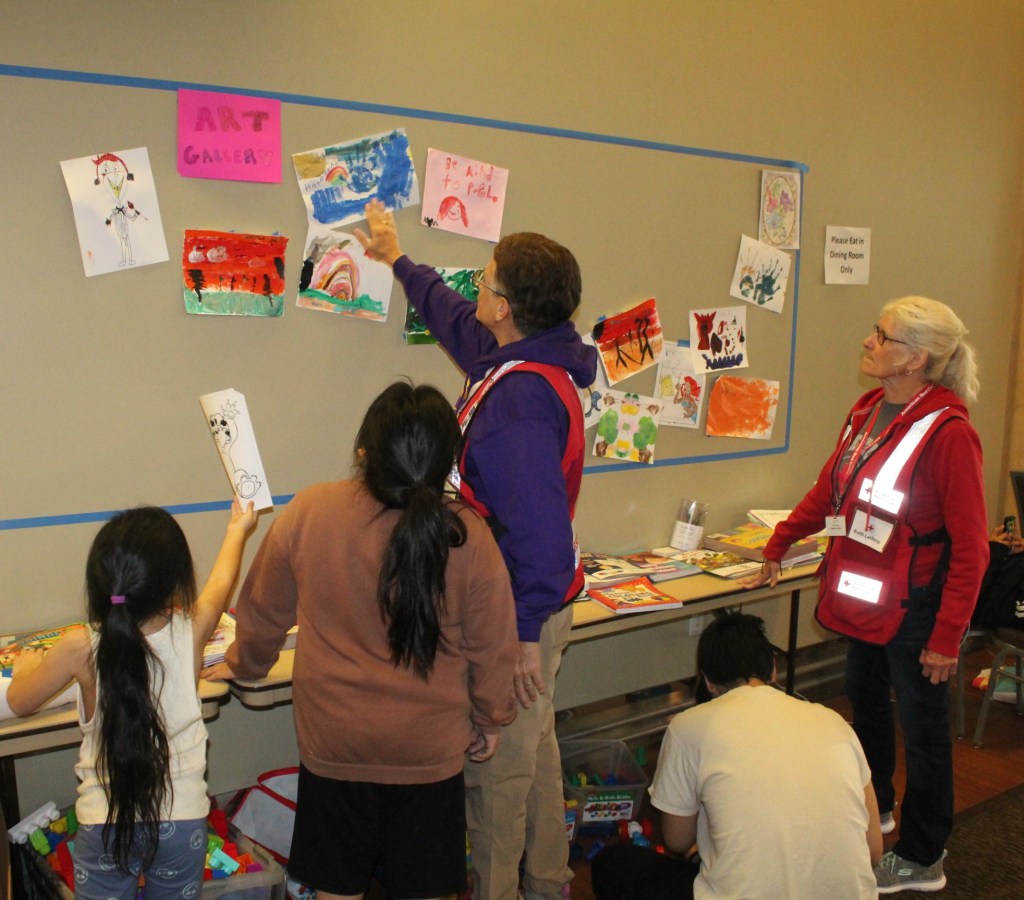
To help people transition out of a short-term shelter and into a longer-term hotel, the Red Cross used volunteer guides, who helped them get accustomed to new environments they had not encountered before.
“The hardest thing about non-congregate sheltering is you go from being in a community to being with your community in a shelter and then being behind a door,” John said. “These people had never been to hotels. It was completely foreign, and the Red Cross really helped hold their hand and took them to that facility. We gave welcome baskets that had cooking utensils and bedding and everything they needed. They were taught how to use the bus. We did everything we could to get them from the shelter, into their rooms, even helping some people unpack to make sure they’re as comfortable as possible in such a foreign environment. Teams would check in with the families every three days. Their whole role was to make sure all their needs were being met.”
The Red Cross volunteers also ensured that the residents were set up to apply for financial assistance.
The swift response to a large-scale natural disaster like Typhoon Halong would not have been possible without Red Cross Disaster Relief workers like. Karl and John, who were only two of the many volunteers that gave their time and energy to aid the Alaskan survivors. Although it will take time for the communities affected to rebuild their lives, the assistance provided by the Red Cross is a lifeline for them to secure the necessary resources to do so.
Learn more about our Disaster Relief Services here.
 Your Red Cross Update